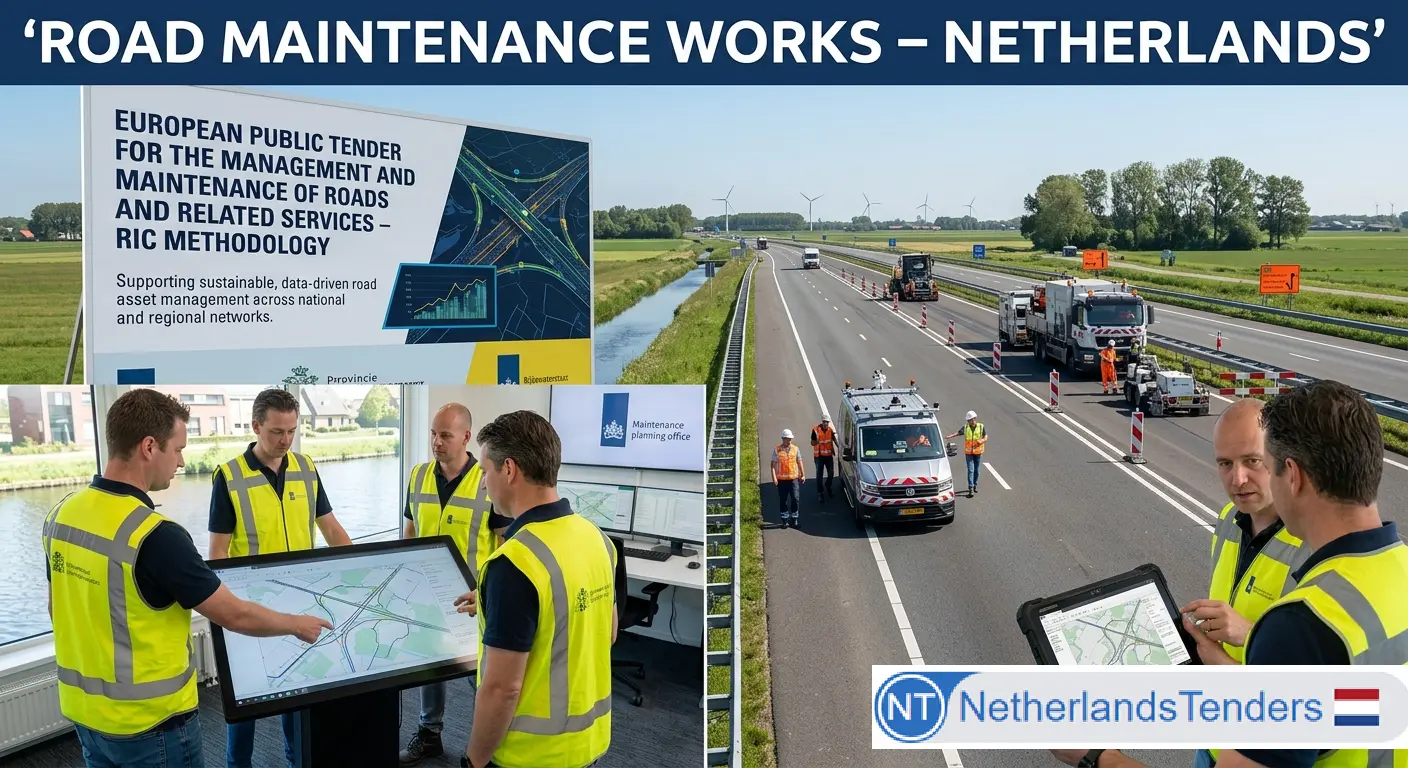
Two Dutch Municipalities Bet Everything on Quality in a 70 Million Euro Road Maintenance Deal
11 Aug 2026
Standfirst Samenwerkingsorganisatie De Wolden Hoogeveen has awarded Schagen Infra B.V. a road management and maintenance contract worth up to 70 million euros over a possible ten years. Uniquely, the tender set no price competition at all, evaluating all eight competing bids purely on how well they matched the authority's ambitions for the road network. Introduction Most public tenders come down, at least in part, to price. This one deliberately did not. When Samenwerkingsorganisatie De Wolden Hoogeveen, the joint administrative body serving the Dutch municipalities of Hoogeveen and De Wolden, went looking for a partner to manage and maintain its roads, it fixed the budget in advance and asked contractors to compete entirely on the strength of their plans. The result is a long term partnership contract built around a Dutch performance based maintenance methodology known as RIC, and it has just been awarded to Schagen Infra B.V. Why This Contract Matters Roads, sewers, bridges, verges and traffic signs are the kind of everyday infrastructure that residents notice only when something goes wrong. This contract bundles the management and maintenance of all of it, road surfaces, weed control, sewer works, civil engineering structures like bridges and embankments, road markings and traffic signage, into a single long term partnership rather than a series of separate maintenance contracts. What makes it particularly notable is the procurement approach itself. Rather than asking contractors to bid a price and compete on cost, the authority set a fixed ceiling budget and asked bidders to compete purely on the quality and ambition of their proposed approach, a structure that puts genuine weight behind the idea that how the work gets done matters more than shaving costs at the margin. Contract Timeline The contract was concluded on 1 August 2026. The notice recording this award was dispatched on 10 August 2026 and published in the Official Journal of the European Union on 11 August 2026, under OJ S issue 153/2026. The initial contract term runs for 96 months, eight years, with an option to extend twice by one year each, giving a maximum possible term of ten years. Contract Overview Samenwerkingsorganisatie De Wolden Hoogeveen ran an open procedure under Directive 2014/24/EU for the management and maintenance of roads and related services, using the RIC methodology, a Dutch results oriented maintenance contracting approach. The main classification is CPV code 45233141, Road maintenance works, with additional classifications spanning engineering and construction works, sewer construction, road surface painting, weed clearance, sewerage management and traffic signage. The overall procedure carried an estimated value of 74,200,000.00 EUR, while the single lot itself was estimated at 70,000,000.00 EUR. The winning tender from Schagen Infra B.V. was recorded at exactly 70,000,000.00 EUR, matching the lot's estimated value precisely. This is not a coincidence or a data anomaly. The notice explicitly states that no price was actually requested from bidders; instead, a fixed ceiling budget applied, and a nominal price criterion was included only because the Dutch national tendering platform, TenderNed, does not allow publication without one. Key Contract Details Contracting AuthoritySamenwerkingsorganisatie De Wolden Hoogeveen Winning BidderSchagen Infra B.V. Contract TitleBeheer en onderhoud van wegen en aanverwante dienstverlening (RIC methodiek), Management and maintenance of roads and related services Procedure TypeOpen procedure, not accelerated Legal BasisDirective 2014/24/EU CPV Code (Main)45233141 Road maintenance works Estimated Procedure Value (excl VAT)74,200,000.00 EUR Estimated and Awarded Lot Value (excl VAT)70,000,000.00 EUR, a fixed ceiling budget rather than a competed price Award CriteriaQuality 100 points, price nominally 0 points (no price competition, fixed ceiling budget) Initial Contract Term96 months (8 years) Maximum Renewals2, one year each, for a maximum total term of 10 years Tenders Received8, all submitted electronically, 1 from an SME EU FundingNot financed with EU funds Covered by GPAYes SubcontractingNo Contract Concluded1 August 2026 Place of PerformanceMunicipalities of Hoogeveen and De Wolden, Zuidwest Drenthe, Netherlands Project Scope The contract covers road maintenance, weed control on all paved surfaces except cemeteries, sewerage works, civil engineering structures including bridges, embankments and jetties, verge maintenance, typically the narrow strip of one to one and a half metres bordering the carriageway, line markings and road figuration, and traffic signage. Under the RIC methodology, the winning contractor and the authority work as partners over the contract term, each contributing their expertise, with the authority's ambitions for the network's condition and performance, rather than a prescriptive technical specification, guiding what the contractor delivers. The tender documents describe this as a Programme of Ambitions, setting out what the authority wants to achieve relative to the current state of its road network, which formed the actual basis for scoring competing bids. About the Contracting Authority Samenwerkingsorganisatie De Wolden Hoogeveen Samenwerkingsorganisatie De Wolden Hoogeveen is a body governed by public law with general public services as its classified activity, based in Hoogeveen in the Zuidwest Drenthe region of the Netherlands. It is a joint administrative organisation serving both the municipality of Hoogeveen and the municipality of De Wolden, running this procurement and managing the resulting contract on behalf of both. About the Organisations Involved Schagen Infra B.V. Schagen Infra B.V., classified as a medium sized enterprise, is based in Hasselt in the Netherlands. It won this contract, designated internally as contract P1, with a tender recorded at the full 70,000,000.00 EUR ceiling budget. No subcontracting was declared, and the tender was not formally ranked against other bids, consistent with an evaluation process built around a qualitative Programme of Ambitions rather than a scored competitive ranking against price. Rechtbank Noord Nederland Rechtbank Noord Nederland, the District Court of North Netherlands, based in Assen, is named alongside the contracting authority itself as the review organisation for this procurement, the standard route for legal challenges to Dutch public procurement decisions in this region. Procurement Analysis This procurement's defining feature is its complete departure from price based competition. Rather than asking bidders to compete on cost, the authority fixed a fully allocated ceiling budget of 70 million euros and asked all eight competing bidders to describe how their approach would meet its ambitions for the road network, scoring proposals entirely on quality across 100 available points. Eight tenders were received, a strong field for a contract of this scale and structure, though only one came from a bidder classified as an SME, suggesting the field was dominated by larger Dutch infrastructure contractors capable of taking on a multi year, multi service maintenance partnership of this size. The RIC methodology itself, a results oriented maintenance contracting approach used in Dutch public infrastructure, reflects a deliberate move away from prescriptive technical specifications toward outcome based partnerships, where the contractor is judged and paid based on achieving stated ambitions for network condition and performance rather than simply completing a fixed list of tasks. Additional Procurement Facts The contract is not financed with EU funds and is covered by the Government Procurement Agreement. No framework agreement or dynamic purchasing system applies. No strategic procurement objectives, such as environmental or social criteria, were declared for this specific lot. No subcontracting was declared by the winning contractor, and zero complainants are recorded against this award. Market and Industry Perspective Performance based, results oriented maintenance contracting is an increasingly established model in Dutch public infrastructure, and this award reflects growing confidence among smaller and mid sized Dutch municipalities in using approaches like RIC for contracts well beyond the scale typically associated with joint municipal administrative bodies of this kind. The decision to remove price competition entirely, relying instead on a fixed budget and pure quality evaluation, is a notable market signal. It suggests this specific buyer prioritises the certainty of a known budget envelope and confidence in contractor capability over the potential savings that open price competition might otherwise deliver. Economic Significance At up to 70 million euros over a potential ten year term, this is a substantial, long term commitment of shared municipal infrastructure budget for two Dutch municipalities. For Schagen Infra, it secures a significant, multi year revenue base and an extended partnership role managing essential road infrastructure across the Hoogeveen and De Wolden area. Future Procurement Opportunities With an initial term of eight years and two possible one year extensions, the next comparable procurement opportunity for competing contractors is unlikely to arise until close to the contract's eventual expiry, potentially a decade from now if both extension options are exercised. Contractors interested in future RIC methodology contracts should watch for similar tenders from other Dutch municipalities and joint administrative bodies, since this procurement approach appears to be gaining traction beyond the largest infrastructure authorities. Opportunities for Suppliers Infrastructure and civil engineering contractors interested in Dutch municipal road maintenance work should note that this tender rewarded quality and ambition alignment over price entirely, a structure that favours contractors able to articulate a compelling, well substantiated approach to network management rather than simply offering the lowest cost. The strong field of eight competing bidders also confirms genuine market interest in RIC style, ceiling budget contracts of this kind, suggesting Dutch infrastructure contractors are increasingly comfortable competing under this results oriented model. What Businesses Should Watch Road and infrastructure maintenance contractors active in the Netherlands should watch for further RIC methodology tenders from other municipalities and joint administrative bodies, and should monitor how Schagen Infra's approach to fulfilling the Programme of Ambitions performs in practice, since a successful outcome here could encourage wider adoption of this fixed budget, quality only procurement model. NetherlandsTenders.com Procurement Intelligence This award is a striking example of a public buyer stepping fully away from price competition in favour of a purely quality driven evaluation, backed by a fixed ceiling budget. It reflects growing confidence in the Netherlands that results oriented maintenance methodologies like RIC can deliver better long term outcomes than traditional price competitive tendering for essential infrastructure services. Its strategic importance lies in what it signals for smaller public buyers considering similar approaches. By removing price as a scoring factor entirely, Samenwerkingsorganisatie De Wolden Hoogeveen placed its full trust in the evaluation of contractor ambition and approach, backed by a fixed, known budget commitment, a model that shifts commercial risk in a different direction than conventional lowest price or even weighted price quality tenders. Suppliers can draw a clear lesson from how this competition was won. With eight competing tenders and price entirely removed from the equation, Schagen Infra's success rested purely on demonstrating the strongest alignment with the authority's stated ambitions for its road network, a reminder that in RIC style procurements, investment in a compelling, well evidenced technical and strategic proposal matters more than in almost any other public procurement format. Contractors targeting future contracts of this kind should build genuine expertise in results oriented maintenance methodologies and invest heavily in proposal quality, since this procurement model explicitly and entirely rewards vision and technical credibility over cost competitiveness. Supplier Takeaways This tender set no price competition at all, evaluating all bids purely on quality against a fixed ceiling budget of 70 million euros Eight tenders were received, with only one from an SME, suggesting the contract's scale favoured larger infrastructure contractors The RIC methodology structures the contract as an ongoing partnership judged on network outcomes rather than task completion The contract can run up to ten years with two optional one year extensions, offering a long term, predictable revenue base for the winner No subcontracting was declared, indicating the winning contractor intends to deliver the full scope directly Key Takeaways Samenwerkingsorganisatie De Wolden Hoogeveen has awarded a road management and maintenance contract worth up to 70 million euros to Schagen Infra B.V. The tender used a fixed ceiling budget with no price competition, scoring all bids entirely on quality Eight tenders were received for this open procedure, and the contract was concluded on 1 August 2026 The initial term is eight years, extendable twice by one year each for a maximum ten year term The contract is not EU funded but is covered by the Government Procurement Agreement Conclusion This award shows two Dutch municipalities placing a clear bet that quality of approach, not price, delivers the best long term outcome for essential road infrastructure. For Schagen Infra B.V., it secures a substantial, potentially decade long partnership managing roads, sewers, bridges and traffic infrastructure across Hoogeveen and De Wolden. For the wider Dutch infrastructure sector, this procurement is a signal that results oriented, quality only contracting models are gaining genuine traction beyond the country's largest infrastructure authorities, and contractors positioning for future opportunities of this kind should prepare accordingly. Source: Tenders Electronic Daily (TED), Contract Award Notice 554923-2026, Official Journal of the European Union, OJ S issue 153/2026, published on 11/08/2026.
View Details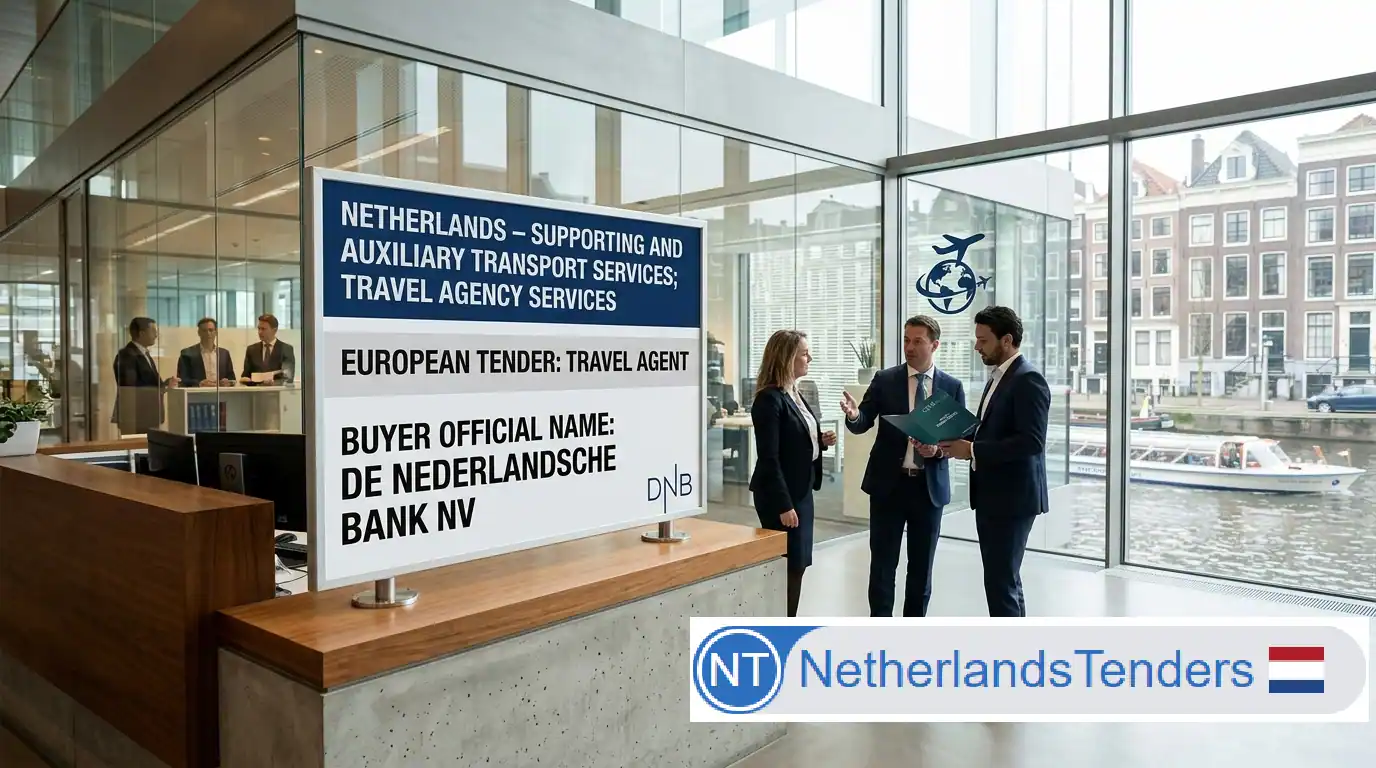
The Dutch Central Bank Picks a Family Run Travel Agency From Venlo to Handle Its Business Trips
10 Aug 2026
Standfirst De Nederlandsche Bank, the Dutch central bank, has awarded its corporate travel management contract to Munckhof Business Travel Venlo B.V., under a framework agreement worth an estimated EUR 7 000 000 and capped at EUR 20 000 000. Only one company bid for the contract, which weights service quality more than twice as heavily as price. Introduction Even a central bank needs someone to book the flights. De Nederlandsche Bank, the institution responsible for Dutch monetary stability and financial supervision, has just settled on who will manage its staff business travel for the next two to four years: Munckhof Business Travel, a family owned travel management company based in the southern Dutch city of Venlo. The tender itself was a quiet affair, drawing exactly one bidder for a contract that could be worth up to EUR 20 000 000 over its full term. What the notice lacks in competitive drama, it makes up for in a clear signal about what DNB actually values in a travel partner: the scoring criteria put service quality well ahead of price. Why This Contract Matters Central bank staff travel is not glamorous, but it is a genuine operational need, covering everything from routine domestic trips to more complex international travel connected to DNB's role in European and global financial oversight. A dependable travel management partner, capable of handling bookings, changes and support around the clock, is a small but real piece of institutional infrastructure. The scoring structure behind this award is also informative. DNB built its evaluation around the traveller's actual journey, from the initial booking request through departure and all the way to return, alongside a separate criterion on the supplier's knowledge continuity and team structure, together worth more than double the weight given to price. That is a deliberate signal that DNB prioritised service reliability and consistency over simply finding the cheapest travel agent. Contract Timeline Winner selected and contract concluded: 6 July 2026 Notice dispatched to the Publications Office: 7 August 2026 Published in the Official Journal, OJ S 152/2026: 10 August 2026 Contract start date: 1 October 2026 Base contract term ends: 30 September 2028 Contract Overview DNB ran an open procedure under Directive 2014/24/EU for corporate travel agency services, structured as a framework agreement without reopening of competition, meaning a single supplier holds the full agreement for its term. Only one tender was submitted, from Munckhof Business Travel Venlo B.V., which was selected as the winner with a tender valued at EUR 7 000 000, matching the contract's estimated value exactly. The framework runs for a base term of two years, from 1 October 2026 to 30 September 2028, with DNB holding a unilateral option to extend twice, each extension lasting up to twelve months, for a maximum possible term of four years and a binding ceiling of EUR 20 000 000. Key Contract Details Contracting authorityDe Nederlandsche Bank N.V. (DNB) Contract titleEuropean tender: Travel agent CPV code63000000, Supporting and auxiliary transport services, travel agencies services Procedure typeOpen procedure Legal basisDirective 2014/24/EU Estimated valueEUR 7 000 000, excluding VAT Maximum framework valueEUR 20 000 000, excluding VAT Base contract term1 October 2026 to 30 September 2028 Renewal optionsUp to 2 renewals of 12 months each, unilateral for DNB, maximum total term 4 years Award criteriaQuality, booking to departure process, 40 points; quality, departure to return process, 20 points; quality, knowledge continuity and team structure, 10 points; price, 30 points Tenders received1 WinnerMunckhof Business Travel Venlo B.V. Winner size classificationLarge enterprise Winner selected and contract signed6 July 2026 GPA coverageYes EU fundingNo Framework structureFramework agreement without reopening of competition SubcontractingNo Review bodyRechtbank van Amsterdam (Amsterdam District Court), 20 calendar day review deadline Complaints received0 Notice reference552946 2026, OJ S 152/2026, published 10 August 2026 Project Scope The contract covers travel agency services for DNB, with the tender documents themselves, referenced but not reproduced in the notice, containing the detailed scope. The four award criteria give the clearest public picture of what DNB actually expects: a well managed process from the moment a travel request is made through to departure, continued quality of service from departure through to the traveller's return, strong knowledge continuity and team structure on the supplier's side and competitive pricing set out in a formal price schedule. That structure suggests DNB is looking for more than transactional booking services, placing real weight on how consistently and reliably the agency supports travellers throughout an entire trip, not just at the point of purchase. About the Contracting Authority De Nederlandsche Bank N.V. is the Dutch central bank, based in Amsterdam and classified in the notice as a central government authority active in economic affairs. DNB is responsible for monetary policy implementation in the Netherlands as part of the Eurosystem, alongside financial supervision and broader economic stability functions. About the Organisations Involved De Nederlandsche Bank N.V. As covered above, DNB is the buyer behind this contract, with its procurement handled through contact point Thomas van Ommeren. Rechtbank van Amsterdam The Amsterdam District Court is named as the review organisation for this contract, with a twenty calendar day window specified for review requests. Munckhof Business Travel Venlo B.V. Munckhof Business Travel Venlo B.V., based in Venlo and classified as a large enterprise, is the sole tenderer and winner of this contract. The company is part of the Munckhof Group, a Dutch mobility and travel business founded in 1927 and has operated as a specialist corporate travel management company for close to three decades, with multiple branches across the Netherlands. Munckhof is also a partner within Reed & Mackay's international network of corporate travel agencies, giving it reach into business travel management across dozens of countries. Alongside standard international business travel, the company has a specific niche handling marine and offshore travel, arranging trips for seafarers and personnel in the shipping, gas and oil sectors, reflecting broader operational scope beyond conventional office worker business travel. Procurement Analysis DNB ran a standard open procedure, in principle accessible to any qualified travel management company able to serve the Dutch market, yet only one firm submitted a tender. For a contract of this profile and value, corporate travel management for a national institution with international dimensions, a single bid is not unusual, since the market for large scale, high service corporate travel management in the Netherlands is served by a relatively concentrated group of established Travel Management Companies capable of meeting the compliance, reporting and continuity demands a central bank would expect. The award criteria weighting, 70 points combined across three quality measures against 30 points for price, reflects a deliberate institutional choice to prioritise service consistency and process quality over cost minimisation. For a buyer like DNB, where travel often intersects with matters of confidentiality, scheduling reliability and staff duty of care, that weighting is a sensible reflection of what actually matters in a travel management relationship. Unlike several other Dutch and European notices, this one shows fully consistent value figures throughout, with the EUR 7 000 000 estimate and EUR 20 000 000 maximum appearing identically at both the procedure and lot level and again matching in the results section, a clean and reliable record. Additional Procurement Facts This project is confirmed as not financed with EU funds. The contract is confirmed as covered by the Government Procurement Agreement. The winning tender involves no subcontracting. No complaints were recorded against this award. This result establishes the framework agreement itself, rather than being a call off issued under an existing one. Market and Industry Perspective Corporate travel management remains a specialised service category dominated by a relatively small number of established Travel Management Companies capable of combining booking technology, account management and round the clock support at the scale large institutional clients require. Munckhof's membership in the Reed & Mackay international network gives it access to a broader pool of global travel infrastructure than its size as a regional Dutch company might otherwise suggest, a structure increasingly common among mid sized national travel agencies competing for large institutional contracts. Economic Significance At an estimated EUR 7 000 000 rising to a possible EUR 20 000 000 across a term that could run four years, this is a moderate but steady institutional contract for Munckhof, providing predictable multi year revenue from one of the Netherlands' most prominent public institutions. Future Procurement Opportunities DNB's two available twelve month renewal options give it flexibility to extend the relationship with Munckhof incrementally rather than committing to the full four year term upfront. A future recompete, whenever it occurs, would offer other Travel Management Companies a fresh opportunity to compete for this business, provided they can meet the same emphasis on service quality DNB has signalled through its scoring criteria. Opportunities for Suppliers Corporate travel management companies serving the Dutch public sector should note DNB's clear preference for quality focused evaluation over price competition in this category. Firms able to demonstrate strong process management across the full travel lifecycle and stable, well resourced account teams, are likely to be well positioned for institutional travel contracts structured along similar lines. What Businesses Should Watch Whether DNB exercises either of its two available twelve month renewal options as the base term progresses toward 2028. Broader Dutch public sector demand for corporate travel management services, particularly among institutions with complex international travel needs. Munckhof's continued expansion within the Reed & Mackay international network and its specialist marine and offshore travel business. NetherlandsTenders.com Procurement Intelligence This contract is a useful, low drama illustration of how institutional buyers signal their real priorities through award criteria rather than through headline competition. With only one bidder in the field, the outcome here was never going to be decided by a contest between rivals, but the scoring structure DNB published still tells suppliers exactly what kind of travel management relationship the bank wants: one built around consistent service delivery across an entire trip, not simply the lowest quoted price. For travel management companies eyeing similar institutional contracts, the lesson is to treat single bidder outcomes on complex service contracts like this one less as evidence of a closed market and more as a reminder that few firms may currently be positioned or motivated, to compete for a specific buyer's exact requirements. A well prepared new entrant, particularly one able to match the international network reach and specialist capabilities incumbents like Munckhof bring, may find real opportunity whenever this or comparable contracts next come to market. Strategically, this award also reflects a broader pattern of institutional buyers favouring established, network affiliated Travel Management Companies for contracts requiring both local service depth and international reach, a combination that increasingly favours mid sized specialists over either purely local agencies or the largest global players. Supplier Takeaways Award criteria weighted quality measures at 70 points combined against 30 points for price, prioritising service consistency over cost. Only one tender was submitted, suggesting a relatively narrow field of Travel Management Companies positioned to compete for large scale Dutch institutional travel contracts. The framework's value figures are fully consistent throughout the notice, a reliable record by comparison with several other recent European procurement notices. Membership in an international travel management network, as Munckhof holds through Reed & Mackay, appears to be a meaningful asset for competing on institutional contracts with international travel dimensions. DNB's two available renewal options give the relationship a potential runway of up to four years before any recompete. Key Takeaways De Nederlandsche Bank awarded its corporate travel management framework, worth an estimated EUR 7 000 000 and capped at EUR 20 000 000, to Munckhof Business Travel Venlo B.V. Only one tender was received for this open procedure. Award criteria weighted quality measures, covering the full travel process and team continuity, at 70 points against 30 points for price. The base contract term runs from October 2026 to September 2028, with up to two 12 month renewal options. No complaints were recorded and the contract is not financed with EU funds. Munckhof is a Venlo based Travel Management Company, part of the Munckhof Group and a partner within the Reed & Mackay international travel network. Conclusion There is nothing dramatic about a central bank choosing a travel agent, but the details still say something worth noting: DNB built its evaluation around the quality of the entire travel experience rather than price alone and found its answer in a family rooted, internationally networked Dutch travel management company nearly a century in business. For Munckhof, it is a steady, multi year institutional relationship. For DNB, it is one small piece of operational continuity secured well before the framework even begins. Source: Tenders Electronic Daily (TED), Contract Award Notice 552946-2026, Official Journal of the European Union, OJ S 152/2026, published on 10 August 2026.
View Details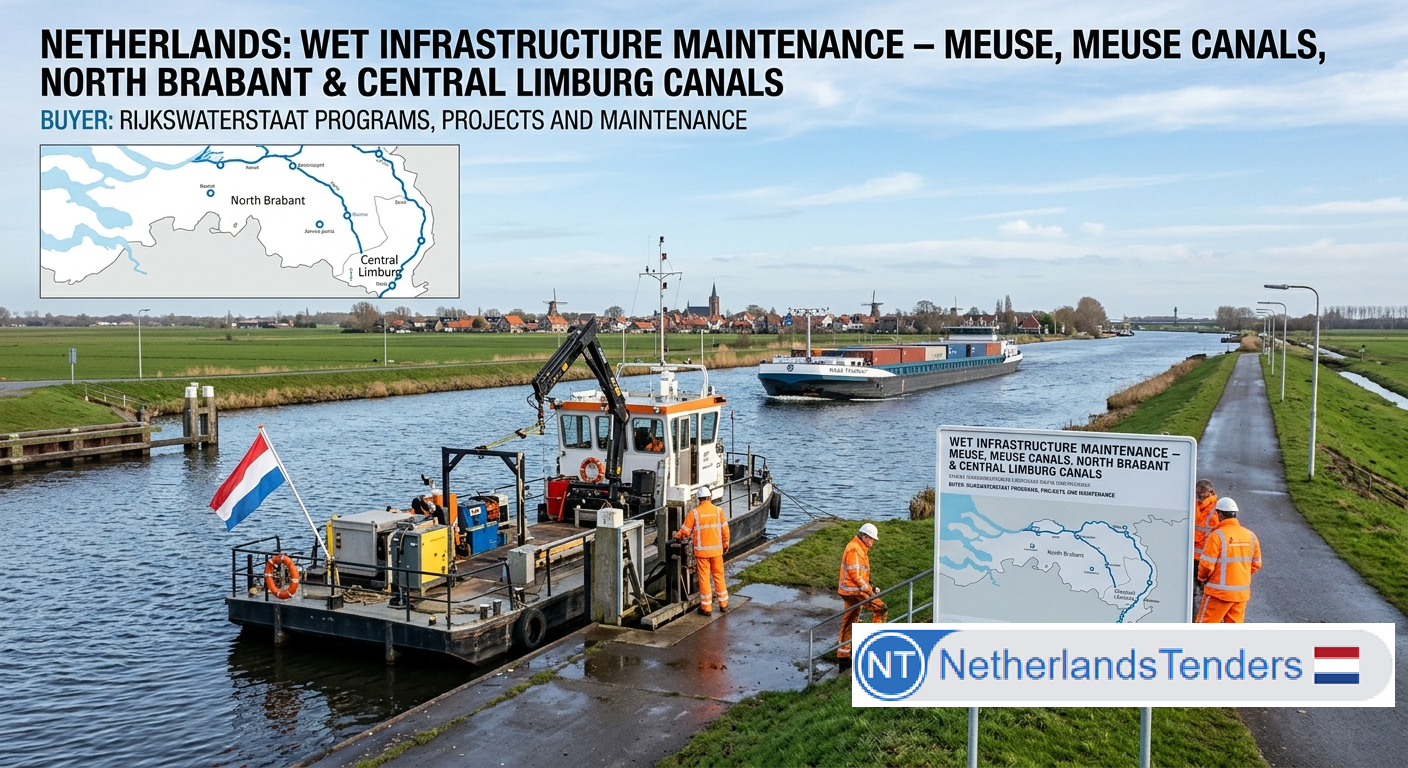
Rijkswaterstaat Splits a EUR 521 Million Meuse River Maintenance Programme Among Four Dutch Contractor Teams
07 Aug 2026
Standfirst Rijkswaterstaat, the Dutch government agency responsible for the country's main infrastructure, has awarded four six year framework agreements for variable maintenance of civil and hydraulic engineering works along the Meuse river and adjoining canals in North Brabant and Limburg. The combined maximum framework value reaches EUR 521 000 000, split among four contractor teams including three multi company joint ventures, though the agency's own figures show realistic spending is likely closer to half that ceiling. Introduction The Meuse river and its canal network through the southern Netherlands need constant upkeep, from lock structures and quay walls to embankments and the vegetation along their banks. Rather than tendering each maintenance job separately, Rijkswaterstaat has set up a structure designed to keep this work flowing steadily for the next six years: four parallel framework agreements, each covering a distinct combination of discipline and geography, each held by a single contractor team for the full term. The four winning teams range from established Dutch engineering names bidding solo to three separate multi company joint ventures, reflecting how contractors are increasingly banding together to take on this scale of long term public infrastructure work. Underpinning the whole programme is an unusually well explained set of financial figures, worth understanding before taking the headline value at face value. Why This Contract Matters Variable maintenance frameworks like this one are the unglamorous backbone of river and canal management: lock gates need repair, banks need reinforcement, vegetation needs clearing and none of it can wait for a fresh tender every time. By securing single contractor per lot arrangements for six years, Rijkswaterstaat gains continuity and faster response times, while contractors gain a stable, long term revenue base tied to one of the Netherlands' busiest inland waterway corridors. The programme's structure, split cleanly between civil engineering and hydraulic engineering work streams and between the Meuse river itself and the separate Brabant and Central Limburg canal network, gives a clear picture of how Rijkswaterstaat organises large scale regional infrastructure upkeep and offers a template other Rijkswaterstaat divisions may follow for comparable work elsewhere in the country. Contract Timeline Procedure type: Competitive dialogue under Directive 2014/24/EU Winner selected, all four lots: 2 March 2026 Contracts concluded, all four lots: 7 May 2026 Notice dispatched to the Publications Office: 6 August 2026 Published in the Official Journal, OJ S 151/2026: 7 August 2026 Framework term per lot: 72 months or 6 years Contract Overview Rijkswaterstaat ran a competitive dialogue procedure, a route reserved for particularly complex contracts where the buyer works iteratively with candidates to shape the final solution before tenders are submitted, for variable maintenance of wet infrastructure across its South Netherlands management area. The programme was split into four lots, each awarded to a single contractor team for the full six year term, with individual maintenance jobs subsequently assigned through further call off agreements within each framework. Rijkswaterstaat explains clearly in its own tender documentation that it uses two distinct financial figures for framework agreements of this kind: an indicative estimate, a non binding planning guideline based on information available at tender time and a maximum financial scope, a binding ceiling that cannot be exceeded but which itself offers no guarantee of actual spending, functioning only as a contract termination threshold. Summed across all four lots, the indicative estimates total EUR 261 000 000, while the binding maximum ceilings total EUR 521 000 000, the figure that appears as this procedure's headline estimated value. Key Contract Details Contracting authorityRijkswaterstaat Programma's, Projecten en Onderhoud Contract titleFramework agreement variable maintenance, Civil and Hydraulic Engineering, wet area South Netherlands CPV code45240000, Construction work for water projects, plus 45000000, Construction work Procedure typeCompetitive dialogue Legal basisDirective 2014/24/EU Combined maximum value, all 4 lotsEUR 521 000 000, excluding VAT Combined indicative estimate, all 4 lotsEUR 261 000 000, a non-binding planning figure roughly half the maximum Framework term per lot72 months (6 years) Award criteriaQuality and price, evaluated under the Dutch Best Price Quality Ratio (BPKV) methodology Tenders received18 total across the 4 lots, ranging from 4 to 5 per lot Framework structureFramework agreement without reopening of competition, single contractor team per lot Winner selected2 March 2026, all lots Contracts signed7 May 2026, all lots GPA coverageYes EU fundingNo Strategic procurement aimNone declared Review bodyCivil Court of The Hague, via Rijkswaterstaat Programma's, Projecten en Onderhoud Notice reference548946 2026, OJ S 151/2026, published 7 August 2026 Project Scope The four lots divide the work by both discipline and geography. Lot and scopeWinner, indicative estimate and maximum value Lot 1, Hydraulic engineering, Meuse riverTebezo Waterbouw & Nautische Dienstverlening B.V., EUR 51 million indicative, EUR 101 million maximum Lot 2, Civil engineering, Meuse riverCombinatie SamenMaasSterk v.o.f. (Mobilis B.V., Mourik Infra B.V. and Van den Herik Kust- en Oeverwerken B.V.), EUR 89 million indicative, EUR 177 million maximum Lot 3, Hydraulic engineering, North Brabant and Central Limburg canalsCombinatie Hakkers Waterbouw B.V. and Beens Constructieve Waterbouw B.V., EUR 85 million indicative, EUR 170 million maximum Lot 4, Civil engineering, North Brabant and Central Limburg canalsCombinatie Van Doorn Geldermalsen B.V. and Hegeman Bouw Civiel B.V., EUR 36 million indicative, EUR 73 million maximum Work covers civil and hydraulic engineering maintenance, including associated vegetation and green space upkeep, across the river Meuse and the canal network spanning North Brabant and Central Limburg. Individual jobs will be commissioned throughout the six year term through further agreements issued under each framework, rather than being fully specified at the point of award. About the Contracting Authority Rijkswaterstaat Programma's, Projecten en Onderhoud is part of Rijkswaterstaat, the executive agency of the Dutch Ministry of Infrastructure and Water Management responsible for the design, construction, management and maintenance of the Netherlands' main road, water and infrastructure networks. This programme falls under its South Netherlands division, covering the Meuse river corridor and associated canal systems across North Brabant and Limburg. About the Organisations Involved Rijkswaterstaat Programma's, Projecten en Onderhoud As covered above, Rijkswaterstaat is the buyer for all four lots and also serves as the organisation signing each contract and providing further procedural information. Tebezo Waterbouw & Nautische Dienstverlening B.V. Tebezo Waterbouw & Nautische Dienstverlening B.V. won Lot 1, covering hydraulic engineering maintenance on the Meuse river, the only one of the four lots awarded to a single company rather than a joint venture. Its winning tender was one of five received for this lot. Combinatie SamenMaasSterk v.o.f. Lot 2, civil engineering maintenance on the Meuse river, went to Combinatie SamenMaasSterk v.o.f., a joint venture of three companies: Mobilis B.V., Mourik Infra B.V. and Van den Herik Kust- en Oeverwerken B.V., operating from Apeldoorn. This was the largest lot by value, with a maximum framework ceiling of EUR 177 million, awarded from a field of four tenders. Combinatie Hakkers Waterbouw B.V. / Beens Constructieve Waterbouw B.V. Lot 3, hydraulic engineering maintenance across the North Brabant and Central Limburg canals, was awarded to a joint venture of Hakkers Waterbouw B.V. and Beens Constructieve Waterbouw B.V., based in Werkendam. Five tenders were received for this lot. Combinatie Van Doorn Geldermalsen B.V. / Hegeman Bouw Civiel B.V. Lot 4, civil engineering maintenance across the same canal network, went to a joint venture of Van Doorn Geldermalsen B.V. and Hegeman Bouw Civiel B.V., based in Geldermalsen. This was the smallest lot by value, with a maximum ceiling of EUR 73 million, drawn from four tenders. Procurement Analysis Rijkswaterstaat's use of competitive dialogue, rather than a simpler open or restricted procedure, reflects the complexity of structuring long term, variable scope maintenance frameworks of this kind, where the precise mix of future work cannot be fully specified upfront. Evaluation combined quality and price under the Dutch Best Price Quality Ratio methodology, a well established Dutch public procurement standard that assesses submitted quality documentation alongside price rather than defaulting to lowest cost. All four lots drew a healthy competitive field, between four and five tenders each, for a combined 18 tenders across the programme, indicating solid market interest in this multi year work despite its complexity and scale. None of the winning tenders for Lot 1 involved subcontracting and none were recorded as variant bids. The clearest and most useful data point in this notice is Rijkswaterstaat's own explanation of its value reporting methodology. Rather than leaving readers to guess why an "estimated value" might differ from a contract's real financial scale, Rijkswaterstaat states plainly that its published maximum figures are binding ceilings that provide no guarantee of actual spending, while its indicative estimates, roughly half the maximum in this case, represent its more realistic planning assumption. That distinction and Rijkswaterstaat's willingness to publish both figures with a clear explanation, sets a genuinely useful transparency standard. Additional Procurement Facts This programme is confirmed as covered by the Government Procurement Agreement and as not financed with EU funds. No strategic procurement aim, such as environmental or social criteria, was declared for these lots. Each framework operates without reopening of competition, meaning the same contractor team handles all call off work under its lot for the full six year term. Rijkswaterstaat operates under its own published code of conduct for public commissioning and directs complaints about the tender process to a dedicated central complaints point. Market and Industry Perspective The prevalence of multi company joint ventures among the winners, three of the four lots, reflects a broader pattern in large scale Dutch civil and hydraulic engineering work, where firms increasingly combine complementary capabilities and capacity to compete for framework agreements of this size and duration. Pairing a hydraulic engineering specialist with a general civil contractor or combining several regional firms under a joint venture structure, spreads both risk and workload across a six year commitment that a single mid sized firm might otherwise struggle to resource consistently. Rijkswaterstaat's decision to split the work by both discipline and geography, rather than awarding one large combined contract, also reflects a deliberate strategy to maintain multiple active supplier relationships across its South Netherlands portfolio, reducing dependency on any single contractor for the region's entire wet infrastructure maintenance need. Economic Significance At a combined maximum of EUR 521 000 000 or a more realistic indicative estimate of EUR 261 000 000, this programme represents a substantial, multi year commitment to maintaining critical inland waterway infrastructure along one of the Netherlands' busiest freight and water management corridors. For the four winning contractor teams, it offers six years of steady, recurring public sector revenue across civil and hydraulic engineering disciplines. Future Procurement Opportunities With each framework running a fixed 72 month term and no reopening of competition, the next major opportunity for other contractors will come when these agreements approach their conclusion around 2032, at which point Rijkswaterstaat is likely to retender the programme along similar lines. Contractors interested in this corridor should also watch for the individual call off agreements issued under these frameworks, which may create subcontracting opportunities even during the current term. Opportunities for Suppliers Civil and hydraulic engineering firms active in the Dutch inland waterway sector should note Rijkswaterstaat's clear preference for joint venture structures on large, multi year maintenance frameworks of this kind. Firms without the scale to bid solo may find that partnering with complementary specialists, as three of the four winning teams did here, offers a credible route into future Rijkswaterstaat framework competitions. What Businesses Should Watch The volume and pace of call off work issued under each of the four frameworks as the six year terms progress. Whether actual spending tracks closer to the indicative estimates or approaches the higher binding maximum ceilings. Rijkswaterstaat's approach to structuring comparable maintenance frameworks in other regions of the Netherlands. Any subcontracting opportunities that may emerge as the four winning teams begin executing work under their frameworks. NetherlandsTenders.com Procurement Intelligence This programme is a strong example of how well designed public value reporting can prevent the kind of unexplained figure discrepancies that undermine trust in procurement data elsewhere. By clearly defining and consistently applying the distinction between an indicative estimate and a binding maximum and by publishing both figures for every lot, Rijkswaterstaat gives suppliers, journalists and the public a genuinely usable picture of this programme's likely scale, rather than a single ambiguous number open to misinterpretation. The competitive dynamics here also carry a clear strategic lesson. With three of four lots going to multi company joint ventures, firms hoping to compete for Rijkswaterstaat's largest, longest running maintenance frameworks should treat partnership structuring as a core part of their bid strategy, not an afterthought. The right combination of hydraulic and civil engineering capability, backed by sufficient scale to sustain six years of variable, unpredictable call off work, appears to be what separates winning teams from the rest of the field in this market. Looking ahead, this award pattern, four parallel single supplier frameworks split by discipline and geography, may well become a template Rijkswaterstaat applies to other regional maintenance portfolios across the Netherlands. Contractors positioning for future opportunities in Dutch inland waterway and civil infrastructure maintenance should study this programme's structure closely as an indicator of how the agency is likely to organise comparable work elsewhere. Supplier Takeaways Rijkswaterstaat's clear distinction between indicative estimates and binding maximum values is a transparency model worth understanding when evaluating the real scale of Dutch public framework agreements. Three of the four lots were won by multi company joint ventures, underscoring the value of partnership structures for large, long term maintenance frameworks. All four lots drew healthy competition, between four and five tenders each, showing this remains an actively contested market segment. Evaluation combined quality and price under the Dutch BPKV methodology, rewarding well documented technical proposals alongside competitive pricing. Each framework runs a fixed six year term without reopening of competition, giving winning teams a stable, multi year revenue base. Key Takeaways Rijkswaterstaat awarded four six year framework agreements for variable maintenance of civil and hydraulic engineering works along the Meuse river and southern Netherlands canal network. The combined maximum framework value across all four lots is EUR 521 000 000, though Rijkswaterstaat's own indicative estimate totals roughly half that, EUR 261 000 000. Winners are Tebezo Waterbouw & Nautische Dienstverlening B.V., Combinatie SamenMaasSterk v.o.f., Combinatie Hakkers Waterbouw B.V./Beens Constructieve Waterbouw B.V. and Combinatie Van Doorn Geldermalsen B.V./Hegeman Bouw Civiel B.V. Three of the four lots were won by multi company joint ventures. All four lots drew active competition, totalling 18 tenders across the programme. Evaluation combined quality and price under the Netherlands' established Best Price Quality Ratio methodology. Conclusion Behind the routine language of a maintenance framework sits a carefully structured, six year commitment to keeping one of the Netherlands' most important inland waterway corridors in working order, split cleanly across discipline and geography and awarded to a mix of established solo contractors and freshly formed joint ventures. With its unusually clear explanation of what its headline numbers actually mean, this programme also offers a useful benchmark for how public buyers can report large, uncertain, multi year contract values without leaving the market to guess. Source: Tenders Electronic Daily (TED), Contract Award Notice 548946-2026, Official Journal of the European Union, OJ S 151/2026, published on 7 August 2026.
View Details