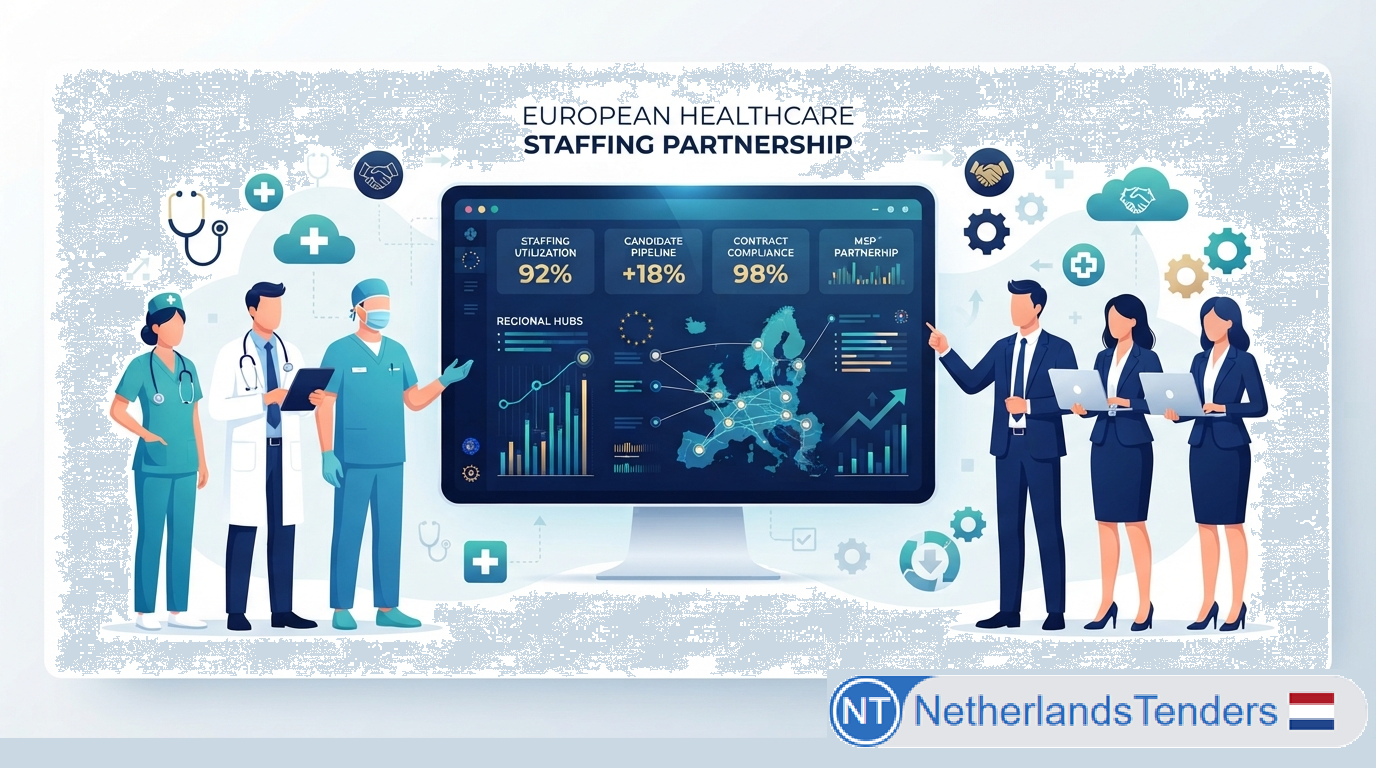
Hecht Awards €173.1 Million Managed Service Provider Framework for External Workforce Management in the Netherlands
24 Jul 2026
Introduction: Dutch public health organisation Hecht has awarded a major framework agreement for the provision of Managed Service Provider (MSP) services to centralise and optimise its external workforce hiring process. The contract, published in the Official Journal of the European Union (OJ S 141/2026), covers the management of temporary staffing, recruitment coordination and vendor management services across the organisation. The framework agreement has a maximum value of €173.1 million excluding VAT, making it one of the largest public sector workforce management contracts awarded in the Netherlands this year. The agreement has been awarded to Randstad Enterprise Inhouse Services B.V. following a negotiated procedure without prior publication after an earlier open procurement failed to receive any suitable tenders. Hecht intends to centralise its complete external hiring process under a single managed service provider supported by a Vendor Management System (VMS). The selected provider will oversee recruitment, supplier management, contract administration and workforce coordination while helping the organisation respond efficiently to both routine staffing requirements and unexpected public health emergencies. The procurement reflects the growing importance of strategic workforce management within healthcare organisations. Besides addressing regular staffing needs, the framework has been designed to provide rapid scalability during crises such as infectious disease outbreaks or future pandemics, ensuring that qualified external professionals can be mobilised quickly whenever required. Why This Contract Matters Healthcare organisations across Europe increasingly depend on flexible staffing models to address workforce shortages, fluctuating service demand and emergency preparedness. Rather than managing multiple recruitment agencies independently, many public authorities are adopting Managed Service Provider models that centralise procurement, supplier management and workforce administration under a single contractual framework. For Hecht, the framework creates a structured approach to external hiring across multiple operational areas while improving governance, transparency and efficiency. According to the procurement notice, the organisation expects a continuing structural need for external personnel over the coming years and anticipates further growth in demand as healthcare responsibilities evolve. The contract is particularly significant because it supports public health resilience. The procurement documentation notes that future infectious disease preparedness or other crisis situations could require the rapid mobilisation of a substantial number of external professionals within a very short timeframe. By establishing a long term MSP framework, Hecht aims to ensure that recruitment processes remain responsive during both normal operations and emergency situations. The procurement also demonstrates how contracting authorities can legally transition to a negotiated procedure when an earlier open competition does not attract suitable bids. Rather than abandoning the procurement, Hecht continued the process under the provisions of Dutch procurement legislation while maintaining the original contractual requirements. Contract Timeline Milestone Details Country Netherlands Notice Type Contract Award Notice - Standard Regime Publication OJ S 141/2026 - 24 July 2026 Contracting Authority Hecht Procedure Negotiated Procedure Without Prior Call for Competition Contract Type Services Main CPV 79610000 - Placement services of personnel Framework Value €173,100,000 excluding VAT Framework Duration 96 Months Winner Selected 30 June 2026 Contract Signed 14 July 2026 Contract Overview The procurement concerns the establishment of a single framework agreement for Managed Service Provider (MSP) services covering the complete lifecycle of external workforce procurement. Hecht intends to centralise recruitment, supplier coordination, contract administration and workforce management through one specialist provider supported by a Vendor Management System. According to the procurement notice, the organisation expects annual external hiring requirements of approximately €6.3 million for routine staffing activities, including regular operational roles, roster based assignments and project related personnel. In addition, the authority has planned significant contingency capacity to support emergency response scenarios that could require rapid recruitment during public health crises. To accommodate future uncertainty, including increased pandemic preparedness and possible expansion of organisational responsibilities, Hecht established a substantially higher maximum framework value. The procurement documentation explains that the overall contract value has been increased to ensure sufficient flexibility throughout the framework period, including extension options. The contract will operate as a framework agreement without reopening competition, allowing Hecht to obtain MSP services directly from the selected provider during the contract term. The procurement is covered by the Government Procurement Agreement (GPA) and is not financed through European Union funds. Key Contract Details Item Information Project Title Managed Service Provider (MSP) - External Hiring Contracting Authority Hecht Country Netherlands Main CPV 79610000 - Placement services of personnel Additional CPV 79620000 - Supply services of personnel including temporary staff Maximum Framework Value €173,100,000 excluding VAT Framework Duration 96 Months Procedure Negotiated Without Prior Call for Competition Framework Agreement Yes - Without Reopening Competition Dynamic Purchasing System No EU Funding Not financed by European Union funds Project Scope The framework agreement establishes a comprehensive Managed Service Provider (MSP) solution that will centralise Hecht's complete external workforce hiring process under a single service provider. The selected contractor will manage recruitment coordination, supplier relationships, contract administration and workforce deployment using a dedicated Vendor Management System (VMS). According to the procurement notice, Hecht expects a long term structural requirement for external personnel across its organisation. For 2026, the authority has allocated approximately €6.3 million for regular external hiring activities, including around €3.25 million for standard operational roles, €1.55 million for roster based staffing and approximately €1.5 million for project related assignments. Beyond routine staffing, the framework has been designed to provide exceptional flexibility during emergency situations. The procurement documentation explains that Hecht is preparing for future public health crises and enhanced infectious disease preparedness. Consequently, the MSP must be capable of rapidly scaling external workforce capacity should circumstances such as pandemics or other emergencies require substantial increases in temporary personnel. The contracting authority decided not to divide the procurement into multiple lots. According to the published notice, managing all external workforce activities through one provider reduces administrative complexity, lowers organisational costs, minimises coordination risks and supports consistent contract management across the organisation. Management of the complete external hiring process. Operation of a Vendor Management System (VMS). Recruitment, sourcing and placement of external professionals. Supplier relationship and contract management. Support for routine staffing requirements across multiple operational areas. Rapid mobilisation of external personnel during crises and emergency situations. Framework management throughout the 96 month contract period. About the Contracting Authority Hecht is a Dutch public sector organisation operating in the healthcare sector. As a body governed by public law, the organisation is responsible for delivering health related services while ensuring access to qualified professionals capable of supporting both routine operations and emergency response activities. The authority initiated this procurement to modernise and centralise its external workforce management strategy. By appointing a single Managed Service Provider, Hecht aims to improve transparency, strengthen supplier governance and standardise recruitment processes across the organisation. The procurement documents indicate that the organisation anticipates continued growth in demand for external personnel. Changing healthcare requirements, evolving organisational responsibilities and future public health preparedness initiatives are expected to increase reliance on flexible workforce solutions during the coming years. Organisations Involved The procurement process was led by Hecht, which acted as the contracting authority responsible for preparing the tender documentation, conducting negotiations and awarding the framework agreement. The notice identifies Rechtbank Den Haag as the review body responsible for handling procurement disputes in accordance with Dutch public procurement legislation. Additional procurement information and review procedure guidance are also provided by Hecht throughout the procurement process. The successful contractor, Randstad Enterprise Inhouse Services B.V., will deliver Managed Service Provider services under the framework agreement and will become the central coordinator for Hecht's external workforce procurement activities. Winning Supplier The framework agreement was awarded to Randstad Enterprise Inhouse Services B.V., a specialist provider of workforce management and recruitment solutions. The company will manage the complete MSP service throughout the framework period, including recruitment coordination, supplier management and operation of the Vendor Management System. The winner was selected following a negotiated procedure conducted without prior publication. The procurement notice explains that this procedure was used because the earlier open tender failed to receive any suitable tenders, allowing the contracting authority to continue under the applicable provisions of Dutch procurement legislation without materially changing the original contract conditions. The successful contractor was selected on 30 June 2026 and the framework agreement was formally concluded on 14 July 2026. Contract Award Details Item Details Winning Supplier Randstad Enterprise Inhouse Services B.V. Contract Type Framework Agreement for Managed Service Provider Services Maximum Framework Value €173,100,000 excluding VAT Winner Selected 30 June 2026 Contract Conclusion Date 14 July 2026 Procurement Procedure Negotiated Procedure Without Prior Call for Competition Framework Agreement Yes - Without Reopening Competition Subcontracting No subcontracting indicated in the published notice. Procurement Analysis The procurement reflects a growing trend among public healthcare organisations to consolidate external workforce management under a single Managed Service Provider (MSP). Rather than coordinating multiple recruitment agencies independently, Hecht has opted for a centralised model supported by a Vendor Management System (VMS), enabling greater oversight of recruitment, supplier performance and contract administration. A notable feature of this procurement is the use of a negotiated procedure without prior call for competition. According to the contract notice, Hecht initially launched an open procurement procedure through TenderNed. However, no tenders were submitted during that competition. As permitted under Article 2.32(1)(a) of the Dutch Public Procurement Act 2012, the contracting authority proceeded with a negotiated procedure without substantially changing the original procurement conditions. The framework agreement has a maximum value of €173.1 million excluding VAT, considerably exceeding the organisation's estimated annual staffing expenditure. The procurement notice explains that this higher ceiling provides sufficient flexibility to accommodate future organisational growth, extension options and potential emergency situations requiring rapid workforce expansion. The decision to appoint a single Managed Service Provider instead of dividing the contract into multiple lots also demonstrates a procurement strategy focused on operational efficiency. According to the published notice, splitting the contract would increase administrative workload, coordination complexity and compliance risks while reducing overall efficiency. Technical Highlights The Managed Service Provider framework extends beyond conventional recruitment services by combining workforce sourcing, contract management and digital workforce administration within a single integrated solution. Centralised management of external workforce procurement. Implementation and operation of a Vendor Management System (VMS). Recruitment, sourcing, matching and placement of external professionals. Supplier relationship and contract management. Support for roster based staffing and project assignments. Capability to rapidly scale workforce capacity during public health emergencies. Single provider governance model reducing administrative complexity. The procurement documentation also places significant emphasis on implementation quality and service delivery. Award criteria covered areas such as recruitment methodology, implementation planning, stakeholder collaboration, Vendor Management System functionality, practical case presentations and pricing, demonstrating that service quality played a central role in contractor selection. Market & Industry Perspective Public sector organisations across Europe continue to modernise workforce procurement through Managed Service Provider models that integrate recruitment, technology platforms and supplier management. Healthcare institutions in particular face increasing pressure to maintain access to qualified professionals while ensuring efficient governance of temporary staffing expenditure. The Hecht framework reflects this broader market evolution by combining recruitment expertise with digital workforce management technology. Vendor Management Systems have become increasingly important in enabling organisations to monitor recruitment activity, improve transparency, standardise procurement processes and generate workforce intelligence for future planning. The procurement also illustrates how public authorities are strengthening workforce resilience following recent public health emergencies. Framework agreements capable of supporting rapid mobilisation of external personnel are becoming increasingly valuable as organisations prepare for future healthcare challenges and changing operational requirements. Economic Significance With a maximum framework value of €173.1 million excluding VAT, the agreement represents a substantial long term investment in workforce management rather than direct infrastructure or equipment procurement. The framework provides financial flexibility for both routine staffing requirements and exceptional circumstances requiring large scale deployment of external professionals. The procurement supports a broad ecosystem of recruitment agencies, staffing suppliers and workforce specialists operating under the Managed Service Provider model. By centralising supplier relationships through one contract, Hecht aims to improve procurement efficiency while maintaining access to a diverse pool of qualified professionals across multiple healthcare disciplines. Although the procurement is not financed by European Union funds, its economic impact extends across the Dutch healthcare labour market through long term demand for specialised recruitment, workforce planning and temporary staffing services over the framework's eight year duration. Additional Procurement Facts Maximum framework agreement value: €173,100,000 excluding VAT. Framework duration: 96 months. Main CPV: 79610000 - Placement services of personnel. Additional CPV: 79620000 - Supply services of personnel including temporary staff. The procurement was conducted through a negotiated procedure without prior publication. The negotiated procedure followed an earlier open competition that received no tenders. The framework agreement operates without reopening competition. The procurement is covered by the Government Procurement Agreement (GPA). The project is not financed through European Union funding. The successful contractor was selected on 30 June 2026, with the contract concluded on 14 July 2026. Future Procurement Opportunities The award of this Managed Service Provider framework establishes a long term partnership that is expected to generate ongoing procurement opportunities throughout the contract period. While the published notice awards a single framework agreement, implementation of the MSP model will require continuous engagement with staffing suppliers, recruitment partners and specialised workforce providers coordinated through the selected service provider. Healthcare organisations across the Netherlands continue to invest in flexible workforce solutions to address staff shortages, evolving healthcare demands and emergency preparedness. Similar procurements for Managed Service Providers, Vendor Management Systems, recruitment services and temporary staffing solutions are likely to remain important within the Dutch public healthcare sector as authorities seek greater operational efficiency and workforce resilience. Opportunities for Suppliers The procurement highlights increasing demand for integrated workforce management solutions that combine recruitment expertise with digital technology platforms. Organisations capable of delivering Vendor Management Systems, recruitment process outsourcing, contract management, supplier governance and workforce analytics may find expanding opportunities in future healthcare procurements. The published procurement also demonstrates that contracting authorities place considerable emphasis on implementation capability rather than price alone. Evaluation criteria included recruitment methodology, implementation planning, collaboration with stakeholders, Vendor Management System functionality and practical demonstrations. Suppliers preparing for future competitions should therefore strengthen both operational expertise and digital service capabilities. What Businesses Should Watch Future Dutch healthcare procurements for Managed Service Provider (MSP) solutions. Vendor Management System (VMS) implementation opportunities. Framework agreements covering temporary staffing and workforce management. Recruitment and supplier management contracts within the public healthcare sector. Digital workforce management platforms supporting procurement transparency. Projects focused on emergency workforce mobilisation and healthcare resilience. NetherlandsTenders.com Procurement Intelligence This framework agreement demonstrates how public sector organisations are transforming workforce procurement from traditional recruitment contracts into strategic workforce management programmes. Instead of simply purchasing recruitment services, Hecht has adopted an integrated Managed Service Provider model that combines sourcing, supplier management, contract administration and digital workforce oversight under a single contractual framework. The procurement also illustrates an important legal aspect of European public procurement. Following an unsuccessful open tender that attracted no bids, the contracting authority lawfully proceeded with a negotiated procedure without prior publication while maintaining the original procurement conditions. This approach ensured procurement continuity without restarting the entire tender process. Another significant insight is the emphasis placed on organisational resilience. The framework has been structured not only to support routine staffing requirements but also to enable rapid workforce expansion during future healthcare emergencies. This reflects a wider trend across European healthcare procurement, where flexibility and crisis preparedness are becoming key procurement objectives. Supplier Takeaways The framework agreement has a maximum value of €173.1 million excluding VAT. Randstad Enterprise Inhouse Services B.V. was awarded the contract. The agreement covers a period of 96 months. The procurement followed a negotiated procedure after an earlier open competition received no tenders. The framework centralises external workforce management through a single Managed Service Provider. Digital workforce management and Vendor Management Systems are central components of the service model. Key Takeaways Hecht has awarded a long term Managed Service Provider framework to centralise external workforce hiring. The framework agreement has a maximum value of €173.1 million excluding VAT. The procurement supports routine staffing requirements as well as emergency workforce mobilisation. The selected provider will manage recruitment, supplier relationships and Vendor Management System operations. The contract demonstrates growing adoption of integrated workforce management solutions within European public healthcare. The framework is expected to strengthen procurement transparency, operational efficiency and workforce resilience over the eight year contract period. Conclusion The award of the Managed Service Provider framework marks a significant step in Hecht's long term workforce management strategy. By centralising recruitment, supplier coordination and contract management under a single provider, the organisation aims to improve operational efficiency while ensuring reliable access to qualified external professionals. Beyond its substantial financial value, the framework reflects broader trends in European public procurement, including digital workforce management, integrated service delivery and increased preparedness for future healthcare emergencies. As workforce flexibility becomes increasingly important across the healthcare sector, similar Managed Service Provider procurements are expected to play an increasingly important role in supporting sustainable public service delivery. Source: TED European Union, Contract Award Notice, OJ S 141/2026, Notice 512828-2026. published 24/07/2026.
View Details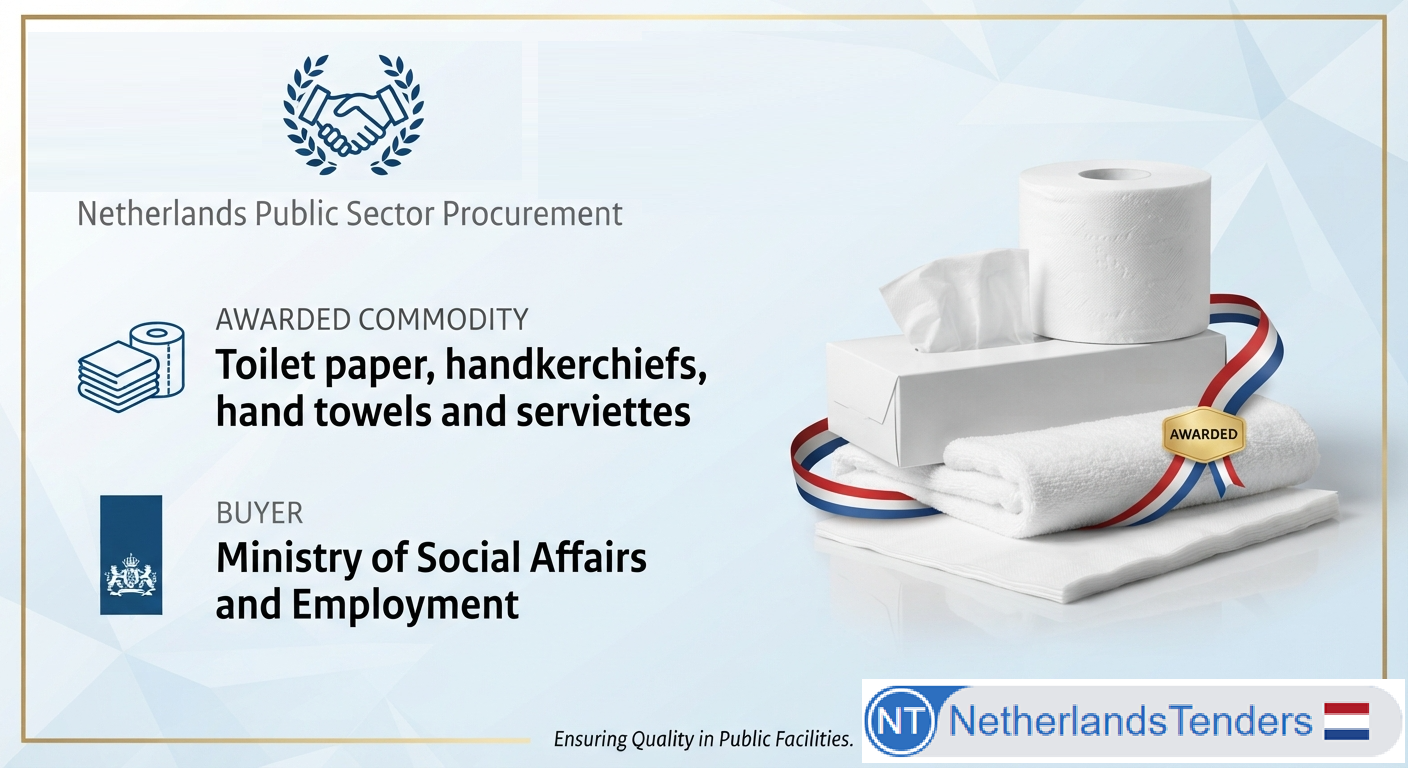
Netherlands Awards €14.87 Million Framework for Sustainable Sanitary Facilities Across Government Buildings
23 Jul 2026
Introduction: The Dutch government has concluded a major public procurement initiative aimed at modernising and standardising sustainable sanitary facilities across central government buildings. The contract, titled "Duurzame sanitaire voorzieningen voor de Rijksoverheid", has been awarded through an open European procurement procedure and carries an estimated framework value of €14.866 million (excluding VAT). The procurement was managed by the Ministerie van Sociale Zaken en Werkgelegenheid (Ministry of Social Affairs and Employment), acting on behalf of the Dutch government's Cleaning Category Management programme. Rather than purchasing products alone, the procurement combines the supply of sanitary dispensers and consumables with long term maintenance and service operations. The framework has been divided into seven regional lots covering virtually every province in the Netherlands, enabling the government to establish reliable supply chains while ensuring consistent service quality across its nationwide property portfolio. The procurement has been designed to support transparent supplier selection and establish framework agreements for future requirements within government buildings. This contract award demonstrates how governments are increasingly adopting framework agreements to simplify procurement, improve operational efficiency and support sustainable public facility management. By combining procurement volumes across multiple ministries and regions, the Dutch government aims to achieve greater purchasing efficiency while maintaining consistent service standards for thousands of public employees and visitors. Why This Contract Matters Although sanitary supplies may appear to represent routine operational spending, they form an essential component of public infrastructure management. Government offices require uninterrupted availability of hygiene products including dispensers, paper products and related consumables. Equally important is the maintenance of these systems to ensure public buildings remain safe, functional and compliant with workplace hygiene standards. This procurement therefore extends beyond purchasing dispensers or refill products. It establishes a long term operational framework covering installation support, replenishment systems and ongoing servicing across multiple Dutch government facilities. By dividing responsibilities geographically, the contracting authority can improve supplier responsiveness while reducing logistical complexity. The framework also reflects broader public procurement priorities seen across Europe, where contracting authorities increasingly integrate sustainability considerations into routine operational contracts. Centralised purchasing enables governments to reduce administrative costs, standardise specifications and create economies of scale without compromising regional service delivery. The procurement further illustrates how category management has become an important element of Dutch public procurement strategy. Instead of individual ministries conducting separate tenders for similar products, procurement responsibilities are consolidated under specialised category managers capable of delivering coordinated purchasing programmes. Contract Timeline Item Details Country Netherlands Contract Type Contract Award Notice – Supplies Procedure Open Procedure Publication OJ S 140/2026 – 23 July 2026 Buyer Ministerie van Sociale Zaken en Werkgelegenheid Estimated Framework Value €14,866,000 (excluding VAT) Total Lots 7 Regional Lots Contract Overview The contracting authority launched this procurement to establish framework agreements for sustainable sanitary provisions throughout government buildings located within the Regional Service Organisation (RSO) coverage areas. According to the procurement documents, the objective of the tender was to conduct a transparent, fair and efficient procurement process capable of selecting the most suitable service providers for supplying sanitary facilities and associated services. The procurement combines two closely connected operational requirements. The first concerns the supply of dispensers and refill products, while the second focuses on service activities necessary to maintain those installations during the framework period. This integrated procurement model allows government agencies to work with coordinated suppliers capable of supporting both product availability and operational maintenance. The estimated value of all seven lots together amounts to approximately €14.866 million, highlighting the substantial scale of routine facilities management undertaken across Dutch government buildings. Rather than concentrating all requirements under one supplier, the procurement divides responsibilities among regional lots, enabling improved market participation and stronger regional service capabilities. The procurement was conducted through an Open Procedure, allowing interested economic operators to compete under transparent European procurement rules. The notice further indicates that the procedure was not accelerated, demonstrating that the contracting authority followed the standard procurement timetable for evaluating submissions and awarding framework agreements. Key Contract Details Category Information Procurement Title Duurzame sanitaire voorzieningen voor de Rijksoverheid Contracting Authority Ministerie van Sociale Zaken en Werkgelegenheid Buyer Type Central Government Authority Main Activity Social Protection Procurement Method Open Procedure Framework Structure Seven Regional Lots Estimated Framework Value €14.866 Million Coverage Government Buildings Across Multiple Dutch Provinces Project Scope The procurement has been structured around seven regional lots covering two primary operational activities. Lots 1 through 4 focus on the supply of sanitary dispensers together with refill products for government buildings located across different Dutch provinces. Lots 5 through 7 cover service operations associated with maintaining those sanitary facilities. For dispenser supply, the procurement divides the Netherlands into four regional clusters. The first covers Groningen, Friesland, Drenthe and Overijssel. The second includes Flevoland, Gelderland, Noord Brabant and Limburg. The third covers Zuid Holland and Zeeland, while the fourth includes Utrecht and Noord Holland. Separate service lots have similarly been organised to provide maintenance activities across corresponding regional groupings. This structure allows suppliers specialising in maintenance services to compete independently while ensuring that operational support remains geographically efficient. By separating supply and service components into dedicated regional lots, the contracting authority creates procurement flexibility while reducing operational risks. Suppliers can focus on their areas of expertise, and government facilities benefit from regional support networks capable of responding more quickly to operational requirements. The framework therefore represents more than a purchasing exercise. It establishes a coordinated facilities management strategy that supports sustainable sanitary infrastructure across the Dutch central government estate while promoting transparent competition, regional supplier participation and efficient public expenditure.About the Contracting Authority The procurement has been managed by the Ministerie van Sociale Zaken en Werkgelegenheid (Ministry of Social Affairs and Employment), acting as the contracting authority on behalf of the Dutch Government's Cleaning Category Management programme. Within the Dutch central procurement framework, the Cleaning Category Manager is responsible for coordinating procurement activities related to sanitary and cleaning services across government organisations. Instead of allowing individual departments to procure these products independently, the category management approach consolidates demand into a single procurement exercise that benefits multiple government entities. According to the contract notice, the objective of this procurement was to establish framework agreements through a transparent, fair and efficient procurement process. These framework agreements will support sanitary facilities across government buildings located within the Regional Service Organisation (RSO) service areas. By centralising procurement under one authority, the government seeks to ensure consistent product quality, uniform service standards and improved procurement efficiency while reducing duplication across ministries. The contracting authority also structured the procurement to encourage competition while ensuring suppliers possess the operational capability required to deliver products and services throughout multiple Dutch provinces. The framework arrangement enables future orders to be placed under predefined contractual conditions, reducing procurement lead times while maintaining compliance with European public procurement regulations. Regional Procurement Structure One of the defining characteristics of this procurement is its regional framework structure. Rather than awarding a single nationwide contract, the procurement has been divided into seven lots covering different geographical regions and operational responsibilities. This approach distributes procurement opportunities among multiple suppliers while improving logistics and service responsiveness. The first four lots relate to the supply of dispensers and refill products for government facilities. These lots have been organised according to regional demand clusters, allowing suppliers to manage inventory, deliveries and customer support more efficiently. Lot Scope Coverage Area Lot 1 Dispensers and Refills Groningen, Friesland, Drenthe and Overijssel Lot 2 Dispensers and Refills Flevoland, Gelderland, Noord Brabant and Limburg Lot 3 Dispensers and Refills Zuid Holland and Zeeland Lot 4 Dispensers and Refills Utrecht and Noord Holland Lot 5 Service Activities Groningen, Friesland, Drenthe, Overijssel, Utrecht and Noord Holland Lot 6 Service Activities Flevoland, Gelderland, Noord Brabant and Limburg Lot 7 Service Activities Zuid Holland and Zeeland The regional structure enables suppliers to focus on specific operational territories while allowing the contracting authority to diversify service delivery across multiple framework participants. Such an arrangement can also improve continuity of supply by avoiding dependence on a single nationwide contractor. Understanding the Scope of Supply and Services The procurement combines two complementary operational components that together support hygiene management across government facilities. The first component involves the supply of sustainable sanitary dispensers together with associated refill products. These products are intended for installation and continuous operation in public buildings occupied by central government organisations. Since sanitary facilities require uninterrupted availability, suppliers are expected to maintain reliable distribution networks capable of meeting recurring demand throughout the framework period. The second component concerns service activities associated with those sanitary installations. These activities include operational support required to maintain dispenser functionality across government premises. By separating supply and service responsibilities into dedicated regional lots, the contracting authority creates opportunities for specialised market participants while ensuring that maintenance activities remain closely aligned with regional operational requirements. The procurement therefore establishes a complete operational solution rather than a simple purchasing contract. Government facilities will receive not only sanitary products but also the ongoing technical and logistical support required to maintain service continuity throughout the duration of the framework agreements. Procurement Strategy and Framework Approach The contract notice explains that the objective of the procurement was to conduct a transparent, fair and efficient competition for selecting the most suitable service providers. To achieve this objective, the contracting authority selected the Open Procedure, enabling eligible suppliers to compete under the same procurement conditions. Framework agreements provide significant operational flexibility for public authorities. Instead of conducting separate procurement exercises whenever sanitary supplies or related services are required, government organisations can place future orders under pre established contractual terms. This reduces administrative effort while allowing procurement activities to remain fully compliant with public procurement legislation. The estimated framework value of €14.866 million demonstrates the long term operational importance of the procurement. Rather than representing a one time purchase, the framework supports continuing requirements across numerous government buildings distributed throughout the Netherlands. The procurement therefore forms part of the government's broader facilities management strategy, ensuring reliable hygiene infrastructure while simplifying future purchasing activities. The regional framework design also supports broader supplier participation. Companies capable of serving individual provinces or regional clusters can compete without necessarily requiring nationwide operational coverage. This creates a more balanced competitive environment while enabling the contracting authority to access specialised regional expertise.Procurement Analysis The contract for sustainable sanitary facilities demonstrates how public procurement is increasingly being used to improve operational efficiency while supporting long term facilities management across government organisations. Rather than procuring products through multiple independent contracts, the Dutch government has consolidated requirements into a single framework divided into regional lots. This approach simplifies procurement administration while ensuring that government buildings receive consistent products and service standards. The procurement strategy reflects a balance between centralised purchasing and regional execution. By establishing one coordinated procurement exercise covering several provinces, the contracting authority can standardise technical specifications, contract conditions and service expectations. At the same time, regional lots allow suppliers to concentrate on manageable geographical areas, reducing transportation complexity and improving responsiveness to operational requirements. Another notable aspect of the procurement is the integration of product supply and operational services. Government organisations require sanitary facilities to remain continuously available throughout the year. Procuring dispensers without corresponding maintenance support could create operational challenges. The inclusion of dedicated service lots therefore helps ensure that installations continue functioning effectively during the framework period. The use of an open procedure also reinforces procurement transparency. Interested suppliers were given the opportunity to compete under uniform conditions, allowing the contracting authority to evaluate market capability before establishing framework agreements. Such competition supports value for money while maintaining compliance with European procurement principles. Additional Procurement Facts The procurement concerns sustainable sanitary facilities for Dutch central government buildings. The framework covers both sanitary dispensers with refill products and associated service activities. The estimated total framework value for all seven lots is approximately €14.866 million. The procurement was conducted through an Open Procedure. The contracting authority confirmed that the procedure was not accelerated. The framework has been divided into seven geographically organised lots. The procurement has been coordinated through the Cleaning Category Management programme operating under the Ministry of Social Affairs and Employment. The framework is intended to support government buildings located across multiple Regional Service Organisation (RSO) coverage areas. Market and Industry Perspective The procurement highlights the growing importance of facilities management contracts within the European public procurement market. While large infrastructure and construction projects often receive greater public attention, recurring operational contracts such as hygiene management represent substantial long term procurement opportunities for suppliers specialising in building services and workplace operations. Framework agreements for sanitary products typically require suppliers to demonstrate not only manufacturing or distribution capability but also reliable logistics, inventory planning and customer support. Government facilities operate continuously throughout the year, making supply continuity an important consideration when awarding contracts of this nature. The regional division adopted in this procurement also reflects broader procurement trends observed across Europe. Rather than concentrating every requirement under a single supplier, contracting authorities increasingly divide procurements into multiple lots to encourage wider participation from regional businesses. Such an approach can strengthen competition while reducing operational dependency on one contractor. Suppliers capable of combining sustainable product offerings with dependable maintenance services are particularly well positioned within this segment of the public procurement market. As governments continue investing in workplace modernisation and environmentally responsible procurement, demand for integrated hygiene management solutions is expected to remain an important component of public facilities management. Economic Significance With an estimated framework value approaching €14.9 million, this procurement represents a significant operational investment in the management of Dutch government facilities. Although the contract focuses on sanitary infrastructure rather than capital construction, its scale demonstrates the substantial financial commitment required to maintain everyday public services across a nationwide government estate. The framework also contributes to long term procurement efficiency. By consolidating purchasing requirements across multiple organisations, the government reduces administrative costs associated with repeated procurement exercises while benefiting from coordinated supplier relationships. Framework agreements further provide budget predictability by establishing predefined contractual conditions for future purchases. Regional implementation creates additional economic benefits by enabling suppliers operating within different parts of the Netherlands to participate in public procurement opportunities. This broader participation supports competitive markets while allowing government organisations to benefit from local service capacity and regional operational expertise. Overall, the procurement illustrates how strategic purchasing decisions can strengthen public sector operations while supporting efficient expenditure, transparent competition and sustainable service delivery across central government facilities. Conclusion The award of the Duurzame sanitaire voorzieningen voor de Rijksoverheid framework demonstrates a structured approach to managing sanitary facilities across the Dutch government's extensive property portfolio. Through an open procurement procedure, the Ministry of Social Affairs and Employment has established regional framework agreements covering both product supply and ongoing service activities, ensuring that government buildings continue to receive reliable hygiene solutions under standardised contractual arrangements. By dividing the procurement into seven regional lots, the contracting authority has created opportunities for specialised suppliers while maintaining nationwide operational coverage. The combination of sustainable sanitary products, maintenance services and regional implementation reflects a procurement strategy designed to improve efficiency, strengthen competition and support long term facilities management across central government organisations. Source: TED European Union, Contract Award Notice, OJ S 140/2026, Notice 511036-2026. Publication Date: 23 July 2026
View Details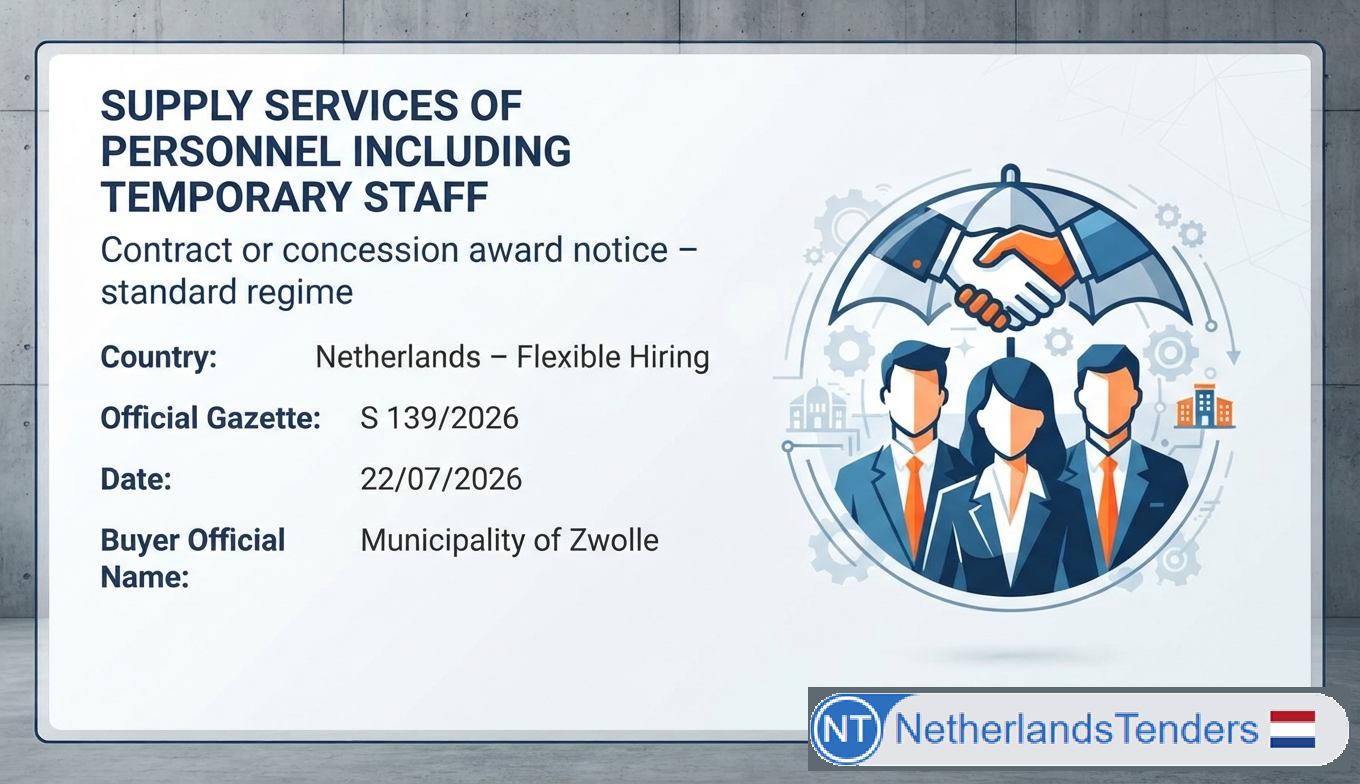
Netherlands Awards €29.89 Million Temporary Staffing Contract to Support Municipal Workforce Requirements
22 Jul 2026
Standfirst: The Municipality of Zwolle has awarded a €29.89 million public services contract to Driessen B.V. for the provision of temporary personnel. The contract will support the municipality's flexible staffing requirements for positions up to salary scale 8, enabling it to respond efficiently to fluctuating workforce demands while maintaining continuity in public service delivery. Introduction Public authorities increasingly rely on flexible workforce solutions to address changing operational demands, staff shortages, seasonal workloads and temporary replacement requirements. Rather than maintaining permanent staffing capacity for every operational scenario, municipalities often procure specialised staffing providers capable of supplying qualified personnel whenever additional resources are required. Reflecting this approach, Gemeente Zwolle (Municipality of Zwolle) has completed a competitive procurement for the provision of temporary staffing services. Published as TED Contract Award Notice 507818-2026, the procurement covers the supply of temporary personnel for positions up to salary scale 8 through an open procurement procedure conducted under the European Union's public procurement framework. The contract has been awarded to Driessen B.V., one of the Netherlands' established workforce solutions providers. With a total contract value of €29.89 million, the agreement is expected to support the municipality's workforce planning by providing access to qualified temporary employees across a range of administrative, office and operational functions. Why This Contract Matters Temporary staffing has become an important component of workforce management within the public sector. Municipal authorities must continue delivering essential public services despite changing workloads, employee absences, project based requirements and recruitment challenges. By awarding a dedicated staffing contract, Gemeente Zwolle gains access to a structured recruitment solution capable of supplying temporary personnel as operational requirements arise. This reduces recruitment lead times while helping departments maintain service continuity during periods of increased demand. The procurement specifically focuses on temporary personnel supplied through employment agency services for positions up to salary scale 8. According to the procurement notice, detailed operational requirements are contained within the tender documentation, while the awarded contract establishes the commercial relationship governing future staffing services. Contract Timeline Milestone Details Country Netherlands Contracting Authority Gemeente Zwolle Procurement Title Flexibele inhuur Procedure Open Procedure Contract Type Services Main CPV 79620000 – Supply services of personnel including temporary staff Winner Selected 10 July 2026 Contract Signed 21 July 2026 Publication Date 22 July 2026 Contract Period 1 January 2027 – 31 December 2028 Contract Overview The procurement concerns the provision of temporary staffing services for Gemeente Zwolle through professional employment agency services. The contract covers the supply of temporary personnel for positions up to salary scale 8, enabling municipal departments to recruit qualified workers when permanent staffing capacity requires reinforcement. The procurement was conducted using the Open Procedure under Directive 2014/24/EU, allowing qualified staffing providers to compete for the contract. Unlike framework agreements commonly used for recurring procurement requirements, this procurement results in a direct service contract awarded to a single supplier. The total value of the awarded contract amounts to €29,890,000. The agreement will commence on 1 January 2027 and continue until 31 December 2028, with the possibility of two one year extensions as described in the procurement documentation. Key Contract Details Category Information Buyer Gemeente Zwolle Country Netherlands Contract Type Services Procurement Title Flexibele inhuur Main CPV 79620000 – Supply services of personnel including temporary staff Additional CPV 79621000 (Office personnel), 79623000 (Commercial or industrial workers) Procedure Open Procedure Contract Value EUR 29,890,000 Contract Duration 1 January 2027 – 31 December 2028 Extension Options Two extensions of one year each Framework Agreement No Dynamic Purchasing System No Legal Basis Directive 2014/24/EU Project Scope The awarded contract enables Gemeente Zwolle to procure temporary staffing services for municipal operations requiring flexible workforce capacity. The procurement covers personnel supplied through employment agency services for positions up to salary scale 8. According to the procurement notice, the contract includes staffing services supporting office personnel as well as commercial or industrial workers under the relevant CPV classifications. Detailed operational requirements, staffing profiles and service specifications are contained within the procurement documents referenced in the notice. The contract will run for an initial two year period beginning on 1 January 2027, with the municipality retaining the option to extend the agreement twice for one additional year each. About the Contracting Authority Gemeente Zwolle serves as the contracting authority responsible for this procurement. As a regional authority in the Netherlands, the municipality delivers a broad range of public services including local administration, urban development, public infrastructure, social services and community programmes. To maintain continuity across these services, the municipality periodically procures specialist external providers capable of supporting operational requirements, including workforce solutions where temporary personnel are required to supplement internal staffing capacity. About the Organisations Involved Gemeente Zwolle acted as the contracting authority, procurement administrator and organisation responsible for signing the contract. The municipality also provides additional procurement information and review related information associated with this tender. Driessen B.V. has been selected as the successful contractor following the competitive procurement process. The company will provide temporary staffing services under the contract valued at €29.89 million. According to the contract award notice, Driessen B.V. was selected on 10 July 2026, with the contract formally concluded on 21 July 2026. The procurement attracted five electronic tenders, demonstrating competitive participation from the staffing services market before the Municipality selected Driessen B.V. as the winning supplier. Procurement Analysis The Municipality of Zwolle conducted this procurement using the Open Procedure under Directive 2014/24/EU, enabling interested staffing providers to compete openly for the contract. The procurement sought a single supplier capable of delivering temporary staffing services for positions up to salary scale 8 while ensuring service quality and competitive pricing. Unlike many recurring personnel procurement arrangements that rely on framework agreements, this procurement resulted in a direct service contract. The notice confirms that neither a framework agreement nor a Dynamic Purchasing System (DPS) forms part of this procurement, meaning Driessen B.V. will provide the services under the awarded contract for its duration. The evaluation was based on the Most Economically Advantageous Tender (MEAT), combining quality and price considerations. Quality accounted for 75 points while price represented 25 points. According to the procurement notice, the quality assessment included three sub criteria covering the quality of temporary workers and good employment practices, service quality and implementation methodology. The contract will commence on 1 January 2027 and continue until 31 December 2028, with the possibility of two one year extensions. The procurement attracted five electronic tenders, indicating competitive participation from the temporary staffing market before the Municipality selected Driessen B.V. as the successful supplier. The procurement is covered by the WTO Government Procurement Agreement (GPA), is not financed by European Union funds and does not include strategic procurement objectives. Additional Procurement Facts Item Details Contracting Authority Gemeente Zwolle Country Netherlands Procedure Open Procedure Contract Type Services Main CPV 79620000 – Supply services of personnel including temporary staff Additional CPV 79621000 and 79623000 Contract Value EUR 29,890,000 Contract Period 1 January 2027 – 31 December 2028 Maximum Extensions Two one year extensions Framework Agreement No Dynamic Purchasing System No Award Criteria Quality (75%) and Price (25%) Number of Tenders Received 5 Government Procurement Agreement Yes EU Funding No Market and Industry Perspective Demand for flexible workforce solutions continues to grow throughout Europe's public sector as government organisations respond to workforce shortages, changing service demands and project based staffing requirements. Temporary staffing contracts provide municipalities with rapid access to qualified personnel without permanently expanding their workforce. Employment service providers increasingly play an important role in supporting public administration by supplying administrative personnel, operational staff and other professionals required for day to day municipal operations. Competitive procurement procedures ensure that contracting authorities can balance workforce quality with cost efficiency while maintaining transparency. The Zwolle procurement reflects a broader trend among European municipalities to outsource temporary recruitment to specialised staffing companies capable of delivering qualified personnel together with recruitment, onboarding and workforce management services. Economic Significance The contract value of approximately €29.89 million represents a significant investment in workforce continuity rather than physical infrastructure. Reliable access to temporary personnel enables municipalities to maintain uninterrupted delivery of essential public services during periods of staff absence, seasonal demand and organisational change. For Driessen B.V., the award provides a long term opportunity to support one of the Netherlands' municipal authorities through the supply of temporary workers over the contract period. The agreement also demonstrates continued investment by public authorities in professional workforce management services. Future Procurement Opportunities The contract highlights continuing opportunities within the European public sector for workforce solution providers. Future tenders may include: Temporary administrative personnel Office support services Industrial and operational workers Municipal project staffing Human resource support services Recruitment and placement services Payroll and workforce administration Public sector staffing programmes Specialist temporary professionals Managed workforce solutions Opportunities for Suppliers The procurement demonstrates opportunities for companies specialising in workforce management and recruitment. Temporary staffing agencies Recruitment consultancies Human resource service providers Managed service providers Payroll service companies Public sector recruitment specialists Administrative staffing providers Industrial workforce suppliers Talent acquisition specialists Employment service organisations What Businesses Should Watch Public authorities across Europe continue investing in flexible workforce arrangements to improve operational resilience. Staffing providers should monitor municipal procurement opportunities that emphasise both service quality and workforce management capability rather than price alone. Suppliers capable of demonstrating strong recruitment processes, employee support and effective implementation strategies are likely to remain competitive in future public staffing procurements. NetherlandsTenders.com Procurement Intelligence From a procurement intelligence perspective, this contract illustrates several developments within European public sector workforce procurement. Municipal authorities continue outsourcing temporary staffing requirements. Quality has become a more influential evaluation factor than price. Long term staffing contracts support workforce continuity. Professional employment agencies remain key partners for local government. Competitive procurement continues driving transparency in workforce services. Public sector demand for flexible staffing solutions remains strong. Supplier Takeaways Invest in workforce quality and employee support programmes. Strengthen implementation and onboarding capabilities. Develop experience serving municipal authorities. Maintain compliance with European procurement regulations. Offer scalable staffing solutions for changing workforce demands. Monitor future Dutch municipal staffing procurements. Key Takeaways Gemeente Zwolle awarded a €29.89 million temporary staffing contract. Driessen B.V. was selected as the successful supplier. The contract covers temporary personnel up to salary scale 8. The procurement used an Open Procedure under Directive 2014/24/EU. Quality carried a 75% weighting compared with 25% for price. The contract runs from January 2027 through December 2028 with extension options. Conclusion The Municipality of Zwolle's procurement demonstrates the growing importance of professional workforce management within public administration. By awarding a long term staffing contract to Driessen B.V., the municipality has secured a structured solution for meeting temporary workforce requirements while maintaining continuity in public service delivery. The procurement also reflects broader trends across Europe, where municipalities increasingly evaluate staffing providers on service quality, implementation capability and employment practices alongside commercial competitiveness. As workforce flexibility continues to play a critical role in public sector operations, similar procurements are expected to remain an important part of municipal procurement strategies. Source: TED Contract Award Notice: 507818-2026; Official Journal of the European Union (OJ S 139/2026); Publication Date: 22 July 2026
View Details