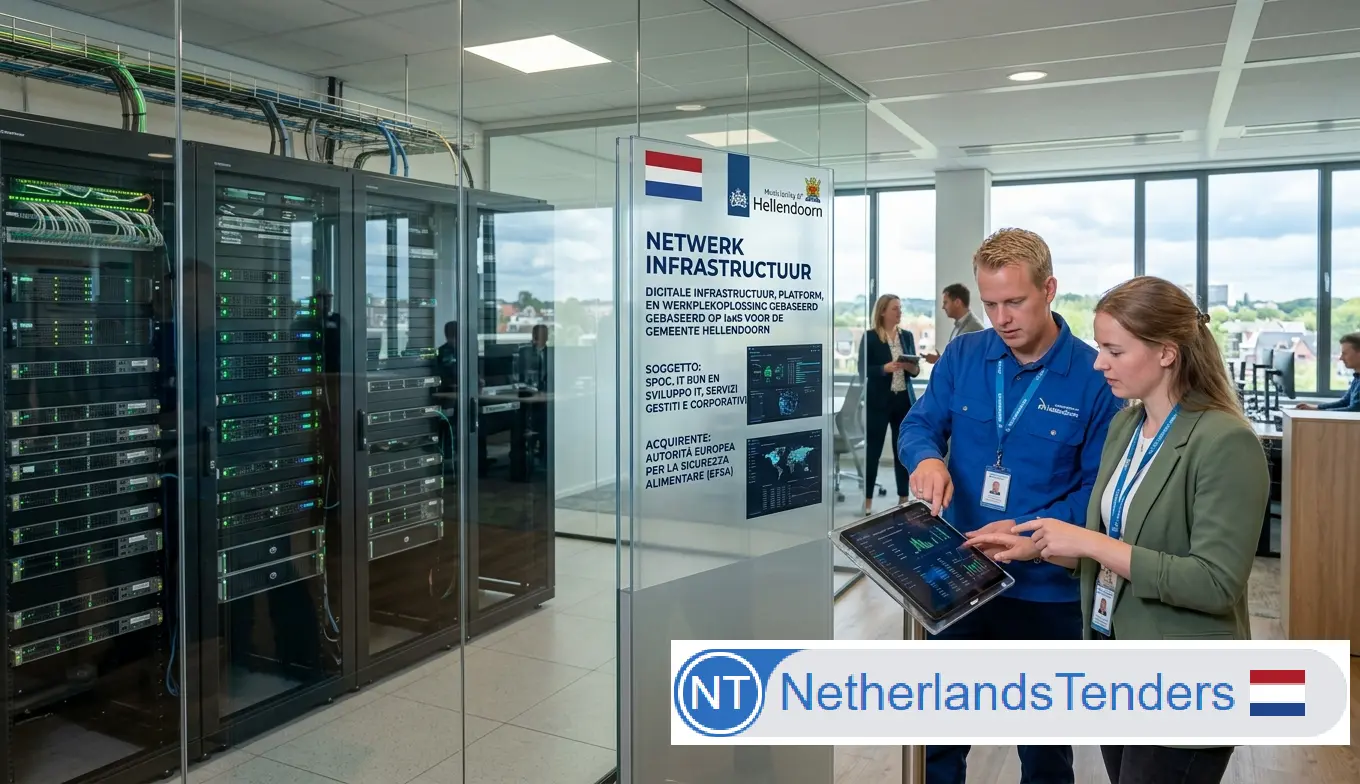
Hellendoorn Locks In a Single Supplier for Its Cloud Migration, Citing Fiber Network Lock-In
24 Aug 2026
Standfirst The Dutch municipality of Hellendoorn has awarded a digital infrastructure and IaaS platform contract directly to Visolity BV, without a competitive tender, citing technical lock-in to its regional fibre network as the reason no genuine alternative supplier exists. The awarded tender value of 4.4 million euros is nearly three times the original 1.5 million euro estimate. Introduction Migrating a municipality's entire digital infrastructure, servers, applications and workplace environment, to a modern cloud based platform is a major undertaking on its own. When that migration also has to preserve an existing regional fibre network connection that underpins performance, redundancy and continuity, the list of suppliers capable of doing the job can narrow sharply. Hellendoorn has just gone through exactly this process, concluding that only one supplier could deliver the migration without unacceptable risk to its existing network infrastructure. Why This Contract Matters Hellendoorn is connected to the Regional Data Network Municipalities, the regional fibre ring operated by IT Platform Twente, which provides existing optical connections, redundancy and performance guarantees across the region. The municipality determined that any new cloud infrastructure had to connect directly, redundantly and operationally to this same regional network to preserve continuity of municipal services. This case is a clear, well documented example of how existing regional digital infrastructure commitments can genuinely narrow supplier choice in subsequent public IT procurements, a dynamic worth understanding for anyone assessing similar direct award justifications elsewhere. Contract Timeline The winner was selected on 14 August 2026 and the contract was concluded on 18 August 2026. The notice recording this award was dispatched on 21 August 2026 and published in the Official Journal of the European Union on 24 August 2026, under OJ S issue 162/2026. The contract runs for an initial two years, with up to six possible renewal periods. Contract Overview Gemeente Hellendoorn ran this as a negotiated procedure without prior call for competition, under Directive 2014/24/EU and article 2.32(1)(b)(2) of the Dutch Aanbestedingswet 2012, both provisions permitting a direct award where competition is absent for genuine technical reasons. The classification is CPV code 32424000, Network infrastructure, with an additional classification of 48000000, Software package and information systems. The estimated value at both procedure and lot level was 1,500,000.00 EUR excluding VAT and this same figure is recorded as the notice's confirmed value of all contracts awarded. However, the individually itemised winning tender value is recorded separately at 4,400,000.00 EUR, nearly three times higher than both the estimate and the notice's own aggregate results figure. This is a significant discrepancy worth flagging directly: the true scale of this contract, based on the itemised tender record, appears substantially larger than the headline estimated and aggregate figures suggest. Key Contract Details Contracting AuthorityGemeente Hellendoorn Winning BidderVisolity BV SubcontractorPrevider BV Contract TitleDigital infrastructure, platform and workplace solution based on IaaS for Gemeente Hellendoorn Procedure TypeNegotiated without prior call for competition Legal BasisDirective 2014/24/EU, article 32(2)(b); Dutch Aanbestedingswet 2012, article 2.32(1)(b)(2) JustificationAbsence of competition for technical reasons CPV Code32424000 Network infrastructure Estimated Value (excl VAT)1,500,000.00 EUR Itemised Awarded Tender Value (excl VAT)4,400,000.00 EUR (flagged discrepancy against estimate) Award CriteriaQuality 80 percent, Price 20 percent Initial Contract Term2 years Maximum Renewals6, limited to what is necessary for continuity, transition, depreciation and a realistic exit or market approach EU FundingNot financed with EU funds Covered by GPAYes Winner Selected14 August 2026 Contract Concluded18 August 2026 Review OrganisationRechtbank Overijssel Project Scope The contract covers the supply, configuration, implementation, transition, management, maintenance, support and further development of an integrated digital infrastructure, platform, connectivity, continuity and workplace solution based on Infrastructure as a Service. The scope includes migrating the municipality's existing datacenter infrastructure, servers, virtual environments and applications to a future proof IaaS environment, building a modern digital workplace environment and providing the required platform services, backup, recovery, failover and disaster recovery provisions, security, monitoring, service management and support. Central to the scope is the requirement that the new IaaS environment connect directly, redundantly and operationally to the RDNG infrastructure, the regional fibre network Hellendoorn already relies on, in order to preserve existing network performance, redundancy and transition feasibility. About the Contracting Authority Gemeente Hellendoorn Gemeente Hellendoorn is a regional authority with general public services as its classified activity, located in the Overijssel province of the Netherlands. It is connected to the Regional Data Network Municipalities, a shared regional fibre network operated by IT Platform Twente, a connection that shaped the technical requirements behind this specific procurement decision. About the Organisations Involved Visolity BV Visolity BV, based in Emmen and classified as a medium sized enterprise, was awarded this contract directly. According to the municipality's own disclosed justification, Visolity BV was identified, following market exploration and technical analysis, as the only supplier capable of delivering this contract within the necessary technical constraints and timeframes, specifically through its use of Previder BV's RDNG connected infrastructure. Previder BV Previder BV, based in Hengelo and classified as a medium sized enterprise, is named as subcontractor on this contract. Previder operates datacenter infrastructure with direct, redundant connectivity to the RDNG regional fibre network, the specific technical capability the municipality determined was essential and not reasonably substitutable by any alternative solution. Rechtbank Overijssel Rechtbank Overijssel, based in Almelo, is named as the review organisation, the organisation providing further information on review procedures and the mediation organisation for this procurement, the standard Dutch court structure for handling public procurement disputes in this region. Procurement Analysis This procurement's central feature is its unusually detailed, explicit justification for bypassing competitive tendering entirely. The municipality states that alternative solutions, including generic internet connections, VPN constructions, new fibre routes, public cloud platforms, or other datacenter solutions not directly connected to RDNG, offer no reasonable alternative or substitute, because they cannot be delivered in time, with equivalent redundancy, while preserving existing optical capacity and without unacceptable continuity, performance, security and transition risk. The municipality further states its view that the absence of competition is not the result of an artificial narrowing of the contract's conditions, but flows from objective technical constraints necessary for continuity, performance, security, redundancy and timely transition of its digital infrastructure. This level of explicit self-justification reflects the legal burden EU and Dutch procurement law place on contracting authorities using this specific negotiated route. Award criteria weighted quality heavily, at 80 percent, against price at 20 percent, though with only one credible bidder under the negotiated procedure, this weighting functioned more as a framework for negotiating contract terms than as a competitive scoring mechanism. The substantial gap between the 1.5 million euro estimate and the 4.4 million euro itemised tender value is a further point worth flagging clearly. Such a gap, without stated explanation in the notice, suggests either a significant scope expansion during negotiation, inclusion of previously unestimated cost elements such as the extensive renewal options, or a data reporting inconsistency; the notice does not clarify which applies. Additional Procurement Facts The contract is not financed with EU funds and is covered by the Government Procurement Agreement. No framework agreement or dynamic purchasing system applies. The renewal structure, up to six extension periods, is explicitly limited to what is necessary for continuity, transition, depreciation and a realistic future exit or market approach, suggesting the municipality is deliberately building in flexibility to eventually return to a competitive market rather than treating this as a permanent single source relationship. Market and Industry Perspective This case illustrates a genuine and increasingly relevant dynamic in Dutch municipal IT procurement: prior investment in shared regional digital infrastructure, like the RDNG fibre network here, can create durable technical dependencies that meaningfully constrain supplier choice in subsequent, seemingly unrelated procurements such as cloud migration projects. Economic Significance Based on the itemised tender value, this appears to be a substantial, multi million euro commitment for a municipality of Hellendoorn's size, reflecting both the scale of a full datacenter to cloud migration and the extended potential contract term if renewal options are exercised. Future Procurement Opportunities The municipality's own description of its renewal structure as supporting "a realistic exit or market approach" signals an intention to eventually return this contract to open competition once transition and depreciation considerations allow, rather than treating Visolity's position as permanent. Opportunities for Suppliers IT infrastructure and cloud services providers interested in future Dutch municipal contracts tied to shared regional fibre networks like RDNG should recognise that building direct, redundant connectivity to such networks, as Previder has done, can become a decisive competitive advantage, potentially the deciding factor in whether a supplier can even be considered for future similar contracts. What Businesses Should Watch Cloud infrastructure and datacenter providers should watch for how Hellendoorn approaches this contract's eventual renewal or exit and should monitor whether other municipalities connected to shared regional fibre networks in the Netherlands face similar technical lock-in situations in their own cloud migration procurements. NetherlandsTenders.com Procurement Intelligence This award is an unusually well documented example of how existing regional digital infrastructure commitments can create genuine, defensible grounds for bypassing competitive tendering, provided the contracting authority can substantiate, as Hellendoorn has done in detail, that no reasonable technical alternative exists. Its strategic importance lies in what it reveals about infrastructure dependency in public sector cloud procurement. Municipalities that have invested in shared regional network infrastructure, like the RDNG fibre ring here, may find their choice of cloud and IT infrastructure suppliers significantly narrowed by that same infrastructure in later procurements, a dynamic that favours whichever supplier already has direct network connectivity in place. Suppliers can draw a clear lesson from this case: building direct connectivity to shared regional digital infrastructure networks, as Previder has done with RDNG, can position a firm as an effectively uncontested candidate for future related public sector contracts in that region, a strategic advantage worth prioritising well ahead of any specific tender opportunity. The unexplained gap between this notice's estimated value and its itemised tender value is also a reminder that even direct award notices with unusually thorough narrative justification can carry unresolved figures and readers should note such discrepancies rather than assume the headline estimate reflects the contract's true scale. Supplier Takeaways This contract was awarded directly, without competition, based on a detailed technical justification tied to regional fibre network lock-in The itemised awarded tender value of 4.4 million euros is nearly three times the original 1.5 million euro estimate, an unexplained discrepancy Direct, redundant connectivity to shared regional digital infrastructure networks can be a decisive factor in winning or even being considered for similar future contracts The contract's renewal structure is explicitly designed to support an eventual return to competitive procurement rather than permanent single sourcing Award criteria weighted quality at 80 percent and price at 20 percent, though functioned mainly as a negotiation framework given the absence of competing bidders Key Takeaways Gemeente Hellendoorn has awarded a digital infrastructure and IaaS platform contract directly to Visolity BV, with Previder BV as subcontractor The award used a negotiated procedure without competition, justified by genuine technical lock-in to the regional RDNG fibre network The itemised tender value of 4,400,000.00 EUR is substantially higher than the original 1,500,000.00 EUR estimate The contract runs for an initial two years with up to six possible renewal periods The contract is covered by the Government Procurement Agreement but not financed with EU funds Conclusion This award shows how deeply embedded regional digital infrastructure can shape and narrow, a municipality's options when it comes time to modernise its IT systems. For Hellendoorn, it secures a migration path that preserves its existing network performance and redundancy commitments. For Visolity and Previder, it is a significant, technically justified single source engagement, with the municipality itself signalling an intention to eventually return to open competition once the transition is complete. Source: Tenders Electronic Daily (TED), Contract Award Notice 581320-2026, Official Journal of the European Union, OJ S issue 162/2026, published on 24/08/2026.
View Details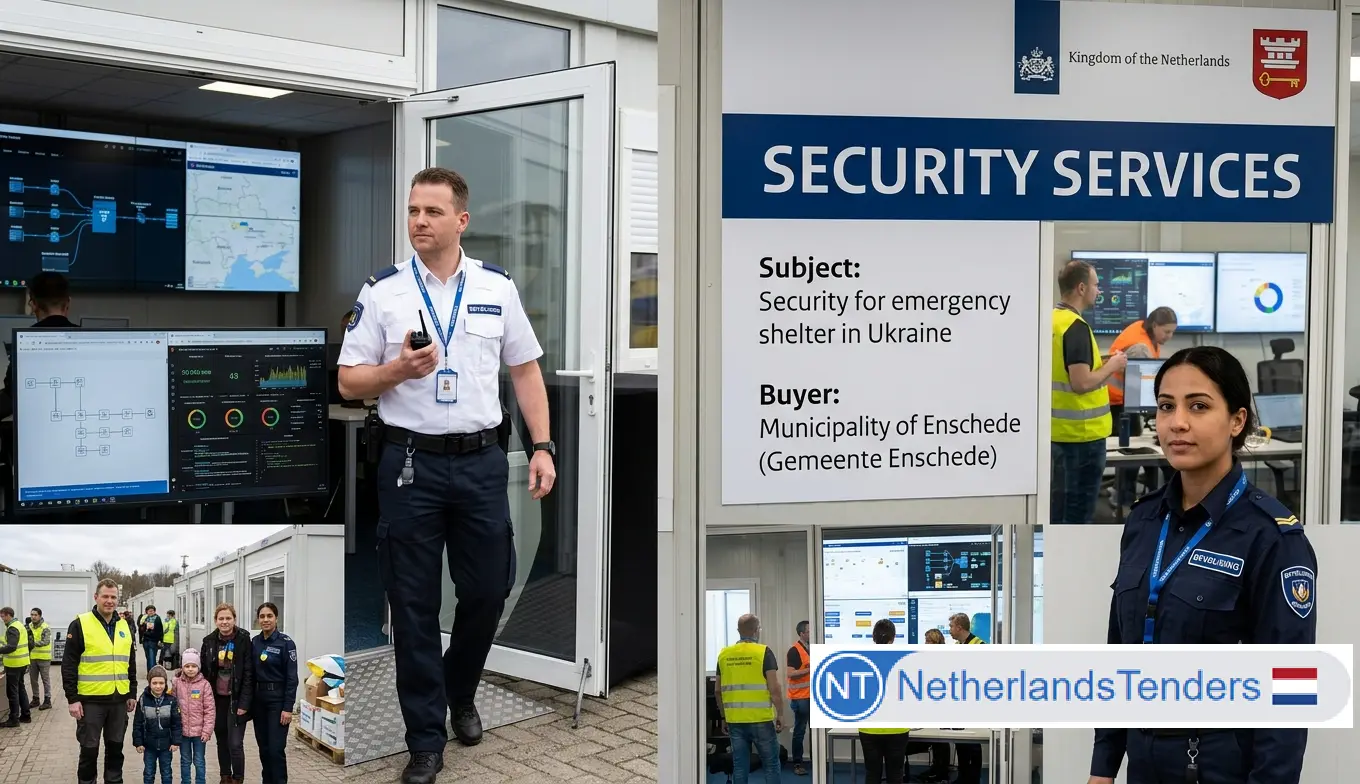
Twente Municipalities Secure Security Guards for Ukrainian Shelter Sites Through 2027, With a Local Firm Winning Both Contracts
21 Aug 2026
Standfirst The municipalities of Enschede and Losser have jointly awarded physical security contracts for their Ukrainian refugee shelter locations to Bravo Beveiliging B.V., a security firm based in nearby Hengelo, worth a combined estimated EUR 11 015 000 and capped at EUR 15 000 000. The contracts, tied directly to the EU's Temporary Protection Directive, can run through mid-2030 if fully extended. Introduction Behind every reception centre housing people who fled the war in Ukraine sits a quieter layer of logistics: security staff who keep the site safe and orderly around the clock. Two municipalities in the Dutch region of Twente, Enschede and Losser, have just secured who will provide that presence for their shelter locations going forward. Bravo Beveiliging B.V., a locally based security company, won both contracts, beating out several competitors across a combined ten bids. The award sits squarely inside the Netherlands' ongoing legal and policy response to displacement from Ukraine, a response the tender documents describe as still evolving and genuinely uncertain in its duration. Why This Contract Matters Enschede and Losser explain their legal obligation plainly in the tender: both municipalities are responsible under the EU's Temporary Protection Directive for housing Ukrainians within their areas and physical, manned security has already been deployed at the various shelter locations involved. The directive itself was extended in June 2025 through 4 March 2027 and the Dutch government is separately preparing both a voluntary return programme for those who wish to go back and a longer term plan covering residency and return after the directive eventually lapses. That context shapes the contract's own structure. Rather than committing to a long, fixed term, both municipalities built in short initial periods with multiple short renewal options, giving them flexibility to scale security provision up or down as the shelter population and the underlying legal framework governing it, continues to change. Contract Timeline Lot 1, Enschede, start date: 1 August 2026 Contracts concluded, both lots: 29 July 2026 Lot 2, Losser, start date: 1 December 2026 Notice dispatched to the Publications Office: 20 August 2026 Published in the Official Journal, OJ S 161/2026: 21 August 2026 Both lots' initial terms end: 31 July 2027, with up to three further 1-year renewal options each Contract Overview Enschede and Losser ran a joint open procedure under Directive 2014/24/EU for physical manned security services at Ukrainian shelter locations, split into two lots by municipality. Lot 1, covering Enschede, drew four tenders; Lot 2, covering Losser, drew six. Bravo Beveiliging B.V. was awarded both, with contracts concluded on the same day, structured as framework agreements without reopening of competition, meaning Bravo holds each contract exclusively rather than sharing the work with other suppliers. Lot 1 carries an estimated value of EUR 8 047 600 and a maximum framework ceiling of EUR 11 000 000; Lot 2 carries an estimated value of EUR 2 967 400 and a maximum of EUR 4 000 000. Both sets of figures are fully consistent between the procedure level totals and each lot's individual result, with no discrepancy in the notice. Key Contract Details Contracting authoritiesGemeente Enschede (lead) and Gemeente Losser Contract titleBeveiliging voor noodopvang Oekraïne (Security for emergency shelter Ukraine) CPV code79710000, Security services Procedure typeOpen procedure Legal basisDirective 2014/24/EU Combined estimated valueEUR 11 015 000, excluding VAT Combined maximum framework valueEUR 15 000 000, excluding VAT Lot 1 (Enschede) term1 August 2026 to 31 July 2027, initial 1 year, plus up to three 1-year renewals Lot 2 (Losser) term1 December 2026 to 31 July 2027, initial 8 months, plus up to three 1-year renewals Award criteria (both lots)Safe and liveable shelter environment 35 points; emergencies and urgency response 20 points; check-in/check-out and presence registration 15 points Tenders received4 for Lot 1, 6 for Lot 2 Winner, both lotsBravo Beveiliging B.V. Winner size classificationMicro, small or medium enterprise Contracts signed29 July 2026, both lots GPA coverageNo, either lot EU fundingNo, either lot Framework structureFramework agreement without reopening of competition, both lots SubcontractingNo, either lot Review bodyRechtbank Overijssel, locatie Almelo, 20 day review deadline Notice reference580423 2026, OJ S 161/2026, published 21 August 2026 Project Scope Both contracts cover physical, manned security at reception locations housing Ukrainian refugees, one set of sites in Enschede and a separate set in Losser. The award criteria give a clear sense of what the municipalities prioritised: the largest single criterion, worth 35 of a possible points total, specifically concerns maintaining a safe and liveable shelter environment for displaced Ukrainians, going beyond conventional site security to focus on the wellbeing of the people living there. A further 20 points reward capability in handling emergencies and urgent situations and 15 points reward reliable check-in, check-out and presence registration systems, essential for a shelter operator to know who is on site at any given time. About the Contracting Authorities Gemeente Enschede is a regional authority in the Twente region of the eastern Netherlands, acting as the lead buyer in this joint procurement alongside Gemeente Losser, a neighbouring municipality. Both are responsible under the EU's Temporary Protection Directive for housing Ukrainian nationals displaced by the war within their jurisdictions. About the Organisations Involved Gemeente Enschede As covered above, Enschede is the lead buyer for this joint procurement, running the tender on behalf of both participating municipalities and providing further information on review procedures. Rechtbank Overijssel, locatie Almelo The Almelo location of the District Court of Overijssel is named as the review organisation for both lots, with a 20-day objection period specified in the notice. Bravo Beveiliging B.V. Bravo Beveiliging B.V., based in Hengelo, in the same Twente region as both contracting municipalities, is classified as a micro, small or medium enterprise and won both lots. Its regional base places it close to the shelter locations it will now be securing across Enschede and Losser. Procurement Analysis Both lots ran as open procedures with award criteria weighted almost entirely toward quality of service rather than a straightforward lowest-price contest, with the disclosed criteria totalling 70 points focused specifically on shelter environment safety, emergency response and presence tracking. That weighting reflects the sensitive, human-centred nature of the service: this is not conventional commercial site security, but security embedded within a humanitarian shelter context where resident wellbeing is an explicit evaluation factor. The renewal structure, a short initial term followed by up to three separate one-year extension options on each lot, gives both municipalities the flexibility to wind the arrangement down relatively quickly should the underlying need diminish, consistent with the genuine uncertainty the tender documents themselves describe around how long the war and the associated need for shelter, will continue. Both lots drew a reasonable competitive field, four bidders for Enschede and six for Losser and Bravo Beveiliging's win across both suggests either particularly strong proposals or an especially good fit with the specific, quality focused criteria both municipalities applied. Additional Procurement Facts Neither lot is covered by the Government Procurement Agreement and neither is financed with EU funds. No subcontracting is involved in either winning tender. Lot 2's shorter initial term, eight months compared with Lot 1's full year, reflects its later December 2026 start date, with both lots converging on the same 31 July 2027 initial end date. Market and Industry Perspective Security provision for asylum and refugee shelter locations has become a recurring, specialised category of Dutch municipal procurement since Russia's invasion of Ukraine triggered mass displacement across Europe. Contracts of this kind demand a different skill set from conventional commercial security work, requiring staff trained to operate sensitively within a shelter environment housing people who have experienced significant upheaval, a distinction the award criteria in this tender make explicit. Economic Significance At a combined estimated EUR 11 015 000, rising to a possible EUR 15 000 000 if all renewal options across both lots are exercised, this is a meaningful, multi-year revenue base for Bravo Beveiliging and a significant operational cost for both municipalities tied directly to their legal obligations under EU displacement policy. Future Procurement Opportunities Because both lots' renewal structures are tied to short, staged extensions rather than long fixed terms, the practical future of this contract depends heavily on how the Netherlands' broader Ukrainian shelter and return policy develops through and beyond March 2027, when the current EU Temporary Protection Directive extension is set to expire. Opportunities for Suppliers Security companies serving Dutch municipalities with asylum and refugee shelter obligations should note the quality focused, resident wellbeing centred evaluation approach both Enschede and Losser applied here. Firms able to demonstrate genuine capability in emergency response and presence management, alongside a track record suited to humanitarian shelter contexts, are well positioned for comparable municipal tenders elsewhere in the Netherlands. What Businesses Should Watch How Dutch national policy on Ukrainian refugee return and residency develops ahead of the EU Temporary Protection Directive's current March 2027 expiry. Whether Enschede and Losser exercise their renewal options as each lot's initial term concludes in July 2027. Broader municipal security tenders tied to Ukrainian and other refugee shelter provision across the Netherlands. NetherlandsTenders.com Procurement Intelligence This contract is a clear example of how a single piece of EU policy, the Temporary Protection Directive, continues to generate real, recurring procurement activity at the municipal level years after Russia's invasion of Ukraine began. The deliberately short, staged contract structure here reflects genuine institutional uncertainty about how long that need will persist, a planning challenge municipal buyers across the EU continue to navigate as the underlying humanitarian situation evolves. For security providers, the quality weighted evaluation criteria offer a useful template: contracts tied to humanitarian shelter contexts increasingly reward demonstrated sensitivity to resident wellbeing, not just conventional guarding competence and firms bidding into this space should tailor their proposals accordingly rather than treating it as standard commercial site security. More broadly, this notice is worth reading alongside the wider set of Dutch and European municipal contracts tied to Ukrainian displacement as a single, evolving procurement category, one where contract structures, terms and evaluation criteria will likely keep shifting in step with the underlying policy and security situation in Ukraine itself. Supplier Takeaways Both lots weighted quality criteria heavily, with the largest single factor specifically concerning shelter environment safety and liveability for displaced residents. Bravo Beveiliging won both contracts against a combined field of ten competing bids across the two lots. Contract terms are deliberately short and staged, reflecting genuine uncertainty about how long the underlying shelter need will persist. This category of security work demands specific sensitivity to humanitarian shelter contexts, distinct from conventional commercial site security. Future opportunities in this space will likely track closely with evolving Dutch and EU policy on Ukrainian displacement and return. Key Takeaways Enschede and Losser jointly awarded physical security contracts for Ukrainian shelter locations, worth a combined estimated EUR 11 015 000 and capped at EUR 15 000 000, to Bravo Beveiliging B.V. Bravo Beveiliging won both lots, beating four competitors for Enschede and five for Losser. Award criteria weighted quality heavily, prioritising a safe and liveable shelter environment, emergency response capability and presence registration. Both contracts carry short initial terms with up to three 1-year renewal options each, reflecting uncertainty about how long the underlying need will last. The contracts are tied directly to the EU's Temporary Protection Directive, currently extended through 4 March 2027. Neither contract is financed with EU funds or covered by the Government Procurement Agreement. Conclusion This is a modest sized municipal contract with an outsized human context: it exists because two Dutch towns are still, years into the war, responsible for keeping Ukrainian families safe in shelter. Bravo Beveiliging now carries that responsibility for both Enschede and Losser, under a contract structure that, like the policy framework it serves, is built to adapt as the underlying need continues to evolve. Source: Tenders Electronic Daily (TED), Contract Award Notice 580423-2026, Official Journal of the European Union, OJ S 161/2026, published on 21 August 2026.
View Details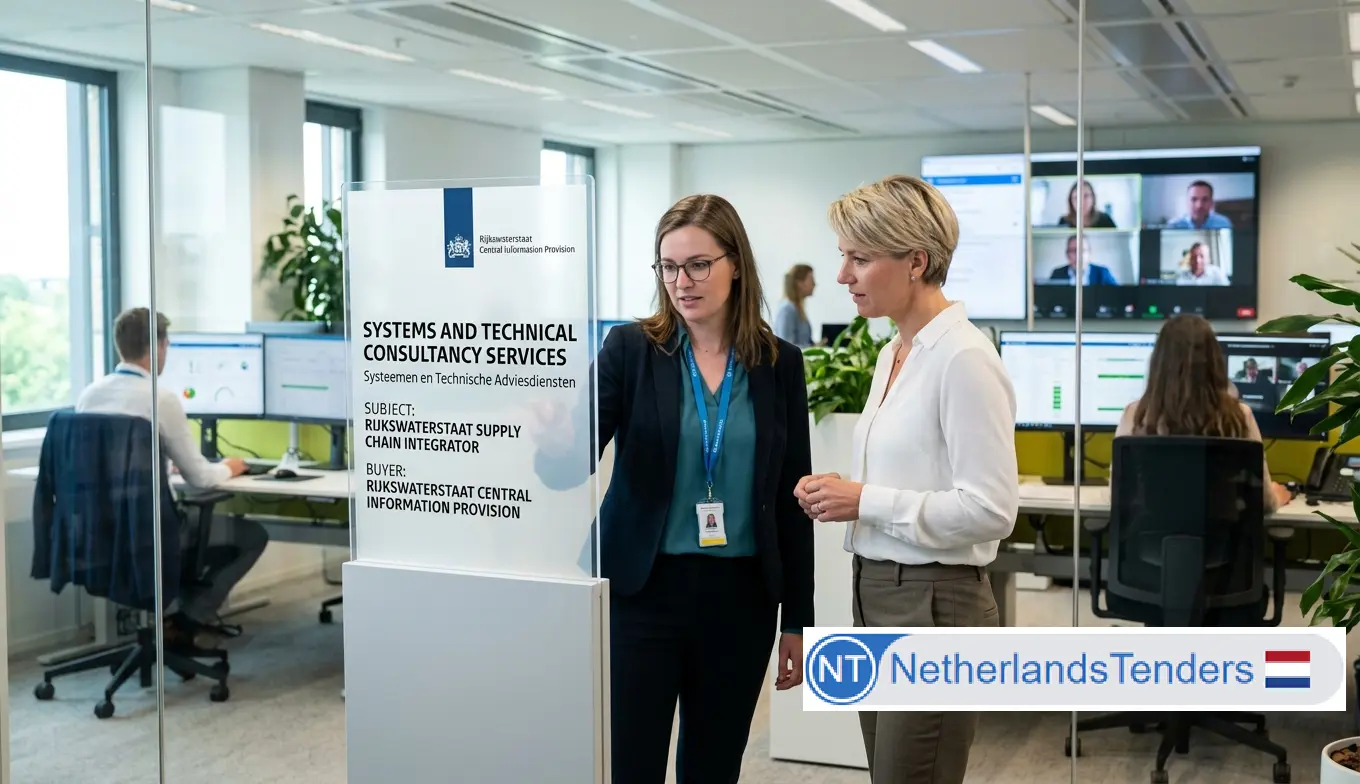
Rijkswaterstaat Hands Its EUR 15 Million Bridge and Lock Control Systems Contract to a Single Bidder
20 Aug 2026
Standfirst Rijkswaterstaat has awarded a EUR 15 000 000 contract to integrate the technical systems behind its "Bedienketen," the operating chain used to remotely control bridges, locks and other movable infrastructure across the Netherlands, to SWARCO Nederland B.V. The seven-year contract, extendable further, drew exactly one bid in an open tender. Introduction Every time a Dutch bridge lifts to let a ship pass or a lock gate opens on command, a chain of technical systems is working behind the scenes to make that remote operation possible. Rijkswaterstaat, the agency responsible for the Netherlands' major roads, waterways and water systems, calls this its Bedienketen, literally its operating chain and it has just secured a long term partner to integrate and maintain the technology that keeps it running. SWARCO Nederland B.V., the Dutch arm of the Austrian founded global traffic technology group, won the contract as the sole bidder in an open tender, a modest field for a contract of this scale and technical specificity. Why This Contract Matters Rijkswaterstaat operates a large number of movable bridges, locks and other structures across the Dutch waterway and road network, many of which have shifted from local, on-site operation to remote or centralised control over recent years. The technical systems enabling that shift, sensors, control software, communication links and integration between different structures and control centres, are what this contract calls the Bedienketen. Keeping that chain reliable and well integrated is directly tied to how smoothly Dutch waterways and roads function day to day. A seven year systems integration contract, with renewal options extending it further, gives Rijkswaterstaat continuity in a technically complex area where switching integrators mid-stream would carry real operational risk. Contract Timeline Procedure type: Open procedure under Directive 2014/24/EU Winner selected: 23 June 2026 Contract concluded: 18 August 2026 Notice dispatched to the Publications Office: 18 August 2026 Published in the Official Journal, OJ S 160/2026: 20 August 2026 Contract duration: 84 months, with up to 2 renewal options Contract Overview Rijkswaterstaat Centrale Informatievoorziening ran an open procedure for a systems and technical consultancy contract described as Integrator Bedienketen Rijkswaterstaat, with most technical detail deferred to a separate descriptive document not included in the published notice. Only one tender was submitted and SWARCO Nederland B.V. was awarded the contract at a value of EUR 15 000 000, matching the notice's total awarded value exactly. The contract runs 84 months, seven years, with up to two renewal options, though the notice does not specify their individual length, again deferring to the underlying tender documentation. Key Contract Details Contracting authorityRijkswaterstaat Centrale Informatievoorziening Contract titleIntegrator Bedienketen Rijkswaterstaat (Integrator Operating Chain Rijkswaterstaat) CPV code72220000, Systems and technical consultancy services, plus 72600000, Computer support and consultancy services Procedure typeOpen procedure Legal basisDirective 2014/24/EU Awarded valueEUR 15 000 000, excluding VAT Contract duration84 months (7 years) Renewal optionsUp to 2, length not specified in the notice Award criteriaQuality 60 points; price 40 points Tenders received1, submitted electronically WinnerSWARCO Nederland B.V. Winner size classificationLarge enterprise Winner selected23 June 2026 Contract signed18 August 2026 GPA coverageYes EU fundingNo Framework structureNo framework agreement, direct contract SubcontractingNo Review bodyRijkswaterstaat internal appeals unit, with the Civil Court of The Hague as the competent authority Notice reference575774 2026, OJ S 160/2026, published 20 August 2026 Project Scope The contract covers systems integration and technical consultancy for Rijkswaterstaat's Bedienketen, the chain of technical systems supporting remote and centralised operation of movable infrastructure such as bridges and locks. The notice discloses that the lot includes options, but directs both the scope of those options and the core technical requirements to the tender's descriptive document, which is not published as part of this result notice. About the Contracting Authority Rijkswaterstaat Centrale Informatievoorziening is a central government authority based in Delft, part of Rijkswaterstaat, the executive agency of the Dutch Ministry of Infrastructure and Water Management responsible for the country's main road, water and infrastructure networks. This particular unit handles central information provision and IT related procurement across Rijkswaterstaat's operations. About the Organisations Involved Rijkswaterstaat Centrale Informatievoorziening As covered above, Rijkswaterstaat Centrale Informatievoorziening is the buyer for this contract and is also the organisation signing the resulting agreement and providing further procedural information. SWARCO Nederland B.V. SWARCO Nederland B.V., based in Amersfoort and classified as a large enterprise, is the winning supplier and the sole tenderer. It is the Dutch subsidiary of SWARCO, an Austrian founded global traffic technology and intelligent transportation systems group established in 1969, active in more than 80 countries with a broad portfolio spanning traffic signals, highway and tunnel management systems, urban traffic control and systems integration for public infrastructure operators. That systems integration background across highway and tunnel control systems aligns closely with the operating chain integration role this contract describes. Procurement Analysis Rijkswaterstaat ran a standard open procedure, weighting quality at 60 points against price at 40 points, an evaluation structure favouring technical capability over cost alone, appropriate for a contract requiring deep integration expertise across critical, safety relevant infrastructure control systems. Despite the open, competitive structure, only one tender was submitted. A single bid outcome for a contract this specialised is not unusual. Systems integration for critical infrastructure operating chains, spanning bridges, locks and centralised control technology, requires a narrow combination of technical capability, security clearance readiness and public infrastructure track record that few firms can credibly offer, likely limiting the realistic field of bidders regardless of how openly the tender was run. The notice's figures are clean and consistent, with no discrepancy between the awarded value and the winning tender value and the contract was signed and published in quick succession, the notice reaching the Official Journal just two days after the contract's conclusion, an unusually prompt turnaround by the standards of comparable notices. Additional Procurement Facts This project is confirmed as not financed with EU funds. The contract is confirmed as covered by the Government Procurement Agreement. No strategic procurement aim, such as environmental or social criteria, was declared for this contract. The winning tender involves no subcontracting and is not recorded as a variant bid. Market and Industry Perspective This contract reflects a broader pattern across European infrastructure agencies: as ageing, locally operated infrastructure like bridges and locks is modernised toward remote and centralised control, the systems integration work required increasingly favours established international traffic technology and intelligent transportation systems specialists over smaller local IT contractors. SWARCO's win here, drawing on its wider portfolio of highway, tunnel and traffic control system integration work across multiple countries, is consistent with that trend. Economic Significance At EUR 15 000 000 over a term that could extend well beyond seven years through its renewal options, this is a meaningful, multi-year commitment supporting the reliability of Rijkswaterstaat's movable infrastructure control systems, a foundational, if largely invisible, piece of how the Dutch waterway and road network actually functions day to day. Future Procurement Opportunities With renewal options built into the contract structure, Rijkswaterstaat retains flexibility to extend its relationship with SWARCO before any full recompete becomes necessary, likely placing the next major opportunity for competing systems integrators well into the next decade. Opportunities for Suppliers Systems integrators and intelligent transportation technology firms serving the Dutch public infrastructure sector should note the highly specialised nature of this contract category. Firms hoping to compete for similar future Rijkswaterstaat systems integration work should focus on demonstrating deep, proven capability in critical infrastructure control systems rather than general IT integration experience alone. What Businesses Should Watch Whether Rijkswaterstaat exercises its renewal options as the base seven-year term progresses. Further Rijkswaterstaat tenders related to modernising and centralising control of its movable infrastructure. SWARCO's broader activity across European public infrastructure control and traffic management contracts. NetherlandsTenders.com Procurement Intelligence This notice is a reminder that specialised infrastructure control system contracts often produce single bidder outcomes even under fully open, competitive procedures, simply because so few firms hold the specific combination of technical depth and public infrastructure track record required. Businesses assessing competitive dynamics in this space should not read a single bid as a procedural failure, but as a genuine reflection of how narrow the qualified supplier pool is for work of this technical sensitivity. For systems integrators considering this market, the strategic lesson is that building a credible position for contracts like this one requires sustained investment in critical infrastructure control systems expertise well before any specific tender appears, since the technical bar effectively pre-selects the realistic competitive field long before bids are submitted. Supplier Takeaways This contract drew only one bid despite being run as a fully open procedure, reflecting the narrow field of firms qualified for critical infrastructure control system integration work. Award criteria weighted quality at 60 percent against price at 40 percent, favouring technical capability over cost. Most technical detail in this notice is deferred to a separate descriptive document, typical for complex systems integration tenders of this kind. The contract's renewal options extend its potential duration well beyond the base seven-year term. Established international traffic technology and ITS specialists appear well positioned for this category of Dutch infrastructure control system work. Key Takeaways Rijkswaterstaat awarded a EUR 15 000 000 contract to integrate its Bedienketen infrastructure control systems to SWARCO Nederland B.V. Only one tender was received under this open procedure. The contract runs 84 months, with up to two renewal options. Award criteria weighted quality at 60 points against price at 40 points. The contract is not financed with EU funds and involves no subcontracting. SWARCO is the Dutch arm of a global Austrian founded traffic technology and intelligent transportation systems group. Conclusion Few travellers waiting for a Dutch bridge to lower back into place ever think about the technical chain that made its remote operation possible, but contracts like this one are what keep that chain reliable. Rijkswaterstaat has secured seven years and potentially more, of systems integration expertise from a global specialist to keep it that way, in a tender whose lone bidder says as much about the narrowness of this market as it does about the winner's fit for the job. Source: Tenders Electronic Daily (TED), Contract Award Notice 575774-2026, Official Journal of the European Union, OJ S 160/2026, published on 20 August 2026.
View Details