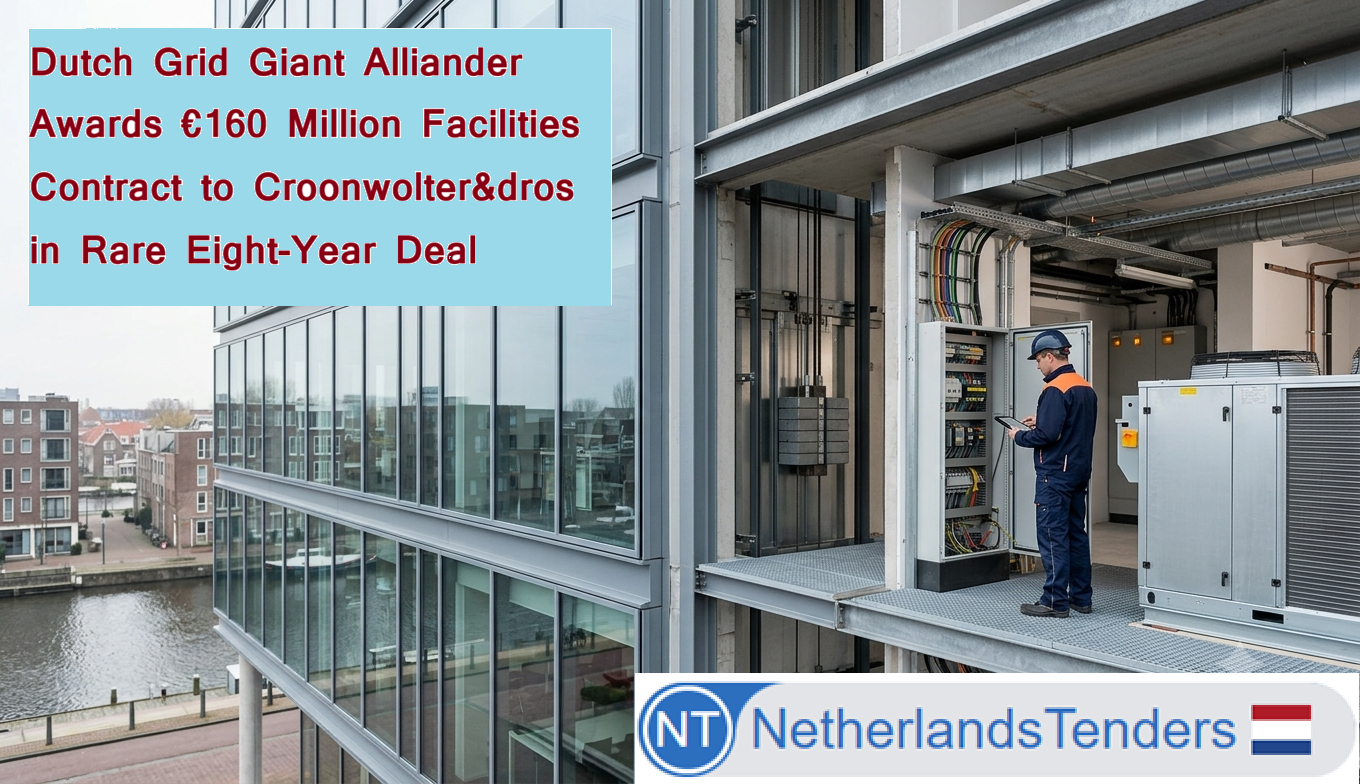
Keeping the Lights On Behind the Lights: Alliander Hands Its Entire Property Empire to One Contractor for Up to Eight Years
16 Jul 2026
StandfirstAlliander, the company that keeps electricity and gas flowing to millions of Dutch households, has just outsourced the upkeep of its own buildings, more than 50 offices, depots and technical sites nationwide, to a single contractor in a deal worth up to €160 million. The winner, Croonwolter&dros, will now be responsible for everything from heating systems to elevators across the grid operator's entire property footprint.IntroductionThere is a quiet irony in a company whose core business is keeping the Netherlands' energy grid running smoothly having to run a lengthy, careful procurement process just to keep its own office boilers, lifts and air conditioning running smoothly too. But that is precisely what Alliander N.V., the parent company behind regional grid operators Liander and others, has just done. After a "competitive dialogue", one of the more demanding procurement procedures available under EU law, reserved for contracts too complex to specify fully in advance, Alliander has awarded a single nationwide framework contract for the technical management and maintenance of its entire property portfolio.The winner is Croonwolter&dros B.V., a large Rotterdam headquartered technical services firm and part of the TBI group of construction and installation companies. The contract, worth an estimated €109 million and capped at €160 million, will see Croonwolter&dros take over mechanical, electrical, transport installation, structural and grounds maintenance across more than 50 Alliander locations throughout the Netherlands, mostly office sites, for at least four years and potentially eight.Why This Contract MattersIt is easy to overlook facilities management as a back office concern, but for a company like Alliander, which operates critical national infrastructure, the condition of its own buildings is not incidental. Grid control rooms, technical depots and administrative offices all depend on functioning heating, cooling, power and elevator systems to keep staff working and operations running. A single maintenance failure at the wrong site, at the wrong time, has knock on consequences for an organisation whose core mission is reliability.This contract also illustrates a broader shift in how large Dutch corporates and utilities are structuring their non core service contracts: fewer, larger, longer term "main contractor" relationships in place of a patchwork of regional or discipline specific maintenance suppliers. Consolidating five separate technical disciplines, mechanical engineering, electrical engineering, transport installations (lifts and escalators), structural maintenance and grounds care, into a single accountable contractor is a deliberate simplification, trading some flexibility for a single point of responsibility and, in principle, more consistent service quality across a nationally dispersed property base.Contract Timeline Date Milestone Prior notice referenced 15636853... (procedure launch notice) Throughout the process Competitive dialogue conducted with shortlisted bidders 24 March 2026 Winner selected 1 July 2026 Contract concluded between Alliander and Croonwolter&dros 13 July 2026 Award notice dispatched to the EU Publications Office 16 July 2026 Notice published in OJ S 135/2026 From 2026 Base contract term of 4 years begins Up to 2034 Potential end of term, if both 2 year extension options are exercised Contract OverviewAlliander ran a competitive dialogue procedure, a format used when a buyer knows what outcome it wants but not necessarily the exact technical or contractual solution to get there and so negotiates the details iteratively with a shortlist of bidders before finalising specifications. The goal, as stated in the notice, was to conclude a framework agreement with a single main contractor for the management and maintenance of Alliander's real estate portfolio, covering execution work, steering and accountability tasks and site coordination across mechanical, electrical, transport installation, structural and grounds maintenance disciplines.Three tenders were received. Croonwolter&dros B.V. was selected as the sole winner, with no other contractor named in the notice. No complaints were filed against the award. The contract itself, rather than being a call off under a preexisting framework, establishes the framework agreement in this instance, the notice confirms the contract was not awarded within an already existing arrangement, meaning this procurement created the vehicle from scratch.Key Contract Details Field Detail Contracting authority Alliander N.V. Winning contractor Croonwolter&dros B.V. Title Raamovereenkomst Hard Service Provider (Hard Service Provider Framework Agreement) CPV codes 50700000 - Repair and maintenance services of building installations; 45262700 - Building alteration work; 45300000 - Building installation work; 50710000 - Repair and maintenance of electrical and mechanical building installations; 71631300 - Technical building-inspection services; 79993000 - Building and facilities management services Procedure type Competitive dialogue Legal basis Directive 2014/24/EU Estimated value €109,000,000 Maximum framework value €160,000,000 Award criteria Quality (multi factor, weighting not disclosed) and Price, evaluated via "gunnen op waarde" (best value award methodology) Contract duration 4 years, with an option for two 2 year extensions (up to 8 years total) Tenders received 3 Complaints/review requests 0 EU funding None disclosed GPA coverage Yes Review body Rechtbank Den Haag (District Court of The Hague) Place of performance Anywhere in the Netherlands Project ScopeThe scope spans five technical maintenance disciplines across Alliander's property portfolio: mechanical engineering (heating, cooling and ventilation systems), electrical engineering, transport installations (lifts and similar equipment), structural building maintenance and grounds and terrain upkeep. Beyond the physical maintenance itself, the contract also covers "steering and accountability" work, meaning contract governance, reporting and performance management and site coordination across what industry sources describe as more than 50 Alliander locations nationwide, predominantly office buildings, spread across regions including Arnhem/Duiven, Apeldoorn and Haarlem/Leiden.The award criteria description, drawn directly from the notice, lists five quality sub criteria: chain collaboration design, promotion of "Best Total Value," contribution of applied systems, safeguarding of integrated service performance and implementation and transition planning. This structure signals that Alliander was evaluating not just technical competence but how well a bidder could integrate itself operationally into Alliander's existing organisation over the life of the contract, a hallmark of the "best value" or "gunnen op waarde" methodology used across Dutch public and utility procurement for complex, relationship driven services contracts.About the Contracting AuthorityAlliander N.V. is one of the Netherlands' largest energy network companies, operating the electricity and gas distribution grids that serve a substantial share of Dutch households and businesses through its regional operating companies. As a body governed by public law with an activity classification of "housing and community amenities," Alliander sits within the Dutch utilities sector and its procurement of a facilities maintenance framework of this scale reflects the operational footprint required to run a national grid business: a network of offices, technical depots and administrative sites spread across the country, each needing consistent, professionally managed upkeep.About the Organisations InvolvedCroonwolter&dros B.V., Winning TendererCroonwolter&dros, headquartered in Rotterdam, is a large technical services company with roots tracing back more than 150 years, operating within the TBI group of Dutch construction, infrastructure and installation businesses. The firm specialises in electrical and mechanical engineering, building automation, energy systems and integrated facilities maintenance, serving clients across sectors including healthcare, education, logistics, commercial real estate and data centres. Its selection for this contract extends an existing relationship with Alliander's property and facilities function and industry sources describe the resulting arrangement as an eight year partnership covering all of Alliander's office locations nationwide, consistent with the four year base term plus two two year extension options recorded in this notice.Rechtbank Den Haag, Review OrganisationThe District Court of The Hague is designated as the review body for this procurement. Its role is limited to handling any legal challenges brought against the award; it played no part in the evaluation or selection process itself.Procurement AnalysisAlliander's choice of competitive dialogue, rather than a standard open or restricted procedure, is itself informative. This procedure is typically reserved for contracts where the buyer cannot fully specify its technical or contractual requirements in advance and instead needs a structured, iterative negotiation process with shortlisted bidders to arrive at a workable solution, common in complex, integrated services contracts where the exact operating model, governance structure and transition plan need to be worked out collaboratively rather than simply specified in a tender document.The award was decided on a combination of quality and price criteria evaluated through "gunnen op waarde", a Dutch best value procurement methodology that typically asks bidders to demonstrate, often through a plan of approach and interviews with proposed key personnel, how they will deliver on both the technical requirements and the softer relationship and integration elements of a long term contract. The five named quality sub criteria in this notice, covering chain collaboration, value promotion, system contribution, service performance safeguarding and implementation and transition, are consistent with that approach, placing meaningful weight on how a contractor plans to operate within Alliander's organisation, not just what it charges.Notably, the price criterion itself was structured around preventive maintenance costs for a set of representative buildings, plus rates and mark ups for management organisation, corrective maintenance and projects, a pricing model designed to make bids comparable despite the inherent variability in the condition and needs of different buildings across a large, geographically dispersed portfolio.Additional Procurement FactsThree tenders were submitted for the single lot covering this contract and Alliander received no review requests or complaints following the award. Subcontracting arrangements for the winning bid are listed as "not yet known" in the notice, suggesting further detail may emerge as the contract transitions into operation. The agreement is confirmed as GPA covered and no EU funding was involved; the project is financed entirely through Alliander's own operating budget.Market & Industry PerspectiveThe Dutch technical facilities management market for large corporate and utility real estate portfolios is served by a mix of large, diversified installation and engineering groups, firms like Croonwolter&dros, part of TBI and more specialised regional maintenance providers. Contracts of this scale and duration tend to favour larger contractors capable of mobilising a nationally distributed technical workforce, managing five distinct engineering disciplines under one roof and absorbing the governance overhead that comes with reporting into a single "main contractor" structure for a client the size of Alliander.The move toward single main contractor consolidation, rather than splitting work across multiple regional or discipline specific suppliers, reflects a broader trend among large Dutch corporates: simplifying vendor management complexity even at the cost of reduced competitive tension on any individual maintenance task, in exchange for a single accountable relationship and, ideally, more consistent service standards nationwide.Economic SignificanceAt an estimated €109 million, rising to a potential €160 million ceiling across an eight year term, this is a substantial services contract by Dutch facilities management standards and a meaningful long term revenue commitment for Croonwolter&dros. For Alliander, the arrangement converts a previously more fragmented and potentially inconsistent maintenance function into a single, contractually governed relationship, with defined quality criteria built into the award structure from the outset, a structure intended to reduce operational risk across a property base that supports critical national grid infrastructure functions.Future Procurement OpportunitiesWith a base term of four years and two possible two year extensions, Alliander has effectively secured its facilities management needs through to as late as 2034, assuming both extension options are exercised. That timeline suggests the next genuinely open competition for this scope of work will not reach the market again until the early to mid 2030s. In the interim, adjacent opportunities may emerge around specific technical upgrades, energy efficiency retrofits, building automation system replacements or sustainability driven renovations, that fall outside the standard maintenance scope and could be tendered separately, particularly as Dutch commercial and institutional real estate faces tightening energy performance and sustainability regulation over the coming years.Opportunities for SuppliersWhile the main contractor role is now filled for the foreseeable future, subcontracting opportunities are likely to exist beneath this framework, particularly given that the notice records subcontracting status for the winning bid as "not yet known" at the time of contract signature. Specialist firms in building automation, energy monitoring, elevator and lift servicing or sustainability retrofit work may find openings as Croonwolter&dros builds out its delivery team across Alliander's more than 50 sites nationwide.What Businesses Should WatchThree factors will shape how this contract develops. First, how effectively Croonwolter&dros executes the "implementation and transition" phase, since a smooth handover across 50 plus sites nationwide is itself an operational challenge distinct from ongoing maintenance delivery. Second, whether Alliander's own sustainability and energy transition ambitions, a theme explicitly referenced in Croonwolter&dros's own descriptions of similar contracts, generate additional retrofit or upgrade work layered on top of the base maintenance scope. Third, whether Alliander exercises its extension options at the four year mark, which would signal satisfaction with the relationship and further delay the next competitive opportunity for other technical services firms.NetherlandsTenders.com Procurement IntelligenceThis award is a clear example of the "single main contractor" consolidation trend now well established across large Dutch corporate and utility facilities management procurement. Rather than splitting mechanical, electrical, structural and grounds maintenance across separate specialist suppliers, an approach that maximises competitive tension on each discipline but multiplies vendor management overhead, Alliander chose to award one comprehensive framework to a single, large technical services group, prioritising integration, accountability and consistency across a widely dispersed property base.The choice of competitive dialogue as the procurement route, rather than a standard open tender, is itself a signal worth tracking. Buyers reaching for this procedure are effectively acknowledging that a straightforward specification and bid process would not capture the complexity of what they actually need, in this case, a governance and delivery model that has to work across dozens of sites with different technical profiles, ages and usage patterns. Suppliers competing for similarly complex, integrated facilities contracts elsewhere in the Dutch utility and corporate real estate sector should expect competitive dialogue, rather than open procedure, to become a more common vehicle for these types of long term "main contracting" relationships.Looking ahead, the sustainability and energy transition dimension embedded in the quality criteria here, particularly "contribution of applied systems" and "promotion of Best Total Value", points to where future specification will likely tighten further. Contractors that can demonstrate genuine capability in energy efficient building operation and predictive, data driven maintenance are best positioned to compete for the next generation of these contracts when they eventually return to market.Supplier Takeaways Large Dutch utilities are increasingly consolidating fragmented, discipline specific maintenance contracts into single "main contractor" frameworks, expect fewer, larger opportunities rather than many smaller regional tenders. Competitive dialogue procedures reward bidders who can demonstrate strong governance, transition planning and organisational integration capability, not just technical competence and price. Subcontracting opportunities beneath large main contractor frameworks like this one are worth pursuing even after the headline award is decided, since subcontracting status was still undetermined at contract signature. Sustainability and energy transition capability is increasingly embedded directly into quality award criteria for facilities management contracts, rather than treated as a separate procurement. With this contract potentially running to 2034, competing firms should look for adjacent retrofit, upgrade or specialist subcontracting opportunities rather than waiting for the main framework to re tender. Key Takeaways Alliander N.V. awarded a nationwide facilities maintenance framework, worth up to €160 million, to Croonwolter&dros B.V. following a competitive dialogue procedure. The contract covers mechanical, electrical, transport installation, structural and grounds maintenance across more than 50 Alliander sites nationwide. The base term is four years, with options for two further two year extensions, potentially extending the relationship to eight years. Three tenders were received; no complaints were filed against the award. The contract was evaluated on quality and price using the Dutch "gunnen op waarde" best value methodology, with five distinct quality sub criteria. ConclusionBehind every reliable electricity and gas connection in the Netherlands sits an unglamorous layer of office buildings, depots and technical sites that themselves need heating, cooling, working lifts and sound structures. Alliander's decision to hand that responsibility to a single contractor for up to eight years reflects a wider shift in how large infrastructure operators manage their own supporting real estate: fewer relationships, more integration and a willingness to use a demanding procurement procedure to get the governance model right before signing on the dotted line.Frequently Asked QuestionsWho won this facilities management contract? Croonwolter&dros B.V., a Rotterdam headquartered technical services company and part of the TBI group.Who is the buyer? Alliander N.V., one of the Netherlands' largest energy grid network companies.What is the contract worth? An estimated €109,000,000, with a maximum framework value of €160,000,000.How long does the contract last? Four years initially, with an option to extend twice by two years each, for a potential total term of eight years.What procurement procedure was used? Competitive dialogue, a procedure used for complex contracts where the buyer negotiates the technical and contractual solution with shortlisted bidders before finalising terms.How many companies bid for the contract?Three tenders were received.What does the contract actually cover? Technical management and maintenance of Alliander's property portfolio, including mechanical, electrical, transport installation (lifts), structural and grounds maintenance across more than 50 sites nationwide, mostly offices.Was any EU funding involved? No. The notice confirms the project was not financed with EU funds. Source: EU Official Journal, Contract Award Notice 492316-2026, OJ S 135/2026, published 16/07/2026. Contracting authority: Alliander N.V. This article is based on information published in the official TED (Tenders Electronic Daily) Contract Award Notice. Editorial analysis, market insights and procurement intelligence have been added by netherlandsTenders.com to help businesses better understand the strategic significance of the procurement and identify future opportunities.
View Details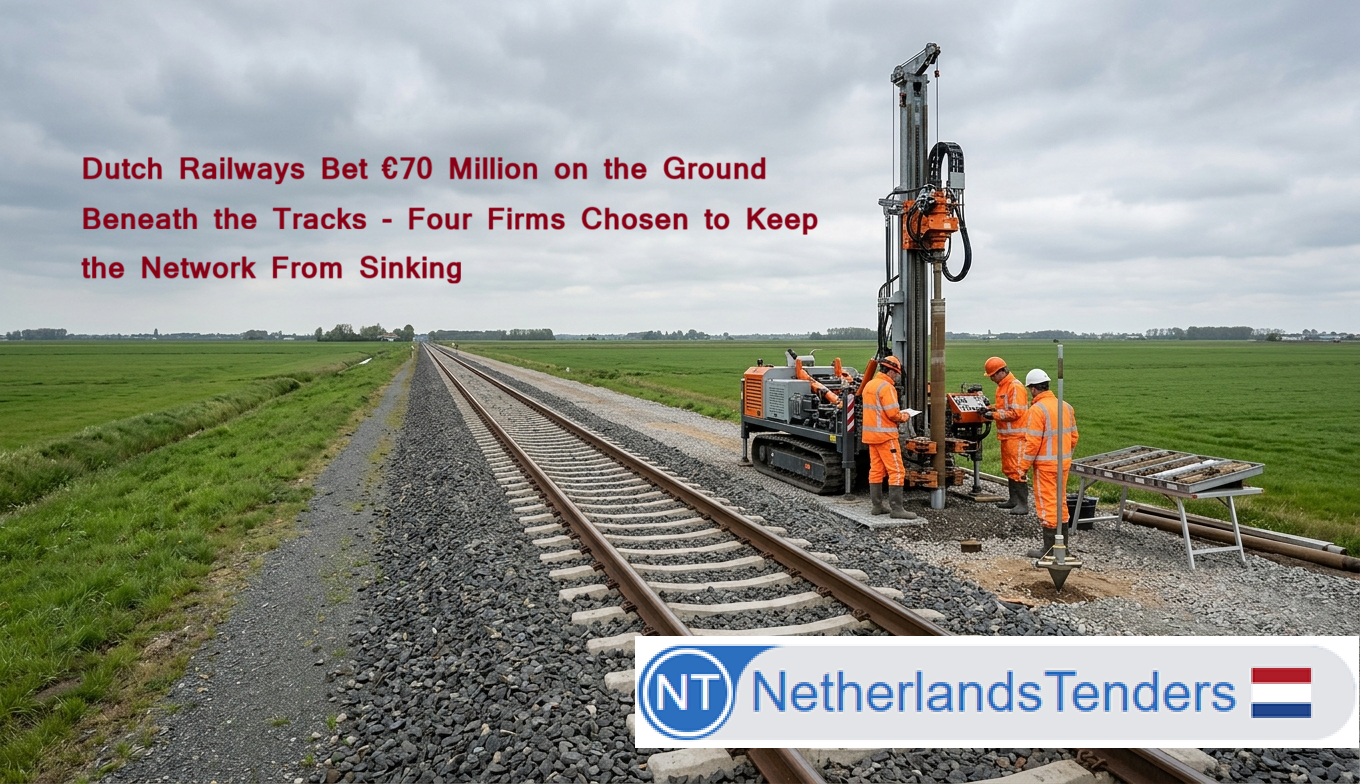
Dutch Railways Bet €70 Million on the Ground Beneath the Tracks - Four Firms Chosen to Keep the Network From Sinking
15 Jul 2026
Standfirst A quiet subsidence incident on one of the Netherlands' busiest rail corridors this year was a reminder that trains do not run on steel alone; they run on soil. ProRail, the state infrastructure manager, has awarded a four year, €70 million framework agreement for nationwide geotechnical investigation to four specialist firms: Geonius Geotechniek, Fugro NL Land, Mos Grondmechanica and BAM Infraconsult. The deal says less about engineering and more about how Europe's rail operators are quietly repricing the risk hidden underground. IntroductionAsk most travellers what keeps a train on its rails and they will talk about signals, timetables or the condition of the track itself. Few will mention the ground underneath. Yet it is precisely that unglamorous layer of clay, peat and sand that has, time and again, brought Dutch rail traffic to a standstill. Earlier this year, a stretch of track between Den Bosch and Tilburg, one of the busiest freight and passenger corridors in the country, buckled after nearby piling work quietly weakened the load bearing capacity of the subsoil. Services stopped. Passengers were delayed. Engineers were sent scrambling.It is against that backdrop that ProRail, the company responsible for managing the Dutch national rail network, has finalised a nationwide framework agreement worth up to €70 million for geotechnical investigation services, the drilling, sampling, testing and monitoring work that tells engineers what is really happening beneath the ballast. Four Dutch engineering firms will share the work over the next four years, with the option to extend it to eight.Why This Contract MattersRailway infrastructure ages in ways that are not always visible. Embankments settle. Groundwater levels shift with the seasons and with climate change. Historic peat soils, common across large parts of the Netherlands, behave unpredictably under the weight of increasingly heavy and frequent trains. When ProRail's engineers get the underlying geotechnical data wrong or do not have enough of it, the consequences show up as speed restrictions, embankment failures, or, in the worst cases, derailments.This contract is ProRail's answer to that risk. It is not a single investigation but a standing capability: a panel of specialists who can be called upon anywhere in the country, at short notice, to characterise the ground before a renewal project begins or a problem occurs. That distinction, building permanent capacity rather than commissioning a one off study, is what turns a technical services contract into a piece of national infrastructure strategy.Contract Timeline Date Milestone 2019 First generation ProRail geotechnical framework agreement launched 17 July 2025 Contracts concluded with the four winning firms (per the notice) 1 August 2025 Framework agreement enters into force, according to industry reporting 13 July 2026 Contract award notice dispatched to the EU Publications Office 15 July 2026 Notice published in OJ S 134/2026 The gap between contract signature and public notice, roughly a year, is not unusual for utilities sector procurement in the Netherlands, where award publication can lag behind the operational start of a framework. By the time this notice reached the Official Journal, the four firms had already been active on Dutch track corridors for close to a year.Contract OverviewProRail ran an open, EU wide tendering procedure for a single nationwide lot covering geotechnical engineering services, cone penetration testing, borehole drilling, installation of groundwater monitoring wells and laboratory soil analysis. Rather than awarding the work to one contractor, ProRail structured the deal as a framework agreement without reopening of competition, splitting capacity across four winners: Geonius Geotechniek B.V., Fugro NL Land B.V., Mos Grondmechanica B.V. and BAM Infraconsult B.V.The contracting authority received six tenders, four of them from micro, small or medium sized enterprises, an unusually strong SME showing for a rail infrastructure framework of this size. No complaints were lodged against the award. All tenders were submitted electronically, in line with the Netherlands' near universal shift to e procurement through the TenderNed platform. Key Contract Details Field Detail Contracting authority ProRail B.V. Title Landelijk-Raamovereenkomst Geotechnisch Onderzoek II (National Framework Agreement for Geotechnical Investigation II) CPV code 71332000-Geotechnical engineering services Procedure type Open procedure Legal basis Dutch ARW 2016 and the Aanbestedingswet 2012 (Netherlands Public Procurement Act) Framework agreement type Without reopening of competition Number of winners 4 Contract duration 4 years Possible renewals Up to 2 renewals of 2 years each (maximum 8 years total) Maximum framework value €70,000,000 Award criterion Price, weighted 100 (best price quality ratio methodology) Tenders received 6 (4 from SMEs) EU funding None disclosed GPA coverage Yes Review body Rechtbank Midden Nederland (District Court of Midden Nederland) Place of performance Anywhere in the Netherlands Project ScopeThe framework covers geotechnical investigation nationwide, not tied to a single railway line or region. In practice, that means the four firms will be called upon wherever ProRail needs to understand what lies beneath a stretch of track before renewing it, reinforcing it or responding to a subsidence event. The scope includes cone penetration testing (a technique that measures soil resistance layer by layer), borehole drilling, installation of piezometers and monitoring wells to track groundwater behaviour over time and laboratory testing of soil samples.No options were built into the contract beyond the base scope and the notice does not describe any strategic procurement objectives, such as green or social criteria, attached to this particular award. That is a notable absence given how frequently sustainability weighting now appears in Dutch infrastructure tenders and it suggests this framework was designed primarily around technical capability and price rather than broader policy goals. About the Contracting AuthorityProRail B.V. is the company responsible for managing, maintaining and developing the Netherlands' main railway network on behalf of the Dutch state, which holds ProRail as its sole shareholder through Railinfratrust B.V., with the Ministry of Infrastructure and Water Management exercising the government's ownership role. ProRail does not run trains, that is the job of operators such as Nederlandse Spoorwegen (NS), but it controls the tracks, signalling and infrastructure those trains depend on, under a management concession granted by the Dutch state.Because ProRail operates under special or exclusive rights in the rail sector, it procures under the EU's utilities regime rather than the classic public sector directive, which explains why this notice cites Dutch national instruments, the ARW 2016 and the Aanbestedingswet 2012, as its legal basis rather than a specific EU directive number. ProRail's core mandate includes network safety and geotechnical risk management sits close to the centre of that responsibility, particularly as climate change alters groundwater patterns beneath ageing embankments. About the Organisations InvolvedGeonius Geotechniek B.V., Winning TendererGeonius Geotechniek, based in Geleen in the southern province of Limburg, is registered as a small economic operator. It is the smallest of the four winners by size classification, illustrating how ProRail's framework structure deliberately created room for a specialist regional player alongside larger multinational and construction group competitors. The firm's presence in the winning group also helps explain the strong SME participation ProRail recorded across the six bids received.Fugro NL Land B.V., Winning TendererFugro NL Land is the Dutch land services arm of Fugro N.V., a publicly listed company on Euronext Amsterdam and one of the world's largest geo data specialists, with roots in soil investigation dating back to 1962. Fugro has worked with ProRail on rail safety and subsurface investigation for well over a decade, including previous framework agreements covering cone penetration testing and drilling in support of track renewal projects. Its scale and long institutional relationship with ProRail make it the most globally recognisable name among the four winners, even though this particular contract was won by its Dutch land services subsidiary rather than the parent group.Mos Grondmechanica B.V., Winning TendererMos Grondmechanica, headquartered in Rotterdam, is registered as a medium sized economic operator specialising in soil mechanics, the branch of engineering that studies how soil behaves under load, water pressure and vibration. Its inclusion reflects a segment of the Dutch geotechnical market built around independent, engineering led firms rather than diversified infrastructure contractors, giving ProRail a source of specialist technical judgement distinct from its larger framework partners.BAM Infraconsult B.V., Winning TendererBAM Infraconsult, based in Gouda, operates as the engineering consultancy arm connected to Royal BAM Group, one of the Netherlands' largest construction and infrastructure companies. Its participation links this geotechnical framework to a wider ecosystem of Dutch civil engineering capacity, since BAM Group companies are frequently engaged on the construction and renewal projects that this very geotechnical data will inform.Rechtbank Midden Nederland, Review OrganisationThe District Court of Midden Nederland is named in the notice as the body responsible for handling any legal challenges to the award. Its role is purely judicial oversight; it has no operational involvement in the contract itself, but its designation is a standard procedural safeguard under Dutch procurement law, giving unsuccessful bidders a defined route to contest the outcome. Procurement AnalysisProRail chose an open procedure, the most transparent and competitive route available under EU utilities procurement rules, allowing any interested firm to submit a tender without a prior shortlisting stage. That choice, combined with electronic submission through TenderNed, points to a buyer prioritising broad market access over speed or discretion.The framework agreement was structured "without reopening of competition," meaning ProRail will not run a mini competition each time it needs a geotechnical investigation. Instead, work will be distributed among the four firms according to internal allocation rules ProRail has not disclosed in this notice, commonly rotation, geographic assignment or capacity based distribution in frameworks of this kind. The tenders were also not ranked against one another (the notice explicitly marks each tender as unranked), reinforcing that all four firms sit on equal footing within the panel rather than in a first choice, second choice hierarchy.The award criterion is listed as "Price" with a full 100 point weighting, but the underlying description makes clear this is evaluated as a best price quality ratio: bidders submitted a tender sum that was then converted into an "evaluation price" through a formula tied to their technical scoring, rather than being judged on quality and price as separate weighted criteria. That is a common Dutch public sector technique for keeping price as the formal decision variable while still rewarding technical strength through the price adjustment mechanism. Additional Procurement FactsProRail received six tenders in total, four of them from micro, small or medium sized enterprises, a two thirds SME share that is high for a national scale infrastructure framework and one that likely reflects the specialised, regionally distributed nature of Dutch geotechnical engineering firms. No review requests or complaints were recorded against the award, suggesting the process was seen as fair by the market or at least did not generate formal disputes. Subcontracting was marked as not applicable for any of the four winning tenders, meaning each firm intends to deliver its share of the work with its own resources rather than through subcontractor arrangements disclosed to ProRail. The contract carries no EU funding component; it is financed entirely through ProRail's own infrastructure budget. Market & Industry PerspectiveThe Dutch geotechnical engineering market sits at an interesting intersection of scale and specialism. On one side are large, often internationally listed players such as Fugro, capable of deploying advanced sensing technology and laboratory capacity across multiple sectors, rail, roads, water defences, offshore energy. On the other are focused regional specialists such as Geonius and Mos Grondmechanica, whose competitive edge lies in deep local soil knowledge and engineering judgement rather than global scale. BAM Infraconsult occupies a third position, embedded within a major construction group that gives it visibility into how geotechnical findings translate directly into renewal and reinforcement projects downstream.ProRail's decision to award to all four, rather than consolidating the framework around one or two large suppliers, signals a preference for resilience and surge capacity over unit cost efficiency. Railway renewal work is inherently uneven, some months and some regions, require far more investigation capacity than others and a four firm panel gives ProRail flexibility that a single supplier contract would not. Economic SignificanceAt up to €70 million over a potential eight year term, this framework is modest by the standards of major rail infrastructure spending, but it is economically significant in a different way: it is preventative spending designed to avoid far larger costs. A single major subsidence event, like the one near Vught this year, can shut down a busy freight and passenger corridor, disrupting logistics chains and commuter services well beyond the immediate repair cost. Investing in better subsurface knowledge is, in effect, an insurance premium against those disruptions.For the four winning firms, the framework provides multi year revenue visibility and a foothold in one of the most consistent public infrastructure clients in the Netherlands. For the broader geotechnical services sector, it reinforces that specialised, safety critical inspection and testing work remains a durable, recession resistant niche within an otherwise cyclical construction and engineering market. Future Procurement OpportunitiesWith a base term of four years and up to two two year renewal options, ProRail has effectively signalled its geotechnical investigation needs through to the early 2030s under this framework alone. The findings generated by Geonius, Fugro, Mos Grondmechanica and BAM Infraconsult will feed directly into subsequent renewal, reinforcement and monitoring contracts, meaning this award is less an endpoint than the opening stage of a much longer pipeline of rail infrastructure work.Suppliers should also watch for parallel developments in ProRail's broader embankment safety programme, including research collaborations already under way with organisations such as Deltares and Delft University of Technology into railway embankment strength, work that is likely, over time, to translate into further tendered investigation and monitoring contracts. Opportunities for SuppliersFirms outside this framework should not assume the opportunity has closed. Framework agreements of this kind typically generate secondary work, laboratory subcontracting, specialist sensor and monitoring equipment supply, software for geotechnical data management and environmental or hydrological consultancy tied to specific sites. Companies with niche capabilities in automated monitoring, remote sensing or AI assisted soil behaviour prediction may find openings feeding into the four framework holders even without being named on the contract themselves.For firms considering a bid when this framework next comes to market, the SME success rate in this round, four of six tenders, is a meaningful signal that ProRail's utilities sector procurement remains genuinely accessible to smaller, specialised operators, not just large incumbents. What Businesses Should WatchThree developments will shape how this framework evolves. First, how ProRail allocates work among the four firms in practice, whether by geography, rotation or capacity, will determine which of them sees the largest share of the €70 million ceiling. Second, any recurrence of subsidence incidents on the scale of the Vught disruption could accelerate demand and prompt ProRail to expand investigation intensity ahead of schedule. Third, the eventual outcome of the Deltares led embankment research programme could reshape technical specifications for the next generation of this framework, favouring firms that can demonstrate advanced monitoring and predictive capability rather than traditional drilling and sampling alone. NetherlandsTenders.com Procurement IntelligenceThis award illustrates a pattern spreading across Europe's rail and utility infrastructure managers: the shift from reactive geotechnical investigation, commissioned after something goes wrong, to standing, framework based capacity that treats subsurface knowledge as a continuous operational input rather than a one off engineering task. It mirrors similar moves by infrastructure managers in Germany, France and the United Kingdom, where climate driven changes in groundwater behaviour are pushing asset owners to formalise geotechnical monitoring rather than commission it project by project.The decision to spread the award across four firms of very different sizes, rather than consolidating around a single large supplier, is also instructive. It suggests ProRail is deliberately preserving a diverse supplier base, partly for resilience and partly, perhaps, to avoid over dependence on any one contractor for a capability this safety critical. Suppliers competing for future utilities sector rail frameworks in the Netherlands should expect this multi winner structure to persist and should position their bids around demonstrable specialist capability rather than assuming scale alone will secure a place on the panel.Looking further ahead, the link between this contract and ProRail's embankment research work with Deltares hints at where the next wave of specification will land: investigation firms that can integrate predictive, data driven risk modelling into their services are likely to have an advantage when this framework is renewed or retendered. Supplier Takeaways ProRail's utilities sector procurement remains genuinely open to SMEs, four of six bidders in this round were small or medium sized firms. Multi winner framework structures, without reopening of competition, mean firms need to focus on qualifying for the panel itself rather than winning individual call offs through repeated competition. Subcontracting and equipment supply opportunities are likely to emerge around the four framework holders, even for firms not directly on the contract. Firms with predictive monitoring, sensor technology or data analytics capability should track ProRail's parallel embankment research work as an early indicator of future specification changes. Review and complaint activity was nil in this award, suggesting bidders should not expect legal challenge as a realistic route to reopening this particular framework. Key Takeaways ProRail awarded a nationwide, €70 million geotechnical investigation framework to four firms: Geonius Geotechniek, Fugro NL Land, Mos Grondmechanica and BAM Infraconsult. The four year contract, extendable by up to two further two year periods, was awarded through an open procedure with price based evaluation. Six tenders were received, four from SMEs; no complaints were filed. The contract responds directly to recurring subsidence risk on the Dutch rail network, illustrated by a recent disruption near Vught. No EU funding is attached; the framework is financed through ProRail's own budget and is covered by the WTO Government Procurement Agreement. ConclusionIt is easy to overlook a contract for soil testing when the headlines are dominated by new train fleets, electrification projects and high speed lines. Yet this framework agreement addresses something more fundamental: whether the ground beneath the Netherlands' railway can be trusted to hold. By spreading that responsibility across four firms of different scale and specialism, ProRail has built itself both resilience and choice, and, in the process, opened a multi year, nationwide channel of work for a segment of the engineering sector that rarely makes the news, but rarely stops being needed either. Frequently Asked QuestionsWho awarded this contract? ProRail B.V., the company responsible for managing the Dutch national railway network, on behalf of the Dutch state.Who won the framework agreement? Four firms: Geonius Geotechniek B.V., Fugro NL Land B.V., Mos Grondmechanica B.V. and BAM Infraconsult B.V.What is the contract worth? Up to €70,000,000 across the full framework term, according to the notice.How long does the contract last? Four years initially, with the option for ProRail to extend it twice by two years each, for a maximum term of eight years.Is the contract funded by the European Union? No. The notice confirms the project is not financed with EU funds.What procurement procedure was used? An open procedure, ProRail's standard route for utilities sector contracts requiring broad EU wide competition.How many companies bid for the contract? Six tenders were received in total, four of them from micro, small or medium sized enterprises.Why does this contract matter beyond the rail sector? It reflects a broader shift among European infrastructure managers toward standing geotechnical monitoring capacity, driven by climate related changes in groundwater behaviour and ageing embankment infrastructure. Source: EU Official Journal, Contract Award Notice 487570-2026, OJ S 134/2026, published 15/07/2026. Contracting authority: ProRail B.V.
View Details
One Recruitment Firm Just Won a Seat at the Table for All Three Lots of the Dutch Parliament's €127 Million Staffing Deal
14 Jul 2026
Standfirst: The Tweede Kamer, the lower house of the Dutch parliament, has finalised a framework worth up to €127 million to supply temporary staff across seven national institutions, from parliament itself to the Council of State and the national ombudsman. Five recruitment firms secured places on the panel, but one, Hero Interim Professionals, is the only company to win a spot on all three lots. Governments everywhere rely on temporary staff to fill gaps: an IT specialist to cover a system migration, a finance professional to bridge a vacancy, a policy adviser brought in for a specific project. The Dutch parliament and six other central institutions have just locked in exactly that kind of flexible workforce for the next several years, through a framework big enough to rank among the larger public staffing deals in the Netherlands this year. Why This Contract Matters This is not simply a Tweede Kamer procurement. The framework covers temporary staffing needs across seven separate Dutch state bodies: the Tweede Kamer (House of Representatives) and Eerste Kamer (Senate), the Algemene Rekenkamer (Netherlands Court of Audit), the Raad van State (Council of State), the Nationale Ombudsman, the Kanselarij der Nederlandse Orden (the office that administers Dutch royal honours), and the Sociaal-Economische Raad (the Social and Economic Council, an advisory body on economic policy). Consolidating staffing procurement across this many institutions under one framework, run by the Tweede Kamer as lead buyer, reflects a broader Dutch government trend: rather than each body running its own recruitment tenders, closely related state institutions increasingly pool this kind of recurring administrative need into shared, larger-scale frameworks, giving both the buyers and the winning suppliers more predictable, longer-term relationships. Contract Timeline 1 July 2026 – All seven underlying contracts across the three lots were concluded. 13 July 2026 – Result notice dispatched to the EU Publications Office. 14 July 2026 – Notice published in OJ S issue 133/2026. Contract Overview The Tweede Kamer ran an open procedure under the EU's general public procurement directive, structuring the requirement into three lots: ICT personnel, financial personnel, and other personnel (a catch-all covering staffing needs outside IT and finance). The combined estimated value across all three lots was €95 million at the outset, though the maximum value of the framework agreements actually confirmed in this result notice, once renewal options are included, comes to €126.83 million. Rather than naming a single winner per lot, the Tweede Kamer built each lot as a multi-supplier framework with reopening of competition, meaning several recruitment firms were appointed to each lot, and specific staffing assignments will subsequently be awarded through further mini-competitions among the appointed suppliers as needs arise. Key Contract Details Contracting authority: Tweede Kamer der Staten-Generaal (Dutch House of Representatives), acting on behalf of itself and six other state institutions Contract title: Inhuur van Personeel (Brokerdiensten), Hiring of Personnel (Broker Services) CPV classification: 79600000 – Recruitment services; additional classification 79621000 – Supply services of office personnel Procedure type: Open procedure, non-accelerated Legal basis: Directive 2014/24/EU Framework type: Framework agreement with reopening of competition, across all three lots Estimated combined value at tender stage: EUR 95,000,000 Maximum value of framework agreements confirmed in this notice: EUR 126,830,000 Contract duration per lot: 2 years, with up to 2 renewals of 12 months each Award criteria (identical across all three lots): Service delivery and relationship management (30 points); scarce profiles and availability (30 points); contract management of freelance staff (30 points); social return on investment/SROI (10 points); price, assessed at the point of individual call-offs rather than at framework stage (0 points at this stage) GPA coverage: Yes, across all three lots EU funding: Not financed with EU funds Place of performance: Anywhere in the Netherlands Project Scope Lot 1 covers the hiring of ICT personnel, with an expected scope of €62 million, by far the largest of the three lots and the one that drew the most competitive interest, with 16 tenders received. Lot 2 covers financial personnel, expected at €12 million, drawing eight tenders. Lot 3 covers "other personnel", staffing needs outside IT and finance, expected at €21 million, drawing 11 tenders. Notably, price was not scored as part of the initial framework-entry evaluation in any lot; all 100 points on offer were allocated to quality criteria, including a specific criterion on managing freelance contractors (zzp'ers, the Dutch term for self-employed independent contractors) and a social-return-on-investment measure. The notice states that the price component, covering both the hourly rate and the broker's fee, will instead be assessed each time a specific staffing assignment is put out to the appointed suppliers under the framework's reopened competition mechanism. About the Contracting Authority The Tweede Kamer der Staten-Generaal is the directly elected lower house of the Dutch parliament, based in The Hague. Classified in the notice as a central government authority operating in general public services, it ran this tender and signs all resulting contracts on behalf of itself and the other participating institutions, working through the Dutch national tendering platform TenderNed. About the Organisations Involved Tweede Kamer der Staten-Generaal, Lead Buyer and Contract Signatory The Tweede Kamer designed and ran the procurement on behalf of itself and six other Dutch state bodies, evaluated all tenders received across the three lots, and signs every resulting contract. It is also named as the organisation providing further information on both the procurement procedure and the review process. Randstad Professional B.V. (trading as Randstad Digital Services), Winner of Lot 1 Randstad Professional, based in Diemen and classified as a large economic operator, is part of the well-known Randstad staffing group. It was appointed to Lot 1, covering ICT personnel, alongside two other winning firms. No subcontracting was disclosed in its winning bid. Pro-Act IT B.V., Winner of Lot 1 Pro-Act IT, based in Haarlem and classified as a medium-sized enterprise, specialises in IT staffing and recruitment. It was appointed to Lot 1 alongside Randstad Professional and Hero Interim Professionals. No subcontracting was disclosed. Hero Interim Professionals B.V., Winner of Lots 1, 2 and 3 Hero Interim Professionals, based in Wognum in North Holland and classified as a medium-sized enterprise, is the only company named as a winner across all three lots of this framework: ICT personnel, financial personnel, and other personnel. That breadth is unusual for a recruitment firm of its size, and it means Hero Interim Professionals now holds a place on every part of this framework, giving it exposure to staffing assignments across the full range of roles the seven participating institutions may need to fill. No subcontracting was disclosed in any of its three winning bids. RA'Quel B.V., Winner of Lot 2 RA'Quel, based in Nootdorp near The Hague and classified as a small enterprise, was appointed to Lot 2 alongside Hero Interim Professionals, covering the hiring of financial personnel. No subcontracting was disclosed. Flinter, Winner of Lot 3 Flinter, based in Heerenveen in Friesland and classified as a small enterprise, was appointed to Lot 3 alongside Hero Interim Professionals, covering the hiring of personnel outside IT and finance. No subcontracting was disclosed. Procurement Analysis The Tweede Kamer used an open procedure, allowing any qualified recruitment or staffing firm to bid without a pre-qualification stage, and the results show genuine competitive interest: 16 tenders for the ICT lot, 8 for the financial personnel lot, and 11 for the other-personnel lot, for a combined 35 tenders across the three lots. Rather than selecting a single winner per lot, the buyer opted for a multi-supplier framework with reopening of competition in every lot, appointing between two and three firms per lot. That structure gives the seven participating institutions choice and flexibility when specific staffing needs arise, and it also means individual mini-competitions among the appointed firms, rather than this framework-entry result, will ultimately determine which supplier fills any particular assignment. The evaluation approach is also notable: every point available at framework-entry stage was allocated to quality criteria, with price deliberately excluded from this stage and reserved instead for assessment at the point of individual call-offs. That structure means firms had to compete purely on service quality, their approach to managing freelance contractors, their availability for scarce specialist profiles, and their social-return commitments, to secure a place on the panel at all, with price competition still to come once specific assignments are tendered. Additional Procurement Facts Any legal challenge relating to this procurement would be heard by Rechtbank Den Haag, the District Court of The Hague. The procurement is confirmed as GPA-covered across all three lots. No EU funds were used to finance this procurement. All tenders across all three lots were submitted electronically through TenderNed. Each lot carries options for up to two 12-month renewals beyond the initial two-year term. Market & Industry Perspective The Dutch temporary staffing and recruitment market is well developed, and this framework brought together a mix of large, established names, such as Randstad, alongside smaller, more specialised firms like Flinter and RA'Quel. That mix reflects how Dutch public buyers increasingly look beyond the biggest staffing brands alone when building multi-supplier frameworks, giving smaller regional or niche specialists a route into large-scale government staffing work. Hero Interim Professionals' presence across all three lots is the standout result here, suggesting the firm's proposition, whatever specific strengths carried it through the quality-based evaluation, translated consistently across very different staffing categories: IT, finance and general administrative roles alike. Economic Significance At a combined maximum framework value of €126.83 million across three lots and up to four years including renewals, this is one of the larger public staffing frameworks awarded in the Netherlands this year. For the five winning firms, a place on this panel represents a substantial, multi-year revenue opportunity, spread across seven separate state institutions with ongoing and evolving staffing needs. For the participating institutions, consolidating this need into a single, centrally run framework likely reduces administrative overhead compared with each body running its own separate staffing tenders, while still preserving competitive tension through the reopened-competition call-off mechanism for individual assignments. Future Procurement Opportunities Because this framework uses reopening of competition, the appointed suppliers in each lot will continue to compete against one another for specific staffing assignments throughout the framework's life, rather than the initial appointment being the end of the competitive process. Recruitment firms not selected in this round should watch for the framework's eventual expiry, expected after the initial two-year term plus any renewals, for a future re-tender opportunity. Other Dutch central government bodies with similar recurring staffing needs may look to this framework's structure, pooling multiple institutions under one lead buyer, evaluating purely on quality at framework-entry stage, and deferring price competition to the call-off stage, as a template for their own future staffing procurements. Opportunities for Suppliers Recruitment firms specialising in IT, finance or general administrative staffing should track this framework's reopened mini-competitions, since actual assignment awards will follow this initial appointment stage. Smaller, regionally based staffing firms should note that this framework included firms of varying size, from large national brands to small specialists, suggesting scale alone is not a prerequisite for winning a place on this kind of panel. Firms with a strong freelance and independent-contractor management proposition should note the explicit weighting given to this criterion, since it may be replicated in future comparable Dutch public-sector staffing tenders. Suppliers should monitor other Dutch state institutions for comparable staffing frameworks, particularly where several related bodies may pool procurement under a single lead buyer. What Businesses Should Watch Watch how the reopened-competition mechanism plays out across the framework's life, since that will determine how staffing assignments are actually distributed among the appointed suppliers in each lot. Watch also whether other Dutch government bodies adopt a similar quality-first, price-deferred evaluation model for staffing procurement, given how deliberately this framework separated quality assessment from price competition. NetherlandsTenders.com Procurement Intelligence This award illustrates a deliberate design choice increasingly common in Dutch public-sector staffing procurement: evaluate suppliers purely on service quality and delivery capability to earn a place on the framework, then let price competition play out separately, assignment by assignment, once real staffing needs materialise. That structure protects the buyer from overpaying while still ensuring only quality-vetted suppliers are in the mix to compete on price later. Hero Interim Professionals' clean sweep across all three lots is the most striking single data point in this notice, and it is worth suppliers' attention: a medium-sized firm competing successfully across ICT, financial and general staffing categories against both larger and smaller specialised rivals suggests a genuinely adaptable service proposition, rather than a narrow, single-discipline strength. Expect more Dutch central government bodies to pool staffing procurement across related institutions under a single lead buyer, and expect quality-first, price-deferred evaluation models to become a more common feature of public-sector staffing frameworks as buyers seek to balance service quality with ongoing cost control. Supplier Takeaways Track this framework's reopened mini-competitions closely, since the real staffing assignments, and the revenue that comes with them, will be awarded through that ongoing process rather than this initial appointment stage. Build a strong, demonstrable proposition on managing freelance and independent-contractor staff, given the explicit weighting this criterion carried in the evaluation. Consider bidding across multiple staffing categories rather than a single specialism, following Hero Interim Professionals' example of winning a place across all three lots. Monitor other Dutch state institutions for similar pooled staffing frameworks, particularly where several related bodies may combine procurement under one lead buyer. Key Takeaways The Tweede Kamer finalised a three-lot staffing broker framework worth up to €126.83 million, covering seven Dutch state institutions. Five recruitment firms were appointed across the three lots: Randstad Professional, Pro-Act IT, Hero Interim Professionals, RA'Quel, and Flinter. Hero Interim Professionals is the only firm appointed to all three lots. All 100 evaluation points at framework-entry stage were allocated to quality criteria; price will be assessed separately at the point of individual assignment call-offs. Any legal challenge would be heard by Rechtbank Den Haag. Conclusion Behind a routine-sounding staffing procurement sits a genuinely large and carefully structured framework, spanning seven Dutch state institutions and running to nearly €127 million at its ceiling. Five firms now have a foothold in supplying the Netherlands' central government with temporary staff, but one of them, Hero Interim Professionals, has positioned itself across every category on offer, a result worth watching as the framework's reopened competitions begin to allocate real assignments in the months ahead. Frequently Asked Questions Who ran this tender?The Tweede Kamer der Staten-Generaal, the Dutch House of Representatives, on behalf of itself and six other state institutions. Which institutions does this framework cover?The Tweede Kamer, Eerste Kamer, Algemene Rekenkamer, Raad van State, Nationale Ombudsman, Kanselarij der Nederlandse Orden, and Sociaal-Economische Raad. Who won the contract?Five firms were appointed across three lots: Randstad Professional and Pro-Act IT (Lot 1, alongside Hero Interim Professionals); Hero Interim Professionals and RA'Quel (Lot 2); and Hero Interim Professionals and Flinter (Lot 3). Hero Interim Professionals is the only firm appointed to all three lots. What is the framework worth?The maximum combined value of the three lots, including renewal options, is EUR 126,830,000. How were bids evaluated?Entirely on quality criteria at framework-entry stage, covering service delivery, availability for scarce profiles, freelance-contractor management, and social return on investment. Price is assessed separately when specific assignments are later put out to the appointed suppliers. How long does the framework run?Two years per lot, with options for up to two 12-month renewals. Is this procurement funded by the European Union?No. The notice confirms it is not financed with EU funds. Where can a legal challenge to this award be filed?Any challenge would go to Rechtbank Den Haag, the District Court of The Hague. Source: EU Official Journal, Contract Award Notice 485835-2026, OJ S 133/2026, published 14 July 2026. Contracting authority: Tweede Kamer der Staten-Generaal.
View Details