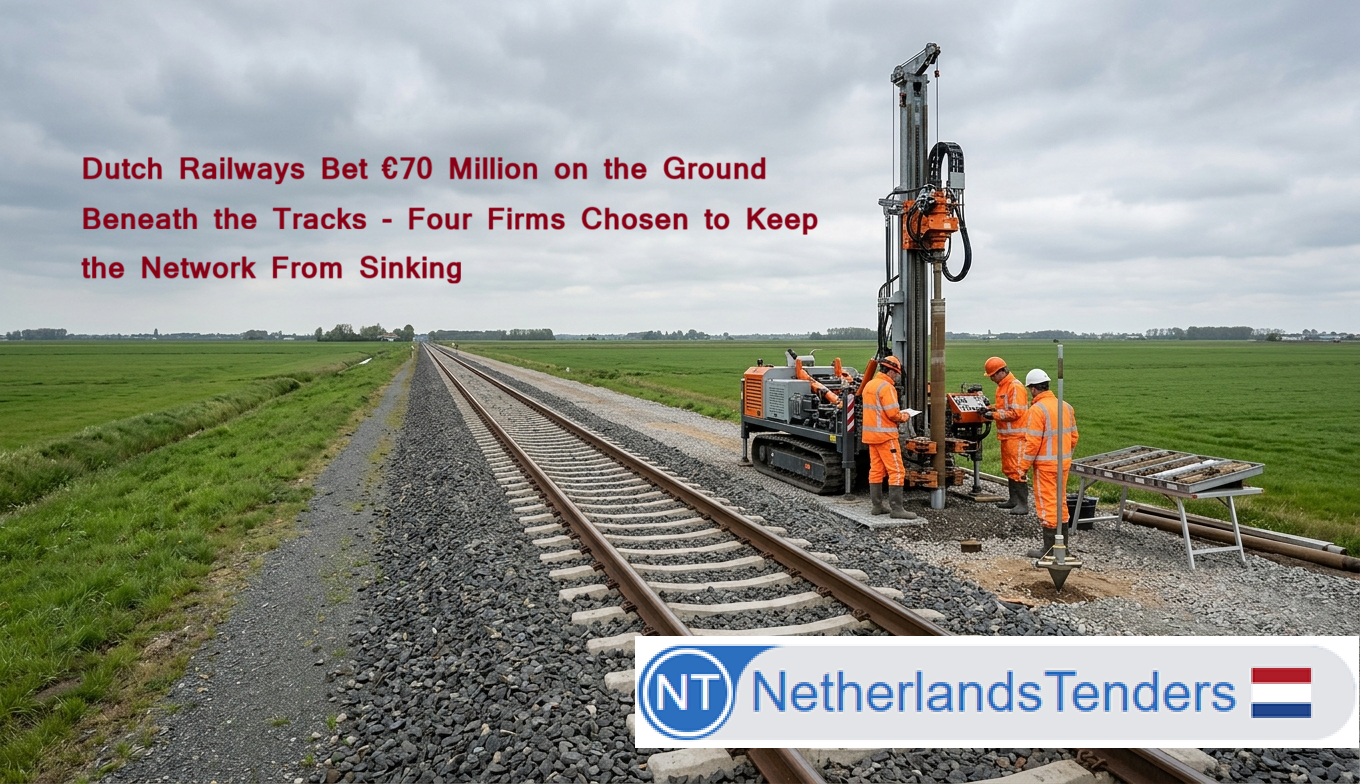
Dutch Railways Bet €70 Million on the Ground Beneath the Tracks - Four Firms Chosen to Keep the Network From Sinking
Standfirst
A quiet subsidence incident on one of the Netherlands' busiest rail corridors this year was a reminder that trains do not run on steel alone; they run on soil. ProRail, the state infrastructure manager, has awarded a four year, €70 million framework agreement for nationwide geotechnical investigation to four specialist firms: Geonius Geotechniek, Fugro NL Land, Mos Grondmechanica and BAM Infraconsult. The deal says less about engineering and more about how Europe's rail operators are quietly repricing the risk hidden underground.
Introduction
Ask most travellers what keeps a train on its rails and they will talk about signals, timetables or the condition of the track itself. Few will mention the ground underneath. Yet it is precisely that unglamorous layer of clay, peat and sand that has, time and again, brought Dutch rail traffic to a standstill. Earlier this year, a stretch of track between Den Bosch and Tilburg, one of the busiest freight and passenger corridors in the country, buckled after nearby piling work quietly weakened the load bearing capacity of the subsoil. Services stopped. Passengers were delayed. Engineers were sent scrambling.
It is against that backdrop that ProRail, the company responsible for managing the Dutch national rail network, has finalised a nationwide framework agreement worth up to €70 million for geotechnical investigation services, the drilling, sampling, testing and monitoring work that tells engineers what is really happening beneath the ballast. Four Dutch engineering firms will share the work over the next four years, with the option to extend it to eight.
Why This Contract Matters
Railway infrastructure ages in ways that are not always visible. Embankments settle. Groundwater levels shift with the seasons and with climate change. Historic peat soils, common across large parts of the Netherlands, behave unpredictably under the weight of increasingly heavy and frequent trains. When ProRail's engineers get the underlying geotechnical data wrong or do not have enough of it, the consequences show up as speed restrictions, embankment failures, or, in the worst cases, derailments.
This contract is ProRail's answer to that risk. It is not a single investigation but a standing capability: a panel of specialists who can be called upon anywhere in the country, at short notice, to characterise the ground before a renewal project begins or a problem occurs. That distinction, building permanent capacity rather than commissioning a one off study, is what turns a technical services contract into a piece of national infrastructure strategy.
Contract Timeline
| Date | Milestone |
|---|---|
| 2019 | First generation ProRail geotechnical framework agreement launched |
| 17 July 2025 | Contracts concluded with the four winning firms (per the notice) |
| 1 August 2025 | Framework agreement enters into force, according to industry reporting |
| 13 July 2026 | Contract award notice dispatched to the EU Publications Office |
| 15 July 2026 | Notice published in OJ S 134/2026 |
The gap between contract signature and public notice, roughly a year, is not unusual for utilities sector procurement in the Netherlands, where award publication can lag behind the operational start of a framework. By the time this notice reached the Official Journal, the four firms had already been active on Dutch track corridors for close to a year.
Contract Overview
ProRail ran an open, EU wide tendering procedure for a single nationwide lot covering geotechnical engineering services, cone penetration testing, borehole drilling, installation of groundwater monitoring wells and laboratory soil analysis. Rather than awarding the work to one contractor, ProRail structured the deal as a framework agreement without reopening of competition, splitting capacity across four winners: Geonius Geotechniek B.V., Fugro NL Land B.V., Mos Grondmechanica B.V. and BAM Infraconsult B.V.
The contracting authority received six tenders, four of them from micro, small or medium sized enterprises, an unusually strong SME showing for a rail infrastructure framework of this size. No complaints were lodged against the award. All tenders were submitted electronically, in line with the Netherlands' near universal shift to e procurement through the TenderNed platform.
Key Contract Details
| Field | Detail |
|---|---|
| Contracting authority | ProRail B.V. |
| Title | Landelijk-Raamovereenkomst Geotechnisch Onderzoek II (National Framework Agreement for Geotechnical Investigation II) |
| CPV code | 71332000-Geotechnical engineering services |
| Procedure type | Open procedure |
| Legal basis | Dutch ARW 2016 and the Aanbestedingswet 2012 (Netherlands Public Procurement Act) |
| Framework agreement type | Without reopening of competition |
| Number of winners | 4 |
| Contract duration | 4 years |
| Possible renewals | Up to 2 renewals of 2 years each (maximum 8 years total) |
| Maximum framework value | €70,000,000 |
| Award criterion | Price, weighted 100 (best price quality ratio methodology) |
| Tenders received | 6 (4 from SMEs) |
| EU funding | None disclosed |
| GPA coverage | Yes |
| Review body | Rechtbank Midden Nederland (District Court of Midden Nederland) |
| Place of performance | Anywhere in the Netherlands |
Project Scope
The framework covers geotechnical investigation nationwide, not tied to a single railway line or region. In practice, that means the four firms will be called upon wherever ProRail needs to understand what lies beneath a stretch of track before renewing it, reinforcing it or responding to a subsidence event. The scope includes cone penetration testing (a technique that measures soil resistance layer by layer), borehole drilling, installation of piezometers and monitoring wells to track groundwater behaviour over time and laboratory testing of soil samples.
No options were built into the contract beyond the base scope and the notice does not describe any strategic procurement objectives, such as green or social criteria, attached to this particular award. That is a notable absence given how frequently sustainability weighting now appears in Dutch infrastructure tenders and it suggests this framework was designed primarily around technical capability and price rather than broader policy goals.
About the Contracting Authority
ProRail B.V. is the company responsible for managing, maintaining and developing the Netherlands' main railway network on behalf of the Dutch state, which holds ProRail as its sole shareholder through Railinfratrust B.V., with the Ministry of Infrastructure and Water Management exercising the government's ownership role. ProRail does not run trains, that is the job of operators such as Nederlandse Spoorwegen (NS), but it controls the tracks, signalling and infrastructure those trains depend on, under a management concession granted by the Dutch state.
Because ProRail operates under special or exclusive rights in the rail sector, it procures under the EU's utilities regime rather than the classic public sector directive, which explains why this notice cites Dutch national instruments, the ARW 2016 and the Aanbestedingswet 2012, as its legal basis rather than a specific EU directive number. ProRail's core mandate includes network safety and geotechnical risk management sits close to the centre of that responsibility, particularly as climate change alters groundwater patterns beneath ageing embankments.
About the Organisations Involved
Geonius Geotechniek B.V., Winning Tenderer
Geonius Geotechniek, based in Geleen in the southern province of Limburg, is registered as a small economic operator. It is the smallest of the four winners by size classification, illustrating how ProRail's framework structure deliberately created room for a specialist regional player alongside larger multinational and construction group competitors. The firm's presence in the winning group also helps explain the strong SME participation ProRail recorded across the six bids received.
Fugro NL Land B.V., Winning Tenderer
Fugro NL Land is the Dutch land services arm of Fugro N.V., a publicly listed company on Euronext Amsterdam and one of the world's largest geo data specialists, with roots in soil investigation dating back to 1962. Fugro has worked with ProRail on rail safety and subsurface investigation for well over a decade, including previous framework agreements covering cone penetration testing and drilling in support of track renewal projects. Its scale and long institutional relationship with ProRail make it the most globally recognisable name among the four winners, even though this particular contract was won by its Dutch land services subsidiary rather than the parent group.
Mos Grondmechanica B.V., Winning Tenderer
Mos Grondmechanica, headquartered in Rotterdam, is registered as a medium sized economic operator specialising in soil mechanics, the branch of engineering that studies how soil behaves under load, water pressure and vibration. Its inclusion reflects a segment of the Dutch geotechnical market built around independent, engineering led firms rather than diversified infrastructure contractors, giving ProRail a source of specialist technical judgement distinct from its larger framework partners.
BAM Infraconsult B.V., Winning Tenderer
BAM Infraconsult, based in Gouda, operates as the engineering consultancy arm connected to Royal BAM Group, one of the Netherlands' largest construction and infrastructure companies. Its participation links this geotechnical framework to a wider ecosystem of Dutch civil engineering capacity, since BAM Group companies are frequently engaged on the construction and renewal projects that this very geotechnical data will inform.
Rechtbank Midden Nederland, Review Organisation
The District Court of Midden Nederland is named in the notice as the body responsible for handling any legal challenges to the award. Its role is purely judicial oversight; it has no operational involvement in the contract itself, but its designation is a standard procedural safeguard under Dutch procurement law, giving unsuccessful bidders a defined route to contest the outcome.
Procurement Analysis
ProRail chose an open procedure, the most transparent and competitive route available under EU utilities procurement rules, allowing any interested firm to submit a tender without a prior shortlisting stage. That choice, combined with electronic submission through TenderNed, points to a buyer prioritising broad market access over speed or discretion.
The framework agreement was structured "without reopening of competition," meaning ProRail will not run a mini competition each time it needs a geotechnical investigation. Instead, work will be distributed among the four firms according to internal allocation rules ProRail has not disclosed in this notice, commonly rotation, geographic assignment or capacity based distribution in frameworks of this kind. The tenders were also not ranked against one another (the notice explicitly marks each tender as unranked), reinforcing that all four firms sit on equal footing within the panel rather than in a first choice, second choice hierarchy.
The award criterion is listed as "Price" with a full 100 point weighting, but the underlying description makes clear this is evaluated as a best price quality ratio: bidders submitted a tender sum that was then converted into an "evaluation price" through a formula tied to their technical scoring, rather than being judged on quality and price as separate weighted criteria. That is a common Dutch public sector technique for keeping price as the formal decision variable while still rewarding technical strength through the price adjustment mechanism.
Additional Procurement Facts
ProRail received six tenders in total, four of them from micro, small or medium sized enterprises, a two thirds SME share that is high for a national scale infrastructure framework and one that likely reflects the specialised, regionally distributed nature of Dutch geotechnical engineering firms. No review requests or complaints were recorded against the award, suggesting the process was seen as fair by the market or at least did not generate formal disputes. Subcontracting was marked as not applicable for any of the four winning tenders, meaning each firm intends to deliver its share of the work with its own resources rather than through subcontractor arrangements disclosed to ProRail. The contract carries no EU funding component; it is financed entirely through ProRail's own infrastructure budget.
Market & Industry Perspective
The Dutch geotechnical engineering market sits at an interesting intersection of scale and specialism. On one side are large, often internationally listed players such as Fugro, capable of deploying advanced sensing technology and laboratory capacity across multiple sectors, rail, roads, water defences, offshore energy. On the other are focused regional specialists such as Geonius and Mos Grondmechanica, whose competitive edge lies in deep local soil knowledge and engineering judgement rather than global scale. BAM Infraconsult occupies a third position, embedded within a major construction group that gives it visibility into how geotechnical findings translate directly into renewal and reinforcement projects downstream.
ProRail's decision to award to all four, rather than consolidating the framework around one or two large suppliers, signals a preference for resilience and surge capacity over unit cost efficiency. Railway renewal work is inherently uneven, some months and some regions, require far more investigation capacity than others and a four firm panel gives ProRail flexibility that a single supplier contract would not.
Economic Significance
At up to €70 million over a potential eight year term, this framework is modest by the standards of major rail infrastructure spending, but it is economically significant in a different way: it is preventative spending designed to avoid far larger costs. A single major subsidence event, like the one near Vught this year, can shut down a busy freight and passenger corridor, disrupting logistics chains and commuter services well beyond the immediate repair cost. Investing in better subsurface knowledge is, in effect, an insurance premium against those disruptions.
For the four winning firms, the framework provides multi year revenue visibility and a foothold in one of the most consistent public infrastructure clients in the Netherlands. For the broader geotechnical services sector, it reinforces that specialised, safety critical inspection and testing work remains a durable, recession resistant niche within an otherwise cyclical construction and engineering market.
Future Procurement Opportunities
With a base term of four years and up to two two year renewal options, ProRail has effectively signalled its geotechnical investigation needs through to the early 2030s under this framework alone. The findings generated by Geonius, Fugro, Mos Grondmechanica and BAM Infraconsult will feed directly into subsequent renewal, reinforcement and monitoring contracts, meaning this award is less an endpoint than the opening stage of a much longer pipeline of rail infrastructure work.
Suppliers should also watch for parallel developments in ProRail's broader embankment safety programme, including research collaborations already under way with organisations such as Deltares and Delft University of Technology into railway embankment strength, work that is likely, over time, to translate into further tendered investigation and monitoring contracts.
Opportunities for Suppliers
Firms outside this framework should not assume the opportunity has closed. Framework agreements of this kind typically generate secondary work, laboratory subcontracting, specialist sensor and monitoring equipment supply, software for geotechnical data management and environmental or hydrological consultancy tied to specific sites. Companies with niche capabilities in automated monitoring, remote sensing or AI assisted soil behaviour prediction may find openings feeding into the four framework holders even without being named on the contract themselves.
For firms considering a bid when this framework next comes to market, the SME success rate in this round, four of six tenders, is a meaningful signal that ProRail's utilities sector procurement remains genuinely accessible to smaller, specialised operators, not just large incumbents.
What Businesses Should Watch
Three developments will shape how this framework evolves. First, how ProRail allocates work among the four firms in practice, whether by geography, rotation or capacity, will determine which of them sees the largest share of the €70 million ceiling. Second, any recurrence of subsidence incidents on the scale of the Vught disruption could accelerate demand and prompt ProRail to expand investigation intensity ahead of schedule. Third, the eventual outcome of the Deltares led embankment research programme could reshape technical specifications for the next generation of this framework, favouring firms that can demonstrate advanced monitoring and predictive capability rather than traditional drilling and sampling alone.
NetherlandsTenders.com Procurement Intelligence
This award illustrates a pattern spreading across Europe's rail and utility infrastructure managers: the shift from reactive geotechnical investigation, commissioned after something goes wrong, to standing, framework based capacity that treats subsurface knowledge as a continuous operational input rather than a one off engineering task. It mirrors similar moves by infrastructure managers in Germany, France and the United Kingdom, where climate driven changes in groundwater behaviour are pushing asset owners to formalise geotechnical monitoring rather than commission it project by project.
The decision to spread the award across four firms of very different sizes, rather than consolidating around a single large supplier, is also instructive. It suggests ProRail is deliberately preserving a diverse supplier base, partly for resilience and partly, perhaps, to avoid over dependence on any one contractor for a capability this safety critical. Suppliers competing for future utilities sector rail frameworks in the Netherlands should expect this multi winner structure to persist and should position their bids around demonstrable specialist capability rather than assuming scale alone will secure a place on the panel.
Looking further ahead, the link between this contract and ProRail's embankment research work with Deltares hints at where the next wave of specification will land: investigation firms that can integrate predictive, data driven risk modelling into their services are likely to have an advantage when this framework is renewed or retendered.
Supplier Takeaways
- ProRail's utilities sector procurement remains genuinely open to SMEs, four of six bidders in this round were small or medium sized firms.
- Multi winner framework structures, without reopening of competition, mean firms need to focus on qualifying for the panel itself rather than winning individual call offs through repeated competition.
- Subcontracting and equipment supply opportunities are likely to emerge around the four framework holders, even for firms not directly on the contract.
- Firms with predictive monitoring, sensor technology or data analytics capability should track ProRail's parallel embankment research work as an early indicator of future specification changes.
- Review and complaint activity was nil in this award, suggesting bidders should not expect legal challenge as a realistic route to reopening this particular framework.
Key Takeaways
- ProRail awarded a nationwide, €70 million geotechnical investigation framework to four firms: Geonius Geotechniek, Fugro NL Land, Mos Grondmechanica and BAM Infraconsult.
- The four year contract, extendable by up to two further two year periods, was awarded through an open procedure with price based evaluation.
- Six tenders were received, four from SMEs; no complaints were filed.
- The contract responds directly to recurring subsidence risk on the Dutch rail network, illustrated by a recent disruption near Vught.
- No EU funding is attached; the framework is financed through ProRail's own budget and is covered by the WTO Government Procurement Agreement.
Conclusion
It is easy to overlook a contract for soil testing when the headlines are dominated by new train fleets, electrification projects and high speed lines. Yet this framework agreement addresses something more fundamental: whether the ground beneath the Netherlands' railway can be trusted to hold. By spreading that responsibility across four firms of different scale and specialism, ProRail has built itself both resilience and choice, and, in the process, opened a multi year, nationwide channel of work for a segment of the engineering sector that rarely makes the news, but rarely stops being needed either.
Frequently Asked Questions
Who awarded this contract?
ProRail B.V., the company responsible for managing the Dutch national railway network, on behalf of the Dutch state.
Who won the framework agreement?
Four firms: Geonius Geotechniek B.V., Fugro NL Land B.V., Mos Grondmechanica B.V. and BAM Infraconsult B.V.
What is the contract worth?
Up to €70,000,000 across the full framework term, according to the notice.
How long does the contract last?
Four years initially, with the option for ProRail to extend it twice by two years each, for a maximum term of eight years.
Is the contract funded by the European Union?
No. The notice confirms the project is not financed with EU funds.
What procurement procedure was used?
An open procedure, ProRail's standard route for utilities sector contracts requiring broad EU wide competition.
How many companies bid for the contract?
Six tenders were received in total, four of them from micro, small or medium sized enterprises.
Why does this contract matter beyond the rail sector?
It reflects a broader shift among European infrastructure managers toward standing geotechnical monitoring capacity, driven by climate related changes in groundwater behaviour and ageing embankment infrastructure.
Source: EU Official Journal, Contract Award Notice 487570-2026, OJ S 134/2026, published 15/07/2026. Contracting authority: ProRail B.V.

Fresh and verified Tenders from Netherlands. Find, search and filter Tenders/Call for bids/RFIs/RFPs/RFQs/Auctions published by the government, public sector undertakings (PSUs) and private entities.
- 1,000+ Tenders
- Verified Tenders Only
- New Tenders Every Day
- Tenders Result Data
- Archive & Historical Tenders Access
- Consultants for RFI/RFP/RFQ
- Tender Notifications & Alerts
- Search, Sort, and Filter Tenders
- Bidding Assistance & Consulting
- Customer Support
- Publish your Tenders
- Export data to Excel
- API for Tender Data
- Tender Documents

Fill out the form below and you will receive a call from us within 24 hours.
Get FREE SAMPLE TENDERS from Netherlands in your email inbox.
Copyright © 2014-2026 NetherlandsTenders.com. All Rights Reserved.