European Medicines Agency Awards €4.1 Million Multi-Lot Framework for Medicines Safety, Quality and Efficacy Research
Introduction
European regulators have selected universities, medicines agencies, research institutes and specialist companies for a major seven-lot research framework supporting the quality, safety and efficacy assessment of medicines.
The European Medicines Agency (EMA), together with the European Centre for Disease Prevention and Control (ECDC), has concluded a major multi-lot procurement covering specialised scientific and research consultancy services related to medicines.
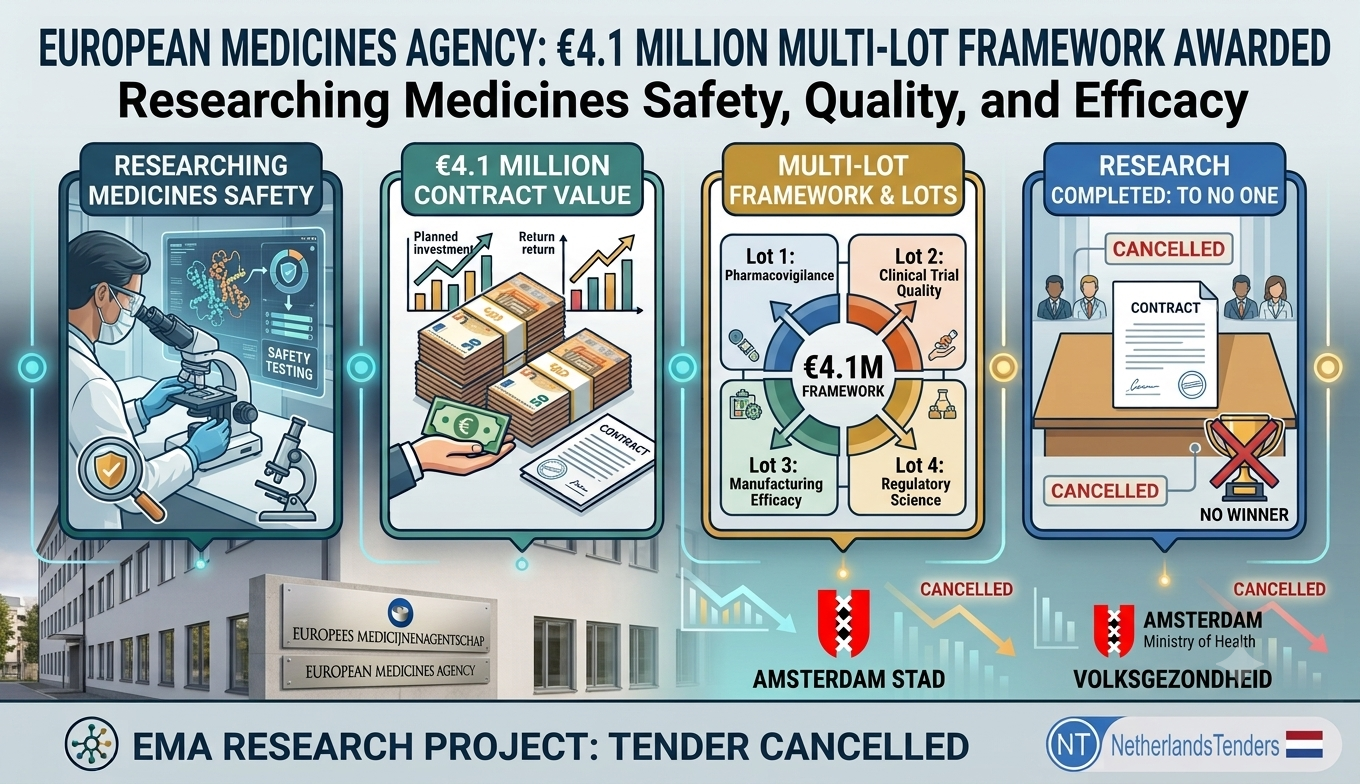
The procurement, published under TED Notice 478941-2026, covers seven distinct research areas and has an estimated total value of €4.1 million excluding VAT. The framework brings together academic institutions, regulatory bodies, research organisations and private-sector specialists from across Europe.
Unlike a conventional single winner procurement, this framework establishes a broad scientific supplier ecosystem. Selected contractors may subsequently compete for specific assignments through reopening of competition, allowing EMA to access specialist expertise according to emerging regulatory and scientific requirements.
Why This Contract Matters
Modern medicines regulation increasingly depends on advanced scientific evidence, real world healthcare data, statistical methodologies, artificial intelligence, manufacturing science and computational research.
Regulators must evaluate increasingly complex products while responding to new challenges involving rare diseases, advanced therapies, biological medicines, medicine shortages and rapidly evolving health technologies.
This procurement therefore represents more than a conventional consultancy contract. It creates a flexible scientific research network that can support European regulatory decision-making across the complete medicines lifecycle.
The contract is particularly significant because it combines expertise from universities, national medicines agencies, specialised research institutes and commercial organisations. This reflects a broader trend in European public procurement: complex scientific challenges increasingly require multidisciplinary supplier ecosystems rather than dependence on a single contractor.
Contract Timeline
- Winner Selection Date: 10 January 2026
- Contract Conclusions: Primarily February and March 2026, depending on the individual lot and contractor
- Updated Notice Dispatch Date: 9 July 2026
- TED Publication Date: 10 July 2026
- TED Notice Number: 478941-2026
Contract Overview
The framework covers seven specialised research categories:
- Research related to the quality of medicines
- Research related to medicine safety and regulatory evidence
- Methodological and statistical research
- Research supporting regulatory science and medicine evaluation
- Specialised medicines research involving real-world data and scientific evidence
- Research concerning manufacturing, bioprocessing and medicine quality
- Computational methods for comparing molecular structural features in medicines for rare diseases
All seven lots form part of a single grouped procurement with an estimated total value of €4.1 million excluding VAT.
Key Contract Details
| Item | Details |
|---|---|
| Contracting Authorities | European Medicines Agency (EMA) and European Centre for Disease Prevention and Control (ECDC) |
| Procurement Subject | Quality, safety and efficacy studies of medicines |
| Contract Type | Services |
| Main CPV Code | 73210000 – Research consultancy services |
| Number of Lots | 7 |
| Estimated Total Value | €4.1 million excluding VAT |
| Procurement Technique | Framework agreement with reopening of competition |
| Evaluation Weighting | Quality: 70% | Price: 30% |
| Dynamic Purchasing System | No |
| Legal Basis | Regulation (EU, Euratom) 2024/2509 |
| TED Notice | 478941-2026 |
| Publication Date | 10 July 2026 |
Understanding the Seven-Lot Research Framework
Lot 1: Medicines Quality Research
The first lot focuses on scientific research supporting the quality assessment of medicinal products. Such work can include analytical methodologies, product characterisation, pharmaceutical quality evaluation and other scientific studies required for evidence-based regulatory decision-making.
Lot 2: Safety and Regulatory Evidence Research
This lot brings regulatory and scientific expertise into research concerning medicine safety and evidence generation. Among the selected organisations is the Danish Medicines Agency, demonstrating direct participation by a national medicines regulator in the framework.
Lot 3: Methodological and Statistical Research
Lot 3 covers methodological and statistical research. Selected expertise includes Hasselt University Data Science Institute and Katholieke Universiteit Leuven's L-BioStat research unit.
This category is particularly important because advanced statistical methodologies underpin clinical evidence assessment, benefit-risk analysis, epidemiological studies and regulatory decision-making.
Lot 4: Specialised Regulatory and Scientific Research
Lot 4 establishes a ranked group of selected research providers. At least four winning tenders were ranked under this lot, demonstrating EMA's intention to maintain competitive access to multiple specialist research teams.
The procurement notice also reveals significant subcontracting in some successful tenders, including a 60% subcontracting share for certain Lot 4 contracts. This highlights the importance of consortium formation and specialist partnerships in complex European research procurement.
Lot 5: Real-World Data and Specialised Medicines Research
Lot 5 attracted a particularly diverse range of organisations, including commercial research specialists and academic institutions.
Disclosed successful organisations include IQVIA Solutions BV, Panepistimio Patron and Certara France SARL, among other selected research providers and consortium participants.
The subcontracting arrangements vary considerably. Individual successful tenders disclose subcontracting shares including 22%, 30%, 82% and 85%, demonstrating how specialist research organisations combine capabilities to meet complex scientific requirements.
Lot 6: Manufacturing, Bioprocessing and Quality Research
It includes specialist expertise in manufacturing science, bioprocessing and pharmaceutical quality.
Among the disclosed winners are:
- Università degli Studi di Milano
- National Institute for Bioprocessing Research and Training Limited
The participation of specialist academic and bioprocessing organisations demonstrates the increasing importance of manufacturing science in medicines regulation, particularly for biological products and advanced therapies.
Lot 7: Computational Research for Rare-Disease Medicines
The seventh lot focuses on computational methods for comparing molecular structural features in the context of medicines for rare diseases.
The maximum framework value disclosed for this lot is €500,000. One of the selected organisations is the Istituto di Ricerche Farmacologiche Mario Negri.
This lot is strategically important because computational science is becoming increasingly relevant to medicine development and regulatory evaluation. Advanced modelling can support molecular comparisons, evidence generation and scientific assessment where conventional clinical datasets may be limited, particularly in rare diseases.
About the Contracting Authorities
European Medicines Agency
The European Medicines Agency is the European Union agency responsible for the scientific evaluation, supervision and safety monitoring of medicines in the EU.
EMA works with national regulatory authorities and scientific experts across Europe to assess medicinal products and support evidence-based regulatory decisions concerning medicine quality, safety and efficacy.
Under this procurement, EMA acts as the organisation signing the framework contracts.
European Centre for Disease Prevention and Control
The European Centre for Disease Prevention and Control is an EU agency supporting Europe in identifying, assessing and responding to threats from infectious diseases.
Its inclusion in the procurement demonstrates the potential cross-agency value of scientific research frameworks, particularly where medicines, public health evidence, epidemiology and infectious disease surveillance intersect.
Organisations Involved in the Framework
The procurement brings together a broad range of scientific organisations. Disclosed winners, tendering parties, leaders and participating organisations include:
- Danish Medicines Agency
- Hasselt University, Data Science Institute
- Katholieke Universiteit Leuven, L-BioStat
- IQVIA Solutions BV
- Panepistimio Patron
- Certara France SARL
- Università degli Studi di Milano
- National Institute for Bioprocessing Research and Training Limited
- Istituto di Ricerche Farmacologiche Mario Negri
The structure of the procurement demonstrates that European scientific tenders are increasingly accessible to several types of organisations, including universities, public-sector institutions, national regulatory authorities, independent research institutes, data-science specialists and private consultancy companies.
Procurement Analysis
Three characteristics make this procurement particularly noteworthy.
1. Quality Dominated the Evaluation
The evaluation assigned 70% weighting to quality and 30% to price. This is highly significant for suppliers.
In advanced scientific procurement, the cheapest bid is not necessarily the strongest. Technical methodology, research capability, scientific expertise, team composition and previous experience can have substantially greater influence on the award decision.
2. EMA Created a Scientific Supplier Ecosystem
Instead of relying on a single research provider, EMA established a network of specialist organisations across seven scientific disciplines.
This gives the agency flexibility to respond to emerging regulatory challenges while maintaining competition among qualified framework contractors.
3. Partnerships and Subcontracting Are Strategically Important
Some successful tenders disclose substantial subcontracting percentages, reaching as high as 85% in individual cases.
This is an important market signal. Specialist companies do not always need to lead major EU research tenders independently. They may participate as consortium members, research partners or subcontractors where their niche capabilities strengthen a broader bid.
Additional Procurement Facts
- The main CPV classification is 73210000 – Research consultancy services.
- The procurement covers all seven lots under a grouped estimated value of €4.1 million excluding VAT.
- The framework uses reopening of competition.
- No dynamic purchasing system is used.
- The legal basis is Regulation (EU, Euratom) 2024/2509.
- The General Court of the European Union is identified as the review organisation.
- The European Medicines Agency signs the contracts.
- The updated award notice was published on 10 July 2026.
Market and Industry Perspective
Pharmaceutical regulatory science is becoming increasingly data-intensive, multidisciplinary and technology-driven.
Regulators now require expertise across traditional pharmaceutical science as well as:
- Advanced biostatistics
- Real-world evidence
- Data science and artificial intelligence
- Pharmacoepidemiology
- Bioprocessing
- Advanced manufacturing
- Molecular modelling
- Rare-disease research
- Regulatory methodology
This creates a growing procurement market for universities, contract research organisations, pharmaceutical consultancies, health-data specialists and scientific institutes capable of delivering highly specialised evidence.
Economic and Strategic Significance
Although the €4.1 million estimated value is relatively modest compared with major infrastructure procurements, the strategic importance of this framework is considerably greater than its financial size alone suggests.
Scientific research commissioned through such frameworks can contribute to regulatory methodologies affecting medicine development, approval, safety monitoring and patient access across the European Union.
The procurement also directs public funding towards a geographically diverse scientific ecosystem, helping connect regulatory agencies with specialist expertise across universities, public institutions and private-sector research organisations.
Future Procurement Opportunities
The structure of this framework provides several signals for organisations targeting future opportunities in European health and scientific procurement.
Demand is likely to remain strong in areas such as:
- Artificial intelligence for medicine assessment
- Real-world evidence and healthcare data analytics
- Advanced statistical methodologies
- Pharmacovigilance and medicine safety
- Rare-disease research
- Biological medicines and advanced therapies
- Pharmaceutical manufacturing science
- Computational modelling
- Regulatory science consultancy
Opportunities for Suppliers
For research organisations seeking to enter this market, direct participation as a prime contractor is only one route.
Potential opportunities also exist through consortium formation, academic partnerships, subcontracting, specialist data services and participation in individual competitions reopened under framework agreements.
Smaller specialist firms can be particularly valuable where they possess niche expertise that larger bidders need to strengthen their technical proposals.
What Businesses Should Watch
Suppliers interested in European pharmaceutical and healthcare procurement should closely monitor EMA, ECDC and other EU agency procurement programmes.
They should pay particular attention to:
- New framework agreements for scientific services
- Reopening of competition under existing frameworks
- Requests for real-world evidence and data analytics
- AI and computational research opportunities
- Consortium-building opportunities before tender deadlines
- Subcontracting requirements published by major research contractors
NetherlandsTenders.com Procurement Intelligence
This award reveals four important trends shaping scientific public procurement in Europe.
1. Scientific Procurement Is Becoming More Specialised
Broad consultancy capability alone is increasingly insufficient. Buyers require deep expertise in precisely defined areas such as biostatistics, molecular modelling, bioprocessing and rare-disease research.
2. Quality Is More Important Than Lowest Price
With quality carrying 70% of the evaluation weight, this procurement demonstrates that technically sophisticated tenders reward methodology, scientific credibility and specialist expertise.
3. Consortium Building Is a Competitive Advantage
The presence of tendering parties, academic partnerships and high subcontracting percentages shows that organisations can strengthen their position by combining complementary capabilities.
4. Framework Qualification Creates Long-Term Opportunity
Winning a place on a framework is not simply about one immediate assignment. It creates access to future competitions and can establish a longer-term commercial relationship with major public buyers.
Supplier Takeaways
- Monitor EMA, ECDC and EU health-agency procurement opportunities regularly.
- Build partnerships with universities, research institutes and specialist consultancies before tenders are published.
- Invest in demonstrable expertise in data science, biostatistics, real-world evidence and regulatory science.
- Do not ignore subcontracting opportunities; some successful tenders rely heavily on external specialist capabilities.
- Focus strongly on technical quality because specialist scientific procurements may assign substantially greater weighting to quality than price.
- Track framework agreements even after the initial award because reopening of competition can generate future contract opportunities.
Key Takeaways
- EMA and ECDC have established a seven-lot framework for studies concerning the quality, safety and efficacy of medicines.
- The grouped procurement has an estimated total value of €4.1 million excluding VAT.
- The framework covers research consultancy services under CPV 73210000.
- Quality accounted for 70% of the evaluation and price for 30%.
- Universities, medicines agencies, research institutes and commercial specialists were selected.
- The framework uses reopening of competition, creating opportunities for future assignments.
- Subcontracting percentages in individual successful bids range significantly and reach as high as 85%.
- The procurement highlights growing demand for advanced statistical research, real-world evidence, bioprocessing and computational science.
Conclusion
The European Medicines Agency's €4.1 million scientific research framework demonstrates how modern medicines regulation increasingly depends on multidisciplinary expertise distributed across universities, regulators, specialist research institutes and private-sector companies.
By dividing the requirement into seven specialised lots and selecting multiple research providers, EMA has created a flexible scientific ecosystem capable of supporting future regulatory challenges.
For suppliers, the procurement offers a valuable lesson: success in highly specialised public-sector research markets increasingly depends on scientific credibility, technical quality, strategic partnerships and early positioning within framework agreements.
As European regulators continue adopting advanced data analytics, real-world evidence, computational methods and sophisticated manufacturing science, procurement opportunities for specialised research organisations are likely to expand further.
Frequently Asked Questions
Q1. What is the subject of the EMA procurement?
The procurement covers research consultancy services supporting studies on the quality, safety and efficacy of medicines.
Q2. What is the estimated value of the framework?
The grouped estimated value of the seven lots is €4.1 million excluding VAT.
Q3. How many lots are included?
The framework consists of seven specialised research lots.
Q4. Who are the contracting authorities?
The buyers identified in the procurement notice are the European Medicines Agency and the European Centre for Disease Prevention and Control.
Q5. What is the main CPV code?
The main CPV code is 73210000 for research consultancy services.
Q6. How were bids evaluated?
The evaluation placed 70% weight on quality and 30% on price, demonstrating the importance of technical and scientific capability.
Q7. Can smaller specialist organisations benefit from similar tenders?
Yes. The procurement shows substantial use of partnerships and subcontracting. Smaller organisations with specialist expertise may participate as consortium members or subcontractors.
Q8. What is reopening of competition?
It means that contractors admitted to a framework may compete again for specific assignments issued during the framework period.
Q9. Why is this procurement important for suppliers?
It demonstrates growing demand for specialist expertise in pharmaceutical science, biostatistics, real-world evidence, bioprocessing, data science and computational research.
Q10. Where was the contract award notice published?
The award was published in the Tenders Electronic Daily under Notice 478941-2026 on 10 July 2026.
Source
Official Tenders Electronic Daily (TED) Contract Award Notice 478941-2026.

Fresh and verified Tenders from Netherlands. Find, search and filter Tenders/Call for bids/RFIs/RFPs/RFQs/Auctions published by the government, public sector undertakings (PSUs) and private entities.
- 1,000+ Tenders
- Verified Tenders Only
- New Tenders Every Day
- Tenders Result Data
- Archive & Historical Tenders Access
- Consultants for RFI/RFP/RFQ
- Tender Notifications & Alerts
- Search, Sort, and Filter Tenders
- Bidding Assistance & Consulting
- Customer Support
- Publish your Tenders
- Export data to Excel
- API for Tender Data
- Tender Documents

Fill out the form below and you will receive a call from us within 24 hours.
Get FREE SAMPLE TENDERS from Netherlands in your email inbox.
Copyright © 2014-2026 NetherlandsTenders.com. All Rights Reserved.