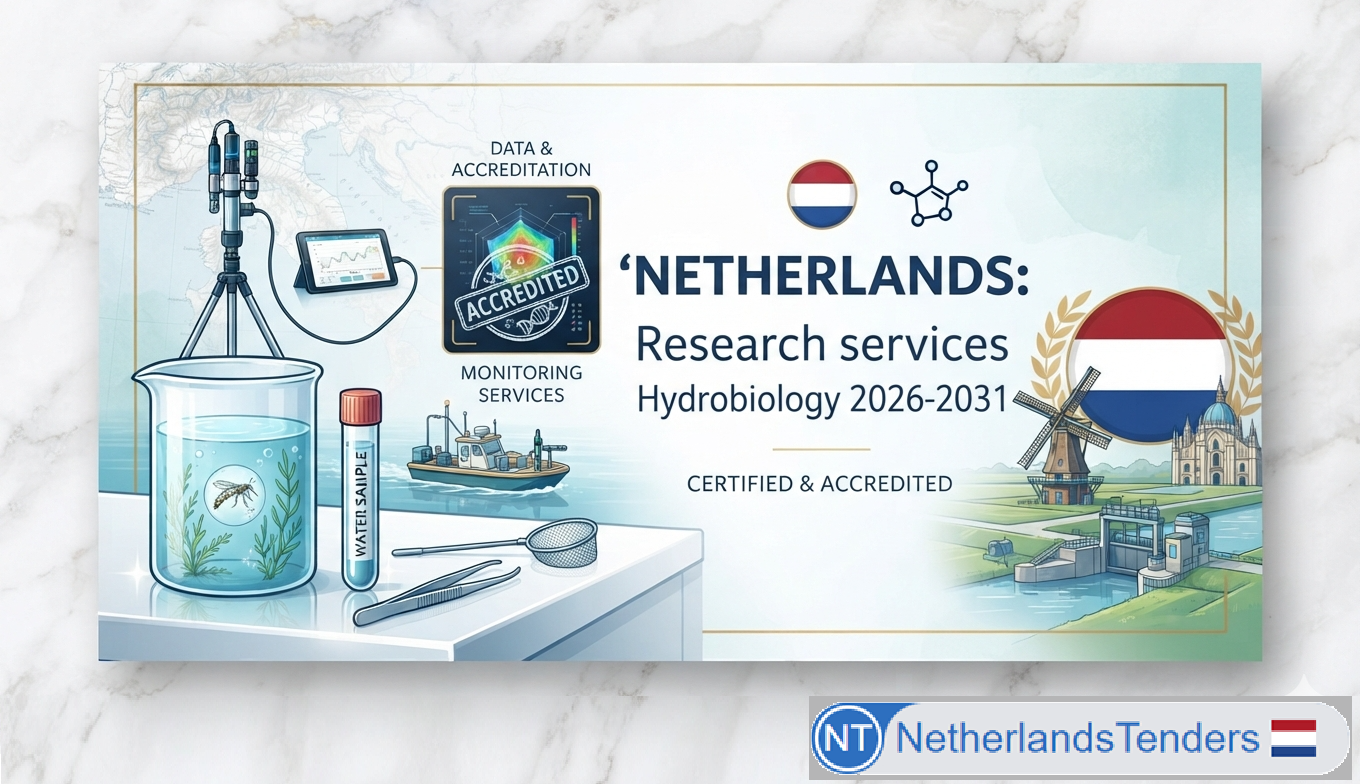
Netherlands Awards €14.1 Million Hydrobiological Monitoring Contract to Support National Water Quality Programmes
21 Jul 2026
Standfirst: Rijkswaterstaat Centrale Informatievoorziening has awarded a €14.1 million contract for accredited hydrobiological monitoring services to the Consortium Bureau Waardenburg B.V. and Eurofins Omegam B.V. The long term agreement will support national monitoring of rivers, estuaries and marine ecosystems, helping the Netherlands meet statutory environmental obligations under European and national water legislation. Introduction The Dutch government has strengthened its long term environmental monitoring programme by awarding a specialised hydrobiological research contract covering the period from 2026 onwards. Rijkswaterstaat Centrale Informatievoorziening, the information and procurement division of the Netherlands' national water management authority, selected the Consortium Bureau Waardenburg B.V. and Eurofins Omegam B.V. to provide accredited hydrobiological monitoring services across the country. Published as TED Contract Award Notice 503862-2026, the procurement covers the collection and analysis of biological information from rivers, estuaries and marine environments. The contract focuses on monitoring aquatic ecosystems through macrozoobenthos, phytobenthos and plankton, providing essential scientific data used by Rijkswaterstaat to fulfil statutory environmental reporting obligations and support evidence based water management policies. The awarded contract has a value of approximately €14.1 million, while the overall estimated procurement value was approximately €28.63 million. The agreement has an initial duration of six years with the possibility of two additional extensions of three years each, allowing environmental monitoring activities to continue consistently over a potential twelve year period. Why This Contract Matters Hydrobiological monitoring forms the scientific foundation of modern water management. Governments rely on continuous biological assessments to understand ecosystem health, evaluate pollution levels, measure biodiversity and comply with environmental legislation. For the Netherlands, a country with an extensive network of rivers, canals, estuaries and coastal waters, maintaining reliable ecological monitoring programmes is particularly important. Data generated under this contract will contribute to national assessments required under several regulatory frameworks, including the European Water Framework Directive (WFD), the Marine Strategy Framework Directive (MSFD) and national monitoring programmes managed by Rijkswaterstaat. The procurement demonstrates how public authorities increasingly depend on long term scientific partnerships rather than short term consultancy assignments. Environmental monitoring requires consistency in sampling methodologies, laboratory accreditation and data interpretation to ensure that results remain comparable across multiple years. By appointing a consortium of specialised environmental research organisations, Rijkswaterstaat aims to preserve continuity in ecological datasets while ensuring that monitoring activities continue to meet internationally recognised laboratory accreditation standards. Contract Timeline Milestone Details Country Netherlands Contracting Authority Rijkswaterstaat Centrale Informatievoorziening TED Notice 503862-2026 Official Journal OJ S 138/2026 Publication Date 21 July 2026 Procedure Negotiated Procedure without Prior Call for Competition Main CPV 73110000 – Research Services Additional CPV 73112000 – Marine Research Services Winner Selected 1 June 2026 Contract Signed 2 June 2026 Contract Overview The procurement covers accredited hydrobiological monitoring services across the Netherlands. The selected consortium will collect and analyse biological information from freshwater and marine ecosystems, enabling Rijkswaterstaat to evaluate ecological conditions in rivers, estuaries and coastal waters. The monitoring programme includes assessment of macrozoobenthos, phytobenthos and plankton, all of which serve as important biological indicators for measuring water quality, ecosystem health and environmental change. These datasets support national reporting obligations while helping policymakers evaluate the effectiveness of environmental protection measures. The contract extends beyond laboratory analysis by providing a comprehensive scientific monitoring service that combines accredited sampling, ecological expertise, quality assurance and long term data continuity. According to the procurement documents, the consortium consists of two accredited companies Eurofins AquaSense and Waardenburg Ecology working together to deliver the required monitoring activities. Key Contract Details Category Information Buyer Rijkswaterstaat Centrale Informatievoorziening Country Netherlands Sector Environmental Research & Water Management Procurement Title Hydrobiologie 2026–2031 (Monitoring Services under Accreditation) Contract Type Services Procedure Negotiated without Prior Call for Competition Main CPV 73110000 – Research Services Additional CPV 73112000 – Marine Research Services Estimated Contract Value €28,629,000 (excluding VAT) Awarded Contract Value €14,102,090.50 Contract Duration 144 Months (including extension options) Winning Consortium Consortium Bureau Waardenburg B.V. and Eurofins Omegam B.V. Project Scope The project focuses on generating scientifically validated hydrobiological information required for national environmental monitoring programmes. Activities include sampling aquatic ecosystems, laboratory analysis and interpretation of biological indicators that measure ecological conditions across Dutch rivers, estuaries and marine waters. The procurement specifically covers monitoring of macrozoobenthos, phytobenthos and plankton communities, which are widely recognised as sensitive indicators of ecosystem health. Maintaining long term datasets enables Rijkswaterstaat to evaluate environmental trends, identify changes in biodiversity and fulfil reporting obligations arising from European environmental legislation. The procurement requires services to be delivered under accredited laboratory standards, ensuring that all monitoring activities comply with recognised quality assurance requirements and produce scientifically reliable data suitable for regulatory decision making. About the Contracting Authority Rijkswaterstaat Centrale Informatievoorziening is part of Rijkswaterstaat, the executive agency of the Dutch Ministry responsible for managing the country's national road network, waterways and water systems. The organisation plays a central role in flood protection, water quality management, environmental monitoring and infrastructure development throughout the Netherlands. Within this procurement, Rijkswaterstaat Centrale Informatievoorziening acted as the contracting authority, procurement coordinator and contract signing organisation. It is also responsible for providing additional procurement information and handling review procedures related to the tender. The authority regularly procures specialised environmental research, engineering, monitoring and information management services that support national public infrastructure and environmental policy.About the Organisations Involved The contract was awarded to the Consortium Bureau Waardenburg B.V. and Eurofins Omegam B.V., two specialised organisations with expertise in ecological research, environmental monitoring and accredited laboratory analysis. Bureau Waardenburg B.V. is a Dutch ecological consultancy recognised for its work in biodiversity assessments, ecological monitoring and environmental research. The organisation has extensive experience supporting government agencies with scientific studies relating to aquatic ecosystems, protected species and environmental impact assessments. Eurofins Omegam B.V., part of the Eurofins Scientific network, provides accredited laboratory testing and environmental analytical services. Its expertise in water quality testing and hydrobiological analysis complements the ecological capabilities of Bureau Waardenburg, enabling the consortium to deliver integrated monitoring services under accredited quality standards. Together, the consortium secured the contract valued at €14,102,090.50, with the agreement commencing following contract signature on 2 June 2026. Procurement Analysis Rijkswaterstaat adopted a Negotiated Procedure without Prior Call for Competition under Directive 2014/24/EU to award this specialised environmental monitoring contract. Unlike an open or restricted tender, this procedure is permitted only under exceptional circumstances. In this case, the contracting authority justified the direct award on the grounds that the services could only be delivered by a specific economic operator because of the absence of competition for technical reasons. According to the procurement notice, the hydrobiological monitoring programme supports statutory obligations under the European Water Framework Directive (WFD), the Marine Strategy Framework Directive (MSFD) and the Dutch national water monitoring programme (MWTL). Delivering these services requires accredited laboratories operating in accordance with NEN-EN ISO/IEC 17025, together with specialist knowledge of Dutch monitoring methodologies, historical ecological datasets and Rijkswaterstaat's technical procedures. Rijkswaterstaat explained that only the consortium of Bureau Waardenburg and Eurofins possesses the combined accreditation, capacity, expertise and historical knowledge required to perform the complete assignment. Replacing the incumbent monitoring arrangement would create significant risks to the continuity and comparability of long-term ecological datasets while also generating additional costs associated with re-accreditation, validation and quality assurance. The contracting authority further noted that market analysis identified only two accredited organisations capable of delivering the required hydrobiological monitoring services and both organisations must collaborate to provide sufficient capacity and technical expertise. Consequently, no reasonable alternative supplier currently exists within the Dutch market. The procurement was evaluated solely on the basis of Price, carrying a weighting of 100 points. Since only one compliant tender was received, the consortium was awarded the contract valued at €14,102,090.50. The procurement was not established as a framework agreement and does not utilise a Dynamic Purchasing System (DPS). Although the project is not financed by European Union funds, it is covered by the WTO Government Procurement Agreement (GPA). Additional Procurement Facts Item Details Contracting Authority Rijkswaterstaat Centrale Informatievoorziening Procedure Negotiated Procedure without Prior Call for Competition Legal Basis Directive 2014/24/EU Main CPV 73110000 – Research Services Additional CPV 73112000 – Marine Research Services Estimated Value €28,629,000 (excluding VAT) Awarded Value €14,102,090.50 Contract Duration 144 Months Tenders Received 1 Framework Agreement No Dynamic Purchasing System No EU Funding No Government Procurement Agreement Yes Strategic Procurement Objective Reduction of Environmental Impacts Market and Industry Perspective The contract reflects the increasing importance of environmental intelligence within public sector decision making. Governments across Europe continue investing in long term ecological monitoring programmes to meet environmental legislation, improve water quality and protect biodiversity. Demand for accredited hydrobiological monitoring services is expected to grow as environmental regulations become more stringent and authorities seek increasingly detailed ecological datasets. Long term monitoring programmes require consistency in methodology, laboratory accreditation and scientific interpretation, creating high barriers to market entry. The procurement also illustrates the highly specialised nature of environmental research markets. Unlike conventional consultancy services, hydrobiological monitoring depends on years of accumulated ecological knowledge, accredited laboratory infrastructure and experienced scientific personnel capable of maintaining continuity across decades of environmental observations. Economic Significance Although relatively modest in value compared with major infrastructure projects, the €14.1 million contract plays a significant role in supporting evidence based environmental management across the Netherlands. The monitoring data generated under this agreement will influence water management policies, ecological restoration programmes, biodiversity protection initiatives and compliance reporting under European environmental legislation. Reliable environmental datasets also support infrastructure planning, flood management, habitat conservation and sustainable development strategies. For specialised environmental consultancies and accredited laboratories, contracts of this nature provide long term revenue stability while strengthening technical expertise and scientific capabilities within the environmental services sector. Future Procurement Opportunities As governments continue expanding environmental monitoring programmes, similar procurement opportunities are expected across Europe in areas such as: Water quality monitoring Marine ecosystem assessments Freshwater biodiversity surveys Environmental laboratory testing Ecological consultancy services Climate adaptation monitoring River restoration studies Coastal ecosystem monitoring Environmental data management Accredited sampling and laboratory services Opportunities for Suppliers The contract highlights opportunities for organisations operating in environmental science and ecological consultancy. Environmental research institutes Accredited testing laboratories Marine ecology specialists Freshwater ecology consultancies Biodiversity monitoring organisations Environmental data analytics providers Water quality laboratories Scientific field survey companies Environmental GIS specialists Natural resource management consultants Companies capable of combining accredited laboratory analysis with long term ecological monitoring expertise will remain well positioned as environmental compliance requirements continue to expand. What Businesses Should Watch Environmental monitoring is becoming an increasingly strategic procurement category across Europe. Suppliers should monitor future opportunities issued by national water authorities, environmental agencies and marine research organisations. Growing investments in climate resilience, biodiversity protection and ecosystem restoration are likely to increase demand for accredited monitoring services, particularly those involving long term scientific datasets and regulatory compliance. NetherlandsTenders.com Procurement Intelligence From a procurement intelligence perspective, this contract highlights several important developments shaping environmental procurement across Europe. Governments are investing in long term scientific monitoring rather than short term consultancy projects. Laboratory accreditation has become a critical qualification requirement. Continuity of environmental datasets is increasingly recognised as strategically important. Highly specialised environmental markets often have limited competition. Ecological monitoring contracts are becoming longer in duration to preserve data consistency. Environmental legislation continues driving investment in scientific monitoring programmes. Supplier Takeaways Invest in internationally recognised laboratory accreditation. Develop specialist expertise in ecological monitoring methodologies. Strengthen long term environmental data management capabilities. Build partnerships with complementary scientific organisations. Monitor procurement pipelines from national environmental authorities. Maintain expertise in European environmental legislation and compliance reporting. Key Takeaways Rijkswaterstaat awarded a €14.1 million hydrobiological monitoring contract. The contract was awarded to Consortium Bureau Waardenburg B.V. and Eurofins Omegam B.V. The agreement supports Dutch and European environmental monitoring obligations. The procurement used a negotiated procedure without prior competition due to technical exclusivity. The contract may continue for up to 12 years through extension options. The project contributes to long term protection of Dutch freshwater and marine ecosystems. Conclusion The Hydrobiology 2026–2031 contract demonstrates the Netherlands' commitment to maintaining high quality environmental monitoring through accredited scientific partnerships. By appointing a specialist consortium with proven technical expertise, Rijkswaterstaat ensures the continuity of ecological datasets that underpin national water management and environmental policy. As governments place greater emphasis on climate resilience, biodiversity conservation and evidence based environmental decision making, long term monitoring contracts of this nature are expected to become increasingly important. For environmental research organisations, accredited laboratories and ecological consultancies, similar procurement opportunities are likely to emerge across Europe as regulatory requirements continue to evolve. Source:TED Contract Award Notice: 503862-2026; Official Journal of the European Union (OJ S 138/2026); Publication Date: 21 July 2026
View Details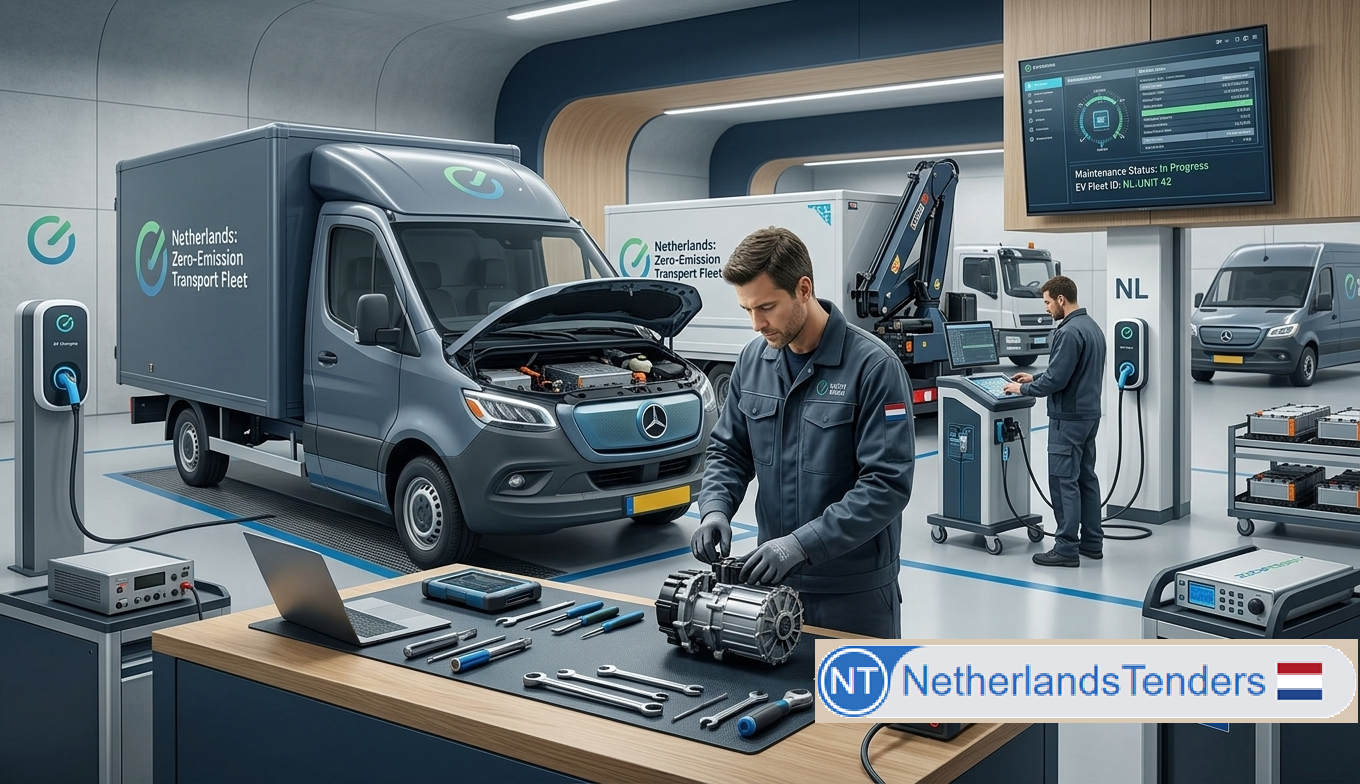
Amsterdam Awards Major Zero-Emission Utility Vehicle Contracts to Accelerate Municipal Fleet Electrification
20 Jul 2026
Standfirst: The Municipality of Amsterdam has concluded one of its largest sustainable fleet procurement programmes by awarding contracts for the supply of approximately 420 zero emission utility vehicles, together with repair, maintenance and damage restoration services. Divided into eight specialist lots, the procurement supports the city's long term climate ambitions while creating significant opportunities for vehicle manufacturers, fleet management providers and electric mobility suppliers. Introduction The Municipality of Amsterdam (Gemeente Amsterdam) has completed a major European public procurement programme for the acquisition of approximately 420 zero emission utility vehicles. The procurement covers not only the supply of battery electric commercial vehicles but also long term repair, maintenance and damage repair services, ensuring complete lifecycle support for the municipal fleet. Published as TED Contract Award Notice 501236-2026, the procurement represents another significant investment in sustainable public transport assets and municipal fleet electrification. By structuring the competition into eight separate lots covering multiple vehicle categories and weight classes, Amsterdam has encouraged wider market participation while ensuring that different operational departments receive vehicles suited to their individual requirements. The procurement aligns with broader Dutch and European Union decarbonisation objectives that encourage public authorities to transition away from fossil fuel powered vehicles. Municipal fleets play a critical role in daily city operations, including infrastructure maintenance, parks management, public works, waste services and logistics, making fleet electrification an important contributor to reducing urban emissions. Why This Contract Matters Amsterdam has consistently positioned itself among Europe's leading smart and sustainable cities. Electrifying municipal vehicle fleets is an important component of its environmental strategy, helping reduce greenhouse gas emissions, improve urban air quality and lower long term operating costs. Rather than purchasing vehicles through a single framework, the municipality divided the procurement into eight specialised lots that cover multiple vehicle configurations, gross vehicle weights and driving licence categories. This approach increases competition among manufacturers while enabling specialised suppliers to compete within their strongest market segments. The contract also demonstrates how European municipalities increasingly procure complete mobility solutions rather than standalone vehicles. Including maintenance, repair and damage restoration within the same procurement ensures predictable lifecycle costs while improving fleet availability throughout the operational period. Contract Timeline Milestone Details Country Netherlands Buyer Gemeente Amsterdam Notice Type Contract Award Notice Notice Number 501236-2026 OJ Publication OJ S 137/2026 Publication Date 20 July 2026 Procedure Open Procedure Main CPV 34144700 – Utility vehicles Procurement Type Supplies Lots 8 Contract Overview The procurement concerns the purchase of approximately 420 zero emission commercial vehicles for municipal operations. Beyond supplying the vehicles themselves, the successful contractors will also provide maintenance, repairs and accident damage restoration throughout the lifecycle of the fleet. The tender has been organised into eight lots covering multiple vehicle categories, including: Chassis cab vehicles with cargo beds Double cab chassis vehicles Closed delivery vans Heavy duty commercial vehicles Licence Category B vehicles Licence Category C vehicles Various gross vehicle weight (GVW) ranges This structure enables Amsterdam to procure vehicles tailored to specific municipal services while encouraging competition among manufacturers that specialise in different vehicle classes. Key Contract Details Category Information Buyer Gemeente Amsterdam Country Netherlands City Amsterdam Sector Municipal Government Procurement Zero emission utility vehicles Vehicle Quantity Approximately 420 units Scope Supply, repair, maintenance and damage restoration Contract Type Supplies Procedure Open Main CPV 34144700 – Utility vehicles Lots Eight specialised lots TED Notice 501236-2026 Project Scope The procurement has been carefully designed to address the operational needs of numerous municipal departments. Instead of relying on one standard vehicle specification, Amsterdam has divided the fleet into several technical categories covering different payload capacities, chassis configurations and licence requirements. The lots include utility vehicles with cargo beds, double cab configurations, closed delivery vans and heavier commercial vehicles for specialised municipal activities. Weight categories range from light duty vehicles below 2.7 tonnes through medium commercial vehicles and larger Category C vehicles exceeding 4.25 tonnes. In addition to vehicle supply, each awarded contract incorporates maintenance, repair and damage recovery services. This integrated procurement model helps minimise fleet downtime while giving the municipality greater certainty over long term operating costs. About Gemeente Amsterdam Gemeente Amsterdam is the municipal authority responsible for governing the Dutch capital. It oversees a broad range of public services including infrastructure, environmental management, transport, public works, housing, parks, sanitation and community services. As one of Europe's largest municipal administrations, Amsterdam regularly undertakes complex public procurements covering sustainable mobility, digital transformation, construction, energy efficiency and smart city infrastructure. The authority has become increasingly active in supporting zero emission technologies through both procurement and urban policy initiatives. The municipality conducted this procurement through an open procedure under European public procurement rules, reinforcing transparency and equal market access for suppliers across the European Union. Procurement Strategy and Analysis The Municipality of Amsterdam adopted an open procurement procedure, allowing qualified suppliers across the European Economic Area to compete for the contract. Open procedures are widely used for high value public procurements because they promote transparency, equal treatment of bidders and strong market competition. Rather than issuing a single contract for all vehicle types, Amsterdam divided the procurement into eight separate lots. This strategy enables manufacturers specialising in different vehicle categories to compete only for the lots that match their product portfolios. It also reduces dependency on a single supplier and increases supply chain resilience throughout the contract period. The procurement covers significantly more than the delivery of electric commercial vehicles. By including maintenance, repairs and accident damage restoration within the same contract, the municipality has adopted a lifecycle procurement approach that focuses on total cost of ownership instead of only the initial purchase price. This model helps improve fleet availability while providing predictable maintenance expenditure over the operational life of the vehicles. The use of the Common Procurement Vocabulary (CPV) code 34144700 – Utility Vehicles clearly defines the procurement category and enables relevant suppliers across Europe to identify the opportunity more efficiently. Additional Procurement Facts Item Details Procurement Type Supplies Procedure Open Procedure Main CPV 34144700 – Utility Vehicles Number of Lots 8 Estimated Fleet Size Approximately 420 Zero Emission Vehicles Services Included Supply, Maintenance, Repairs and Damage Restoration Contracting Authority Gemeente Amsterdam Review Authority Rechtbank Amsterdam Market and Industry Perspective The award reflects the accelerating transition towards zero emission municipal fleets across Europe. Cities are increasingly replacing diesel powered commercial vehicles with electric alternatives to comply with national climate legislation, improve urban air quality and reduce greenhouse gas emissions. Demand is expanding rapidly for electric vans, chassis cabs and specialised municipal vehicles. Public authorities are no longer purchasing vehicles alone; instead, they increasingly seek comprehensive fleet management solutions that include servicing, maintenance, spare parts availability and long term operational support. For manufacturers, this trend creates opportunities beyond vehicle sales. Suppliers capable of providing integrated after sales support, predictive maintenance, battery diagnostics and fleet optimisation services are becoming more competitive in European public procurement. The division into eight specialist lots further demonstrates a growing preference among contracting authorities to encourage competition while allowing niche manufacturers to participate alongside larger international vehicle producers. Economic Significance Large scale fleet electrification projects generate economic benefits that extend beyond municipal operations. Orders of this size stimulate demand throughout the electric vehicle supply chain, including vehicle manufacturers, body builders, charging infrastructure providers, maintenance contractors and component suppliers. Municipal procurements also provide suppliers with valuable reference contracts that strengthen their credentials for future public sector opportunities elsewhere in Europe. Successful participation in high profile city procurements often improves competitiveness in subsequent tenders issued by regional governments, transport authorities and other municipalities. For Amsterdam, investing in electric utility vehicles supports long term sustainability goals while potentially reducing fuel consumption, maintenance costs and emissions over the operational life of the fleet. Future Procurement Opportunities The procurement indicates that Amsterdam is continuing to modernise its municipal fleet through phased investment. Future opportunities may arise in areas such as: Additional zero emission commercial vehicles Fleet replacement programmes Charging infrastructure deployment Battery maintenance services Vehicle telematics and fleet management software Replacement batteries and spare parts Workshop equipment for electric vehicle servicing Mobile repair and roadside assistance services Suppliers already active in municipal mobility projects should continue monitoring future procurement notices issued by the Municipality of Amsterdam. Opportunities for Suppliers This procurement highlights several market opportunities for businesses operating within the electric mobility ecosystem. Electric commercial vehicle manufacturers Fleet maintenance companies Body builders and vehicle conversion specialists Battery service providers Charging infrastructure suppliers Fleet software developers Vehicle telematics providers Replacement parts distributors Insurance and accident repair specialists Companies capable of delivering complete lifecycle support are likely to remain well positioned as municipalities increasingly adopt integrated procurement strategies. What Businesses Should Watch Public sector demand for zero emission vehicles continues to grow as European authorities pursue sustainability targets. Suppliers should monitor future tenders not only from Amsterdam but also from other Dutch municipalities implementing similar fleet electrification programmes. Businesses should pay particular attention to procurements that combine vehicle supply with long term maintenance, digital fleet management and charging infrastructure, as these integrated contracts are becoming increasingly common throughout Europe. NetherlandsTenders.com Procurement Intelligence From a procurement intelligence perspective, this contract demonstrates several important trends shaping the European public procurement market. Municipal fleet electrification continues to accelerate. Lifecycle procurement is replacing simple vehicle purchasing. Authorities increasingly divide large procurements into specialist lots. Electric vehicle suppliers with strong service capabilities gain competitive advantages. Integrated maintenance and repair services are becoming standard evaluation requirements. Large municipalities remain key drivers of sustainable mobility investment. These trends suggest that suppliers investing in electric mobility technologies, service networks and fleet management capabilities will remain well positioned for future European public procurement opportunities. Supplier Takeaways Develop comprehensive electric fleet service capabilities. Strengthen maintenance and after sales support networks. Prepare for lot based procurement structures. Invest in lifecycle fleet management solutions. Monitor Dutch municipal procurement pipelines. Build partnerships with specialised body builders and maintenance providers. Key Takeaways Amsterdam is procuring approximately 420 zero emission utility vehicles. The procurement is divided into eight specialised lots. The contract includes maintenance, repair and damage restoration. An open procedure was used to maximise competition. The procurement supports long term municipal sustainability objectives. The project creates significant opportunities across the European electric mobility supply chain. Conclusion The Municipality of Amsterdam's procurement for zero emission utility vehicles represents a significant step in the city's transition towards a cleaner and more sustainable municipal fleet. By combining vehicle acquisition with comprehensive maintenance and repair services, the authority has adopted a procurement strategy focused on long term operational efficiency rather than simple asset acquisition. For suppliers, the contract illustrates the growing importance of offering integrated mobility solutions that combine vehicles, technical support and lifecycle services. As municipalities across Europe continue to invest in fleet electrification, similar procurement opportunities are expected to become increasingly common, creating sustained demand for manufacturers and service providers throughout the electric commercial vehicle ecosystem. Source: TED Contract Award Notice: 501236-2026: Official Journal of the European Union (OJ S 137/2026): Publication Date: 20 July 2026
View Details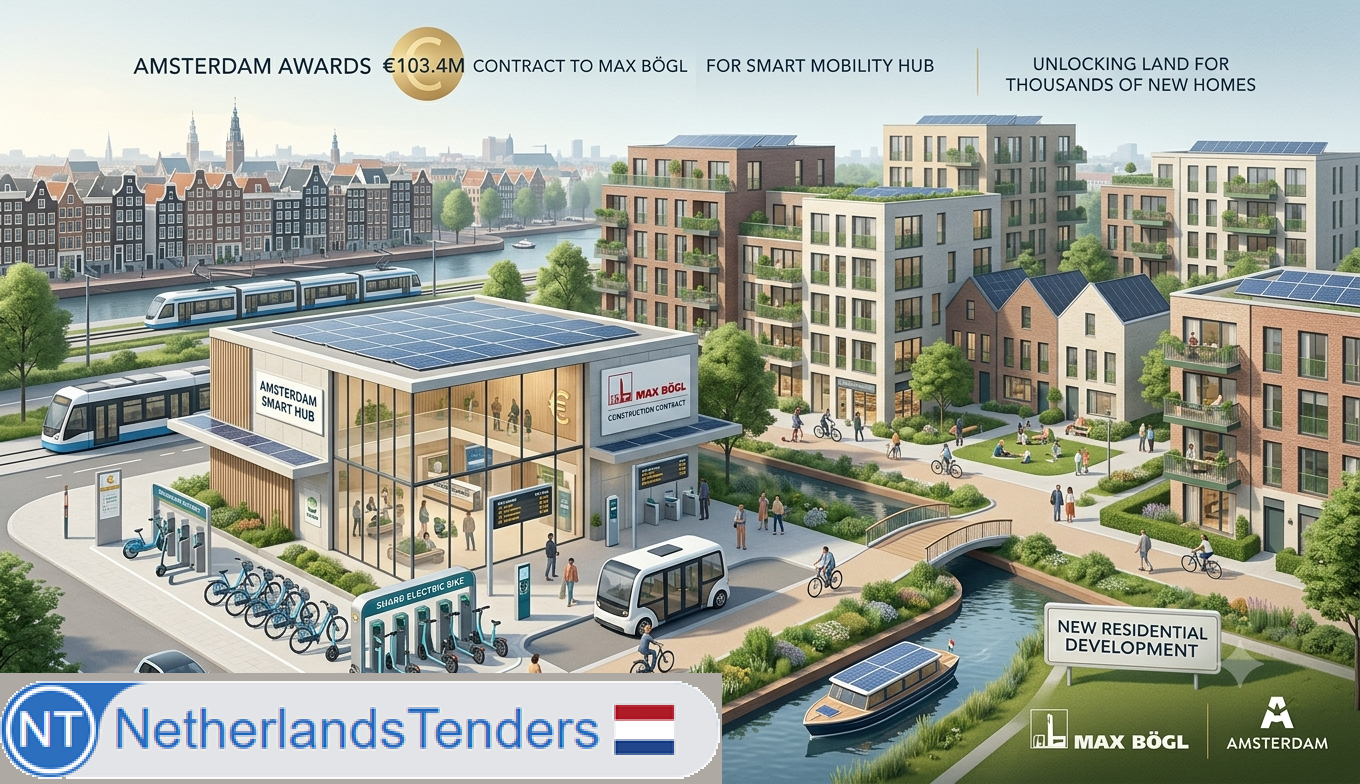
Amsterdam Builds a €103 Million Building That Parks Cars, Hosts Ajax's Neighbours, and Shelters the Homeless - All Under One Roof
17 Jul 2026
Standfirst Next to the Johan Cruijff ArenA, Amsterdam is replacing an ordinary parking lot with something far stranger and more ambitious: a single building that parks over 2,000 cars and 700 bicycles, carries a rooftop sports park the size of six football pitches, houses a winter shelter and clears the ground for thousands of new homes and Ajax's new training campus. The city has now awarded the construction contract, worth just over €103 million, to Max Bögl Nederland. Introduction Cities running out of land tend to solve the problem in one of two ways: build up or build cleverer. Amsterdam, wedged between a football stadium, a concert arena, a motorway and a fast growing new neighbourhood, has chosen the second path in a fairly dramatic way. On a site currently occupied by surface parking north of the Johan Cruijff ArenA, the city is constructing the Smart Mobility Hub, a building that does the work of a parking garage, a sports centre, a public transport interchange, a winter shelter and a piece of urban glue, all stacked into a single structure. The Municipality of Amsterdam's engineering bureau has now concluded the contract to build and maintain the Smart Mobility Hub for the next 15 years, awarding it to Max Bögl Nederland B.V., the Dutch arm of the German construction and engineering group, following a restricted competitive procedure. The contract is valued at just over €103.4 million, against an estimated ceiling of €100 million set when the tender was launched. Why This Contract Matters This is not simply a parking garage tender. It is the opening move in one of southeast Amsterdam's largest area transformations, a project called De Nieuwe Kern, "the new core", which will eventually bring thousands of new homes, offices and public space to a stretch of land currently used mostly for event parking and old sports fields. The Smart Mobility Hub has to go first, precisely because it frees up the land beneath the existing surface parking for everything else the city wants to build, including an expanded training campus for AFC Ajax, "De Nieuwe Toekomst." The building's design is also a statement about how European cities are rethinking car infrastructure. Rather than treating a car park as dead space that serves one narrow purpose, Amsterdam is asking a single structure to flex across uses depending on the hour and the season: commuter parking on a Tuesday morning, event overflow for the ArenA or the Ziggo Dome on a Saturday night, a rooftop sports park for local residents every day in between and a warm place to sleep for homeless people during the coldest months of the year. Contract Timeline Date Milestone 2020 Initial planning framework for the Smart Mobility Hub published by the Municipality of Amsterdam 2024 Design phase ("bouwteam") for the project's architecture and engineering concluded with a separate contracting team 2025 Restricted procedure launched (internal reference AI 2025-0220) for the realisation and long term maintenance contract 1 July 2026 Planned construction start date, per the notice 14 July 2026 Contract concluded with Max Bögl Nederland B.V. 15 July 2026 Award notice dispatched to the EU Publications Office 17 July 2026 Notice published in OJ S 136/2026 3 January 2028 Estimated construction completion date recorded in the notice Through approximately 2041 Multi year maintenance period (15 years from completion), as described in the project scope Contract Overview The Municipality of Amsterdam's Ingenieursbureau (Engineering Bureau) ran a restricted procedure, a two stage process in which interested firms first qualify to participate before a shortlist submits detailed tenders, to select a contractor for the realisation and 15 year multi year maintenance of the Smart Mobility Hub. Two tenders were received, one of them from a micro, small or medium sized enterprise and all submissions were electronic. Max Bögl Nederland B.V. was declared the winner, with its own bid valued at just over €103.4 million, marginally above the tender's own estimated ceiling of €100 million. The award structure combined a price criterion, the total tender sum, with several quality based criteria to be assessed through a descriptive technical design document and, at the final "Best and Final Offer" stage, additional EMVI (economically most advantageous tender) quality sub criteria covering compliance with environmental, social and labour law obligations and a formal integrity declaration. Key Contract Details Field Detail Contracting authority Gemeente Amsterdam, Ingenieursbureau Winning contractor Max Bögl Nederland B.V. Title AI 2025-0220 SMH P1: Mobiliteitshub CPV code 45000000 – Construction work Procedure type Restricted Legal basis Directive 2014/24/EU Estimated contract value €100,000,000 Awarded contract value €103,457,507 Award criteria Price ("Inschrijvingssom"); Quality – Technical Design descriptive document; Quality – EMVI criteria (submitted at final offer stage); Compliance declarations on environmental/social/labour law and integrity Contract period 1 July 2026 – 3 January 2028 (construction), plus 15 years of subsequent maintenance Tenders received 2 (1 from an SME) EU funding Project fully or partially financed with EU funds GPA coverage Yes Strategic procurement objectives None formally recorded in the notice Review body Rechtbank Amsterdam (Amsterdam District Court) Place of performance Groot Amsterdam (NUTS NL32B), Netherlands, technically sited in the municipality of Ouder Amstel Project Scope The Smart Mobility Hub combines three functions in one structure: a multi modal mobility hub at ground and lower levels, offering parking for cars, bicycles, taxis, coaches, kiss and ride drop off traffic and additional public transport capacity around major events; a rooftop sports park of roughly 40,000 square metres, replacing the football pitches of the existing Sportpark Strandvliet and adding facilities for skating, three on three basketball, a BMX and skate "pumptrack," and an open air fitness and movement area; and, on the ground floor ("plint"), a mix of commercial and social facilities, including a winter shelter for homeless people during cold months. According to earlier public design information, the building is expected to offer more than 2,000 car parking spaces and around 700 bicycle spaces, along with charging infrastructure for electric vehicles and shared mobility. The hub sits directly beside the Johan Cruijff ArenA and Strandvliet metro station, within five minutes' walk of Bijlmer ArenA railway station and forms the first phase of the wider De Nieuwe Kern area development connecting Amsterdam Zuidoost to the rest of the city. The site's construction directly enables the relocation and expansion of AFC Ajax's training complex, "De Nieuwe Toekomst," on land the parking structure currently occupies. About the Contracting Authority Gemeente Amsterdam, Ingenieursbureau is the City of Amsterdam's in house engineering and infrastructure delivery bureau, responsible for procuring and overseeing major public works projects on behalf of the municipality. Structured as a regional authority under Dutch law, the bureau manages large, technically complex urban infrastructure contracts, of which the Smart Mobility Hub, spanning mobility infrastructure, sports facilities and social services under a single roof, is among the more architecturally unusual examples currently under way in the city. About the Organisations Involved Max Bögl Nederland B.V., Winning Tenderer: Max Bögl Nederland is the Dutch subsidiary of Max Bögl, a large German construction, engineering and infrastructure group with operations spanning transport infrastructure, precast concrete manufacturing and complex structural engineering projects across Europe. Registered as a medium sized economic operator and based in Amsterdam itself, the company was selected from a field of two tenderers to deliver both the construction and the 15 year subsequent maintenance of the Smart Mobility Hub, a scope that combines heavy structural engineering with a long term facilities responsibility, reflecting the building's multi functional design. Rechtbank Amsterdam, Review Organisation: The Amsterdam District Court is designated as the review body for this procurement, providing the formal legal channel through which any unsuccessful bidder could challenge the award. Its role is limited to judicial oversight and it had no part in the technical evaluation of the tenders. Procurement Analysis Amsterdam's choice of a restricted procedure, rather than a fully open tender, reflects the scale and technical complexity of the project: pre qualifying a shortlist of contractors before requesting detailed, costed proposals reduces the burden on both the city and bidders when a project's specifications, a multi use structure combining parking, sport and social infrastructure, are this unusual. Only two tenders were ultimately received, a relatively narrow field for a contract of this size, suggesting the technical demands of the brief limited participation to contractors with genuinely relevant large scale structural and multi disciplinary delivery experience. The award criteria structure is a hallmark of Dutch "EMVI" (best value) procurement for complex works: alongside the headline price, bidders had to submit a descriptive Technical Design document addressing their proposed structural system, column positioning, load bearing material choices and floor systems, verified against the city's own reference design and underlying technical specification documents. Additional EMVI quality criteria, along with formal declarations on environmental, social and labour law compliance and an anti collusion integrity statement (the "Model K" declaration), were reserved for submission only at the final Best and Final Offer stage, a structured approach designed to filter out weaker bids early while reserving the most sensitive compliance and quality assessments for the final round. Additional Procurement Facts Two tenders were received in total, both submitted electronically, with one originating from a micro, small or medium sized enterprise. The project is confirmed as partially or fully financed with EU funds and is covered by the WTO Government Procurement Agreement. No strategic procurement objectives, such as specific green public procurement or social value targets, are formally recorded against this lot in the notice, despite the project's evident sustainability and social inclusion dimensions (the winter shelter, the rooftop public sports facilities and the broader climate adaptive urban design referenced in the project description). Market & Industry Perspective Large scale, mixed use infrastructure projects of this kind sit at the intersection of several distinct construction disciplines, heavy structural parking garage engineering, sports facility construction and social infrastructure fit out, which naturally narrows the field of contractors capable of bidding competitively. Max Bögl's background in complex precast concrete and infrastructure engineering, combined with its established Dutch operating base in Amsterdam itself, positioned it well for a project requiring both structural sophistication and long term local maintenance presence. It is also notable that an earlier design phase "bouwteam" contract for this same project was awarded separately to a different Dutch contractor, working alongside architecture firm cepezed, according to earlier public project reporting. That distinction between an initial collaborative design phase and this later, separately tendered realisation and maintenance contract is a common structure in complex Dutch public works: the team that shapes the design is not always the same team that ultimately builds and maintains the finished structure. Economic Significance At €103.4 million, the Smart Mobility Hub construction and maintenance contract is a significant piece of public infrastructure spending, but its economic value extends well beyond its own price tag. By consolidating parking and mobility functions into a single, efficient structure, the project frees up a large tract of land currently occupied by surface parking for new housing, sports infrastructure and area development, land that would otherwise remain locked into a single, low intensity use. For a city facing an acute housing shortage, converting underused parking land into space for thousands of new homes represents a meaningful, if indirect, economic return on this contract, well beyond the value of the building itself. The project also supports continued large scale event activity at the Johan Cruijff ArenA and Ziggo Dome by preserving flexible parking and coach capacity even as the surrounding area redevelops. Future Procurement Opportunities With construction targeted for completion by January 2028 and a subsequent 15 year maintenance term attached to this same contract, the immediate scope of work is now locked in for close to two decades. However, the wider De Nieuwe Kern area development, encompassing thousands of new homes, commercial space and additional public infrastructure across a roughly 190 hectare site involving multiple landowners including the municipality, Dutch rail operator NS, AFC Ajax and private developers, will generate a long pipeline of further tenders over the coming years, spanning housing construction, road and utility infrastructure and public space design. Suppliers with expertise in modular or flexible use building design, rooftop sports and recreation infrastructure or integrated social service fit outs should watch for further contracts tied to this same area development programme as it progresses beyond the mobility hub itself. Opportunities for Suppliers Specialist subcontractors in areas such as sports surface installation, EV charging infrastructure, smart parking and access control systems and social service facility fit out (relevant to the building's winter shelter component) may find opportunities beneath Max Bögl's main contract as construction proceeds. Given the project's location beside two major event venues, suppliers of crowd management, signage and wayfinding systems tailored to high volume event traffic may also find relevant openings as the hub moves toward operational readiness ahead of its 2028 target date. What Businesses Should Watch Three developments are worth tracking. First, whether construction stays on schedule for the January 2028 completion date, given the technical complexity of integrating structural parking, a rooftop sports park and social facilities within one building envelope. Second, how quickly the freed up former parking land is brought forward for the promised AFC Ajax training campus expansion and new housing construction, since that is the area development this project is specifically designed to unlock. Third, how the wider De Nieuwe Kern programme's tendering pipeline develops over the coming years, as this mobility hub is explicitly framed as the first phase of a much larger neighbourhood transformation. NetherlandsTenders.com Procurement Intelligence This contract is a clear illustration of a trend gathering pace across land constrained European cities: treating car parking infrastructure not as a single purpose necessity but as a flexible, multi functional urban asset that can carry other public functions on top of and around it. Rather than commissioning a conventional parking garage and a separate sports facility and a separate social services building, Amsterdam combined all three into one procurement, betting that shared structural costs and a single flexible footprint would deliver more public value per euro spent than three standalone projects ever could. The structure of the award criteria, heavy emphasis on a detailed technical design submission alongside price, with compliance and integrity declarations reserved for the final offer stage, also reflects how Dutch public works procurement has matured toward genuinely evaluating buildability and design quality for complex, non standard structures, rather than defaulting to price only competition once a project moves beyond routine infrastructure. Suppliers watching similar dense, land constrained European cities, where surface parking increasingly competes directly with housing and public space for scarce land, should expect more of this "stacked function" building typology to appear in future tenders: combining mobility infrastructure with sport, retail, social services or even housing within a single structure, rather than treating each use as a separate site and a separate contract. Supplier Takeaways Multi functional infrastructure projects that stack parking, sport, retail and social services into a single structure are likely to become more common in space constrained European cities, position technical capability across disciplines accordingly. Restricted procedures for complex works projects reward contractors who can demonstrate structural and multi disciplinary delivery capability well before the final Best and Final Offer stage. The broader De Nieuwe Kern area development, of which this hub is the first phase, is likely to generate a substantial pipeline of further housing, infrastructure and public space tenders over the coming decade. Subcontracting opportunities in sports surfacing, EV charging, smart access systems and social facility fit out are worth tracking as the main contract moves into delivery. Compliance declarations on environmental, social and labour law and anti collusion integrity statements, are now standard, binding elements of Dutch EMVI works procurement, not optional extras. Key Takeaways The Municipality of Amsterdam awarded a €103.4 million contract to Max Bögl Nederland B.V. to build and maintain the Smart Mobility Hub for 15 years. The building combines a multi modal parking and transport hub, a 40,000 square metre rooftop sports park and ground floor social and commercial facilities including a winter shelter. The project is the first phase of the wider De Nieuwe Kern area development, freeing up land for thousands of new homes and AFC Ajax's expanded training campus. Only two tenders were received, one from an SME, following a restricted procurement procedure. Construction is targeted for completion by January 2028, with the contract also covering 15 years of subsequent maintenance. Conclusion Most parking garages disappear from public conversation the moment they open. The Smart Mobility Hub is designed to do the opposite, to become the anchor of an entirely new piece of Amsterdam, hosting football fans, football pitches and people with nowhere else to sleep on the coldest nights of the year, all inside the same concrete frame. Max Bögl now has just under eighteen months to build it and fifteen years to keep it running. Frequently Asked Questions Who won the contract to build the Smart Mobility Hub? Max Bögl Nederland B.V., the Dutch subsidiary of the German construction and engineering group Max Bögl. Who is the buyer? Gemeente Amsterdam, Ingenieursbureau, the City of Amsterdam's engineering bureau. What is the contract worth? €103,457,507, against an original estimated value of €100,000,000. What does the Smart Mobility Hub actually contain? A multi modal parking and transport hub for cars, bicycles, taxis and coaches; a rooftop sports park of roughly 40,000 square metres; and ground floor commercial and social facilities, including a winter shelter. When will it be completed? Construction is scheduled to run from 1 July 2026 to 3 January 2028, according to the notice, with a further 15 years of maintenance under the same contract. How many companies bid for the contract? Two, one of which was a micro, small or medium sized enterprise. Is the project funded by the European Union? Yes. The notice confirms the project is fully or partially financed with EU funds. Why is this project significant beyond the building itself? It is the first phase of the De Nieuwe Kern area development, freeing up land currently used for surface parking for thousands of new homes and the expansion of AFC Ajax's training complex. Source: EU Official Journal, Contract Award Notice 497369-2026, OJ S 136/2026, published 17/07/2026. Contracting authority: Gemeente Amsterdam, Ingenieursbureau.
View Details